

at 15.0° C—higher than the Specic heat of any other Substance except lithium and ammonia. Below, the specic heat of some other substances are compared with that of water at 00 C [11]:
Water
1.007
Alcohol (ethyl)
0.535
Acetone
0.506
Sulfuric acid
0.270
Carbon tetrachloride
0.198
Because so much heat must be applied in order to raise water temperature,
large bodies of water do not uctuate in temperature as much as large bodies
of land do. This is also one reason why shoreline environments have a more
constant temperature than inland areas; another reason is the cooling effect of
water evaporation. Terrestrial animals have had to adapt to a wider range
of
temperatures and more rapid temperature uctuations than aquatic organ—
isms have. Or, to put this another way, aquatic organisms are less adaptable
and more vulnerable to temperature changes than terrestrial organisms; because of the protection of their watery environment with its more constant
and more slowly—changing temperature, aquatic organisms have not had to
develop such adaptability. VVater’s high specic heat also explains other
climatic phenomena—for example, why deserts become cold at night. Since
there is little moisture in desert air and sand has a specic heat of 0.2 (one—
fth the capacity of water for storing heat), less heat reserve is available in
the desert than in wet climates after the sun sets [12].
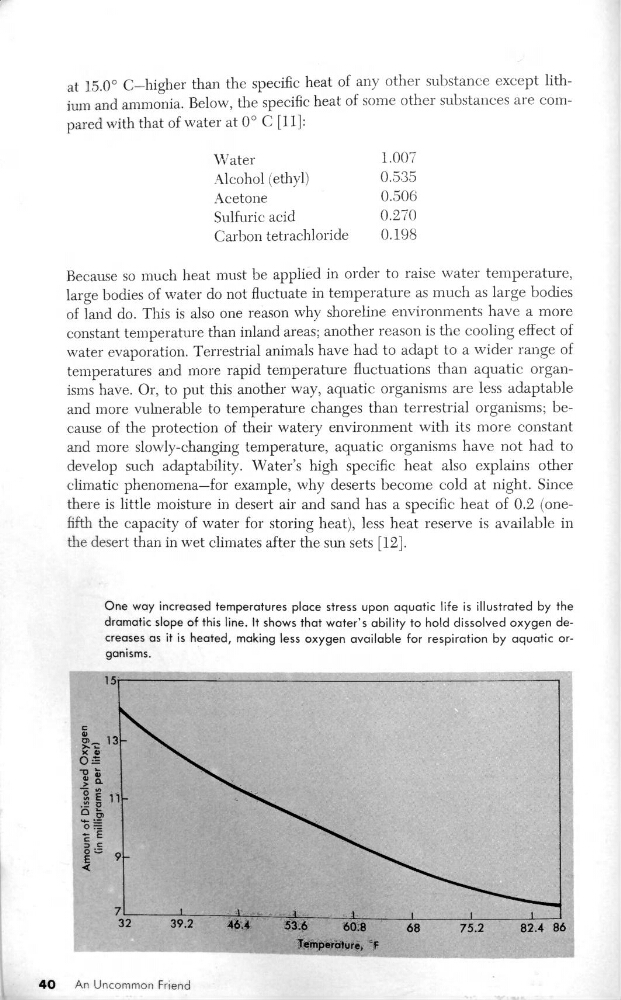
One way increased temperatures place stress upon aquatic life is illustrated by the
dramatic slope of this line. lt shows that water‘s ability to hold dissolved oxygen decreases as it is heated, making less oxygen available for respiration by aquatic organisms.
&:
…
 '
,
0=
.
,
,
_
'U
3 "
'
o
;
,
.'ê %
/
;,“
° 8 …
'
° =
,«
,
_
32
_
—
75.2
j 82—4 sa
…
ï
»
…“»
40
An Uncommon Friend
Water
1.007
Alcohol (ethyl)
0.535
Acetone
0.506
Sulfuric acid
0.270
Carbon tetrachloride
0.198
Because so much heat must be applied in order to raise water temperature,
large bodies of water do not uctuate in temperature as much as large bodies
of land do. This is also one reason why shoreline environments have a more
constant temperature than inland areas; another reason is the cooling effect of
water evaporation. Terrestrial animals have had to adapt to a wider range
of
temperatures and more rapid temperature uctuations than aquatic organ—
isms have. Or, to put this another way, aquatic organisms are less adaptable
and more vulnerable to temperature changes than terrestrial organisms; because of the protection of their watery environment with its more constant
and more slowly—changing temperature, aquatic organisms have not had to
develop such adaptability. VVater’s high specic heat also explains other
climatic phenomena—for example, why deserts become cold at night. Since
there is little moisture in desert air and sand has a specic heat of 0.2 (one—
fth the capacity of water for storing heat), less heat reserve is available in
the desert than in wet climates after the sun sets [12].
One way increased temperatures place stress upon aquatic life is illustrated by the
dramatic slope of this line. lt shows that water‘s ability to hold dissolved oxygen decreases as it is heated, making less oxygen available for respiration by aquatic organisms.
&:
…
 '
,
0=
.
,
,
_
'U
3 "
'
o
;
,
.'ê %
/
;,“
° 8 …
'
° =
,«
,
_
32
_
—
75.2
j 82—4 sa
…
ï
»
…“»
40
An Uncommon Friend