

tracted to the oxygen in the glass without losing its internal cohesion. When
water is placed in a glass tube it therefore moves up along the glass sides of
the tube, like kerosene up a wick in a kerosene lamp. This phenomenon is
called capillary or wick action. Water moves upward through the soil on the
same principle—its cohesion and its adherence to clay particles provide capil—
lary action. Water can move upward as much as several feet in order to be
available to the roots of plants.
Thermal Properties of Water
Water has an exceptional ability to store heat. This means that, compared
with other substances, a large amount of heat must be applied to water to
produce a given rise in temperature. Water’s specic heat (the number of calories required to raise one gram of a substance one degree centigrade) is 1.0
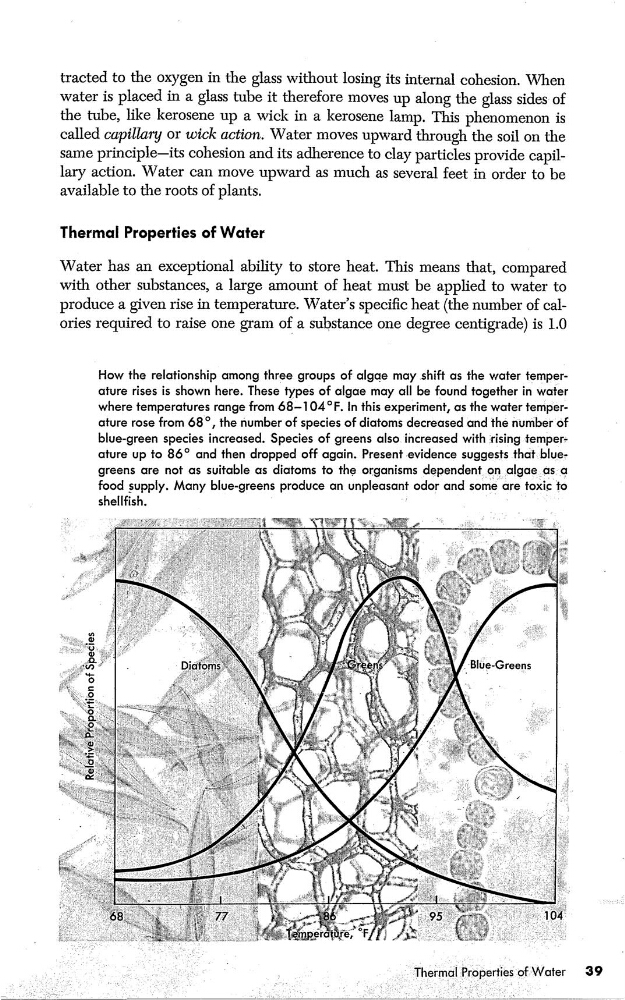
How the relationship among three groups of algae may shift as the water temper—
ature rises is shown here. These types
of algue may all be found together in water
where temperatures range from 68-104°F. ln this experiment, as the water temper—
ature rose from 68°, the number of species of diatoms decreased and the numberof
'
blue-green species increased. Species of greens also increased with }rising temper—
ature up to 86° and then dropped off again. Present evidence suggests thatblue.—
greens are not as suitable as diatoms to the organisms
food supply. Many blue-greens produce an unpleasant color and some are toxic to
'
_
shellfish.
'
.
'
'
'
_
1$%
*
“<“;
'
**
"
.
*Ëâ
W
'
‘
'
"
'
..
ÊÎ1
…
‘
.…
“*
“»“
.
.…“ï
î*‘ "
% “ ”
'
\
'
*
.f
@“;
"
…
—
“>
;“
l{=*‘ …:,“
$
\
*1*
-'
ä
..
-
+
.,
.….
:
g« .
% ”%
*=
"
'
'
.
}.
$\
.
.:
$
“*
°—
'
,
:
-
.
$**
; *\.
*
*\a$* '
.
!
.
**;5\ .$\\
**
\ ..
‘
‘
'
*‘3
.
.
.c“
…:
—' »=‘
-
"
. Ë
*ËÎ
\\\*
—
…“—
'
…$,
1;\‘*
î*
.:
\
‘
…
$$$
s*.
Ë*“$ î$ $
**
._
**
‘
â*
\\
..
”$:
…
îî*\
»…
.
77
…
_
95
104
. *
Æel
F
ë
‘
ÏÂ'Ï
.
“
.
-
39
water is placed in a glass tube it therefore moves up along the glass sides of
the tube, like kerosene up a wick in a kerosene lamp. This phenomenon is
called capillary or wick action. Water moves upward through the soil on the
same principle—its cohesion and its adherence to clay particles provide capil—
lary action. Water can move upward as much as several feet in order to be
available to the roots of plants.
Thermal Properties of Water
Water has an exceptional ability to store heat. This means that, compared
with other substances, a large amount of heat must be applied to water to
produce a given rise in temperature. Water’s specic heat (the number of calories required to raise one gram of a substance one degree centigrade) is 1.0
How the relationship among three groups of algae may shift as the water temper—
ature rises is shown here. These types
of algue may all be found together in water
where temperatures range from 68-104°F. ln this experiment, as the water temper—
ature rose from 68°, the number of species of diatoms decreased and the numberof
'
blue-green species increased. Species of greens also increased with }rising temper—
ature up to 86° and then dropped off again. Present evidence suggests thatblue.—
greens are not as suitable as diatoms to the organisms
food supply. Many blue-greens produce an unpleasant color and some are toxic to
'
_
shellfish.
'
.
'
'
'
_
1$%
*
“<“;
'
**
"
.
*Ëâ
W
'
‘
'
"
'
..
ÊÎ1
…
‘
.…
“*
“»“
.
.…“ï
î*‘ "
% “ ”
'
\
'
*
.f
@“;
"
…
—
“>
;“
l{=*‘ …:,“
$
\
*1*
-'
ä
..
-
+
.,
.….
:
g« .
% ”%
*=
"
'
'
.
}.
$\
.
.:
$
“*
°—
'
,
:
-
.
$**
; *\.
*
*\a$* '
.
!
.
**;5\ .$\\
**
\ ..
‘
‘
'
*‘3
.
.
.c“
…:
—' »=‘
-
"
. Ë
*ËÎ
\\\*
—
…“—
'
…$,
1;\‘*
î*
.:
\
‘
…
$$$
s*.
Ë*“$ î$ $
**
._
**
‘
â*
\\
..
”$:
…
îî*\
»…
.
77
…
_
95
104
. *
Æel
F
ë
‘
ÏÂ'Ï
.
“
.
-
39