

Like other substances, water may
exist in three states—solid, liquid, and
gaseous—but unlike most other substances, water is found in all three states
within the ranges of temperature and pressure common to the earth. A great
deal of heat energy is required to evaporate water, changing it from the liq—
uid to the gaseous state. (This latent heat energy is then released when the
water vapor
returns to the liquid state.) Water is therefore said to have a high
.
latent heat of oapom‘zaü'on compared to other substances. Similarly, it takes '
more heat to melt ice, changing water from its solid to its liquid state. (Again,
the liquid water contains latent heat energy which is released if it returns to
its solid state.) Water is therefore said to have a high latent heat of fusion.
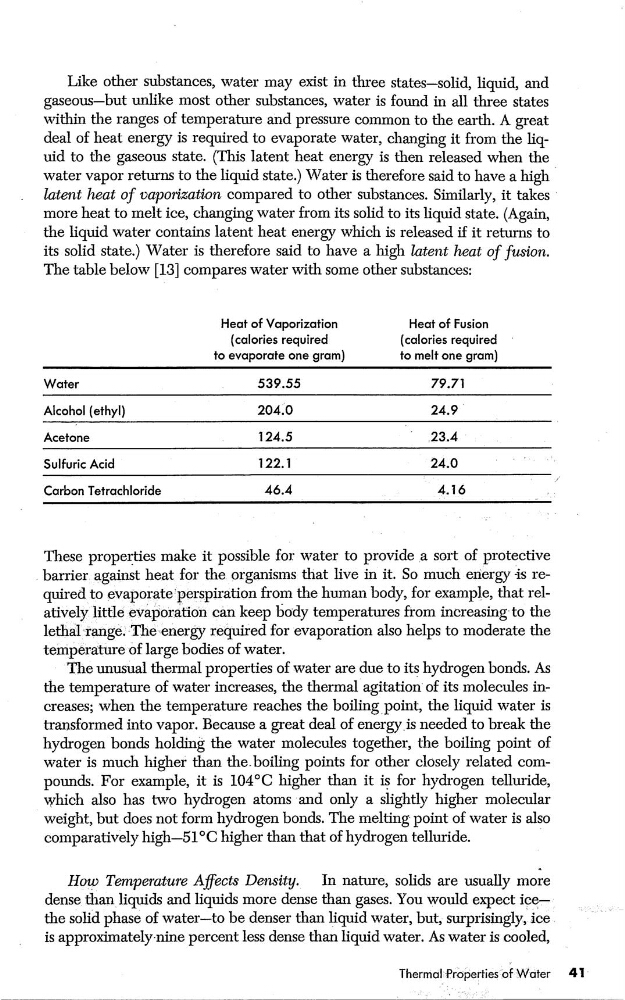
The table below [13] compares
water With some other substances:
Heat of Vaporization
Heat of Fusion
(calories required
(calories required
'
to evaporate one gram)
to melt one gram)
Water
539.55
79.71
,
Alcohol (ethyl)
204.0
24.9
Acetone
,
124.5
23.4
.
.
Sulfuric Acid
122.1
24.0
‘
'
Carbon Tetrachloride
_
46.4
_
4.16
,
These properties make ”it possible for water to provide a sort of protective
_
barrier against heat for the organisms that live in it. So much-energy is re—
quired to evaporateperspiration from the human body, for example, that rel—
_
atiVely little .evaporaon can keep body temperatures from increasingto the
required for evaporation also helps to moderate the
temperature of large bodies of water.
The unusual thermal properties of water are due to its hydrogen bonds. As
the temperature of water increases, the thermal agitation“ of its molecules in—
creases; when the temperature reaches the boilù1gpoint, the liquid water is
transformed into vapor. Because a great deal of energy_is needed to break the
hydrogen bonds holding the water molecules together, the boiling point of
water is much higher than the.boiling points for other closely related com—
pounds. For example, it is lO4°C higher than it is for hydrogen telluride,
which also has two hydrogen atoms and only a slightly higher molecular
weight, but does not form hydrogen bonds. The melting point of water is also
comparativdy high—51°C higher than that of hydrogen telluride.
How Temperature A’eots Density.
In nature, solids are usually more
dense thanliquids and liquids more dense than gases. You would expect ice—;
the solid phase of water—to be denser than liquid water, but, surprisingly, ice
.
is approximately-nine percent less dense than liquid water. As water is cooled,
lol: “Water
41 ‘
exist in three states—solid, liquid, and
gaseous—but unlike most other substances, water is found in all three states
within the ranges of temperature and pressure common to the earth. A great
deal of heat energy is required to evaporate water, changing it from the liq—
uid to the gaseous state. (This latent heat energy is then released when the
water vapor
returns to the liquid state.) Water is therefore said to have a high
.
latent heat of oapom‘zaü'on compared to other substances. Similarly, it takes '
more heat to melt ice, changing water from its solid to its liquid state. (Again,
the liquid water contains latent heat energy which is released if it returns to
its solid state.) Water is therefore said to have a high latent heat of fusion.
The table below [13] compares
water With some other substances:
Heat of Vaporization
Heat of Fusion
(calories required
(calories required
'
to evaporate one gram)
to melt one gram)
Water
539.55
79.71
,
Alcohol (ethyl)
204.0
24.9
Acetone
,
124.5
23.4
.
.
Sulfuric Acid
122.1
24.0
‘
'
Carbon Tetrachloride
_
46.4
_
4.16
,
These properties make ”it possible for water to provide a sort of protective
_
barrier against heat for the organisms that live in it. So much-energy is re—
quired to evaporateperspiration from the human body, for example, that rel—
_
atiVely little .evaporaon can keep body temperatures from increasingto the
required for evaporation also helps to moderate the
temperature of large bodies of water.
The unusual thermal properties of water are due to its hydrogen bonds. As
the temperature of water increases, the thermal agitation“ of its molecules in—
creases; when the temperature reaches the boilù1gpoint, the liquid water is
transformed into vapor. Because a great deal of energy_is needed to break the
hydrogen bonds holding the water molecules together, the boiling point of
water is much higher than the.boiling points for other closely related com—
pounds. For example, it is lO4°C higher than it is for hydrogen telluride,
which also has two hydrogen atoms and only a slightly higher molecular
weight, but does not form hydrogen bonds. The melting point of water is also
comparativdy high—51°C higher than that of hydrogen telluride.
How Temperature A’eots Density.
In nature, solids are usually more
dense thanliquids and liquids more dense than gases. You would expect ice—;
the solid phase of water—to be denser than liquid water, but, surprisingly, ice
.
is approximately-nine percent less dense than liquid water. As water is cooled,
lol: “Water
41 ‘