

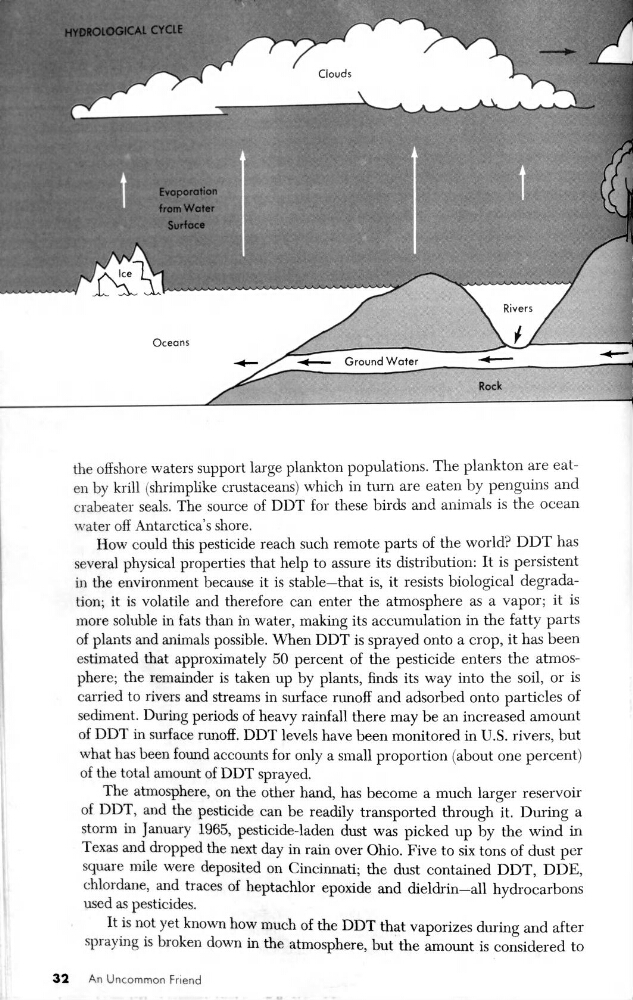
Clouds
i
Rivers
Oceans
4——
<——
Ground Water
4——
|
the offshore waters support large plankton populations.
The plankton are eat—
en by krill (shrimplike crustaceans) which in turn are eaten by penguins
and
crabeater seals. The source of DDT for these birds and animals is the ocean
water oif Antarctica’s shore.
How could this pesticide reach such remote parts of the world? DDT has
several physical properties that help to assure its distribution: It is persistent
in the environment because it is stable—that is, it resists biological degrada—
tion; it is volatile and therefore can enter the atmosphere as a vapor;
it is
more soluble in tats than in water, making its accumulation in the fatty parts
;
of plants and animals possible. When DDT is sprayed onto a crop,
it has been
estimated that approximately 50 percent of the pesticide enters the atmos—
_
phere; the remainder is taken up by plants, nds its way into the soil, or is
carried to rivers and streams in surface runoff and adsorbed onto particles of
sediment. During periods of heavy rainfall there may be an increased amount
of DDT in surface runoff. DDT levels have been monitored in US. rivers, but
what has been found accounts for only a small proportion (about one percent)
of the total amount of DDT sprayed.
The atmosphere, on the other hand, has become a much larger reservoir
of DDT, and the pesticide can be readin transported through it. During a
storm m ]anuary 1965, pesticide—laden dust was picked up by the wind in
Texas and dropped the next day in rain over Ohio. Five to six tons of dust per
square mile were deposited on Cincinnati; the dust contained DDT, DDE,
chlordane, and
traces of heptachlor epoxide and dieldrin—all hydrocarbons
used as pesticides.
is not yet known how
much of the DDT that vaporizes during and after
spraymg rs broken down m the atmosphere, but the amount is considered to
32
An Uncommon Friend
i
Rivers
Oceans
4——
<——
Ground Water
4——
|
the offshore waters support large plankton populations.
The plankton are eat—
en by krill (shrimplike crustaceans) which in turn are eaten by penguins
and
crabeater seals. The source of DDT for these birds and animals is the ocean
water oif Antarctica’s shore.
How could this pesticide reach such remote parts of the world? DDT has
several physical properties that help to assure its distribution: It is persistent
in the environment because it is stable—that is, it resists biological degrada—
tion; it is volatile and therefore can enter the atmosphere as a vapor;
it is
more soluble in tats than in water, making its accumulation in the fatty parts
;
of plants and animals possible. When DDT is sprayed onto a crop,
it has been
estimated that approximately 50 percent of the pesticide enters the atmos—
_
phere; the remainder is taken up by plants, nds its way into the soil, or is
carried to rivers and streams in surface runoff and adsorbed onto particles of
sediment. During periods of heavy rainfall there may be an increased amount
of DDT in surface runoff. DDT levels have been monitored in US. rivers, but
what has been found accounts for only a small proportion (about one percent)
of the total amount of DDT sprayed.
The atmosphere, on the other hand, has become a much larger reservoir
of DDT, and the pesticide can be readin transported through it. During a
storm m ]anuary 1965, pesticide—laden dust was picked up by the wind in
Texas and dropped the next day in rain over Ohio. Five to six tons of dust per
square mile were deposited on Cincinnati; the dust contained DDT, DDE,
chlordane, and
traces of heptachlor epoxide and dieldrin—all hydrocarbons
used as pesticides.
is not yet known how
much of the DDT that vaporizes during and after
spraymg rs broken down m the atmosphere, but the amount is considered to
32
An Uncommon Friend