

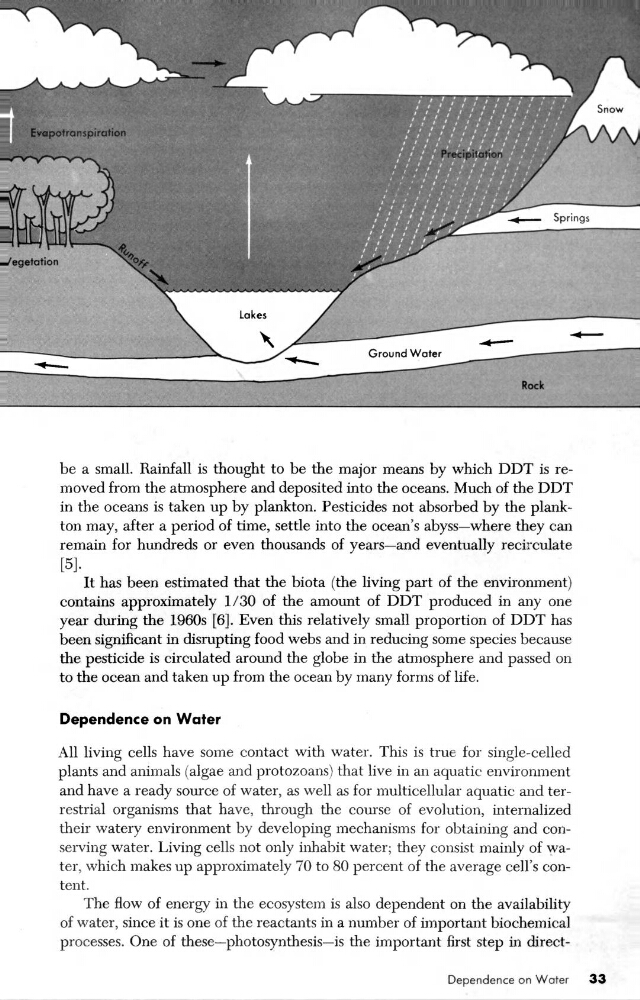
.
Snow
|
4-—
Springs
‘
Lakes
,
…
'Â'
'
\
'
'
*\
Ground Water
_
_
be a small. Rainfall is thought to be the major means by which DDT is re—
moved from the atmosphere and deposited into the oceans. Much of the DDT
in the oceans is taken up by plankton. Pesticides not absorbed by the plank—
ton may, after a period of time, settle into the ocean’s abyss—where they can
remain for hundreds or even thousands of years—and eventually recirculate
[5].
It has been estimated that the biota (the living part of the enviromnent)
contains approximately 1/30 of the amount of DDT produced in any one
year during the 1960s [6]. Even this relatively small proportion of DDT has
been signicant in dismpting food webs and in reducing some species because
the pesticide is circulated around the globe in the atmosphere and passed on
to the ocean and taken up from the ocean by many forms of life.
Dependence on Water
All living cells have some contact With water. This is true for single-celled
plants and animals (algae and protozoans) that live in an aquatic environment
and have a ready source of water, as well as for multicellular aquatic and ter—
restrial organisms that have, through the course of evolution, internalized
their watery environment by developing mechanisms for obtaining and con—
serving water. Living cells not only inhabit water; they consist mainly of water, which makes up approximately 70 to 80 percent of the average cell’s content.
The ow of energy in the ecosystem is also dependent on the availability
of water, since -it is one of the reactants in a number of important biochemical
processes.
One of these—photosynthesis—is the important rst step in directDependence on Water
33
Snow
|
4-—
Springs
‘
Lakes
,
…
'Â'
'
\
'
'
*\
Ground Water
_
_
be a small. Rainfall is thought to be the major means by which DDT is re—
moved from the atmosphere and deposited into the oceans. Much of the DDT
in the oceans is taken up by plankton. Pesticides not absorbed by the plank—
ton may, after a period of time, settle into the ocean’s abyss—where they can
remain for hundreds or even thousands of years—and eventually recirculate
[5].
It has been estimated that the biota (the living part of the enviromnent)
contains approximately 1/30 of the amount of DDT produced in any one
year during the 1960s [6]. Even this relatively small proportion of DDT has
been signicant in dismpting food webs and in reducing some species because
the pesticide is circulated around the globe in the atmosphere and passed on
to the ocean and taken up from the ocean by many forms of life.
Dependence on Water
All living cells have some contact With water. This is true for single-celled
plants and animals (algae and protozoans) that live in an aquatic environment
and have a ready source of water, as well as for multicellular aquatic and ter—
restrial organisms that have, through the course of evolution, internalized
their watery environment by developing mechanisms for obtaining and con—
serving water. Living cells not only inhabit water; they consist mainly of water, which makes up approximately 70 to 80 percent of the average cell’s content.
The ow of energy in the ecosystem is also dependent on the availability
of water, since -it is one of the reactants in a number of important biochemical
processes.
One of these—photosynthesis—is the important rst step in directDependence on Water
33