

f”
.
.
f:’
'
.
_
r_,
.
.;
'
|
'
'
”
’
_
:
S,
+-*“'
'
f’f"
uT
'
!
:
ç’;"
‘.
.
'
“
...:
'
!
Ë
\
'
Î":
’
c
'
»
.
I
È
—
_
“
,:
,
=
\
’
“»l
Î
-
;
-
I
‘
'
’.
-'
.}
‘Ï'i
:*“
!
_
..
.'
,
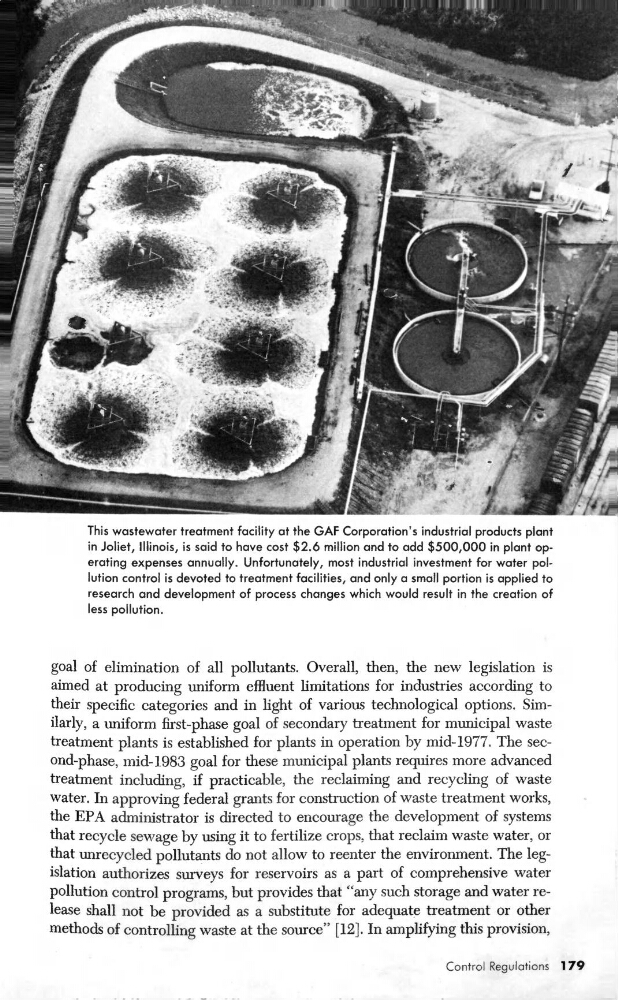
This wastewater treatment facility at the GAF Corporation's industrial products plant
in Joliet, Illinois, is said to have cost $2.6 million and to add $500,000 in plant operating expenses annually. Untortunately, most industrial investment for water pollution control is devoted to treatment facilities, and only a small portion is applied to
research and development of process changes which would result in the creation of
less pollution.
goal of elimination of all pollutants. Overall, then, the new legislation is
aimed at producing uniform eiuent limitations for industries according to
their specic categories and in light of various technological options. Sim—
ilarly, & uniform rst—phase goal of secondary treatment for municipal waste
treatment plants is established for plants in operation by mid-1977. The second—phase, mid—1983 goal for these municipal plants requires more advanced
treatment including, if practicable, the reclaimîng and recycling of waste
water. In approving federal grants for construction of waste treatment works,
=
the EPA admirstrator is directed to encourage the development of systems
that recycle sewage by using it to fertilize crops, that reclaim waste water, or
that unrecycled pollutants do not allow to reenter the environment. The leg—
islation authorizes surveys
for reservoirs as a part of comprehensive water
pollution control programs,
but provides that “any such storage and water release shall not be provided as a substitute for adequate treatment or other
methods of controlling waste at the source” [12]. In amplifyîng this provision,
Control Regulations 179
.
.
f:’
'
.
_
r_,
.
.;
'
|
'
'
”
’
_
:
S,
+-*“'
'
f’f"
uT
'
!
:
ç’;"
‘.
.
'
“
...:
'
!
Ë
\
'
Î":
’
c
'
»
.
I
È
—
_
“
,:
,
=
\
’
“»l
Î
-
;
-
I
‘
'
’.
-'
.}
‘Ï'i
:*“
!
_
..
.'
,
This wastewater treatment facility at the GAF Corporation's industrial products plant
in Joliet, Illinois, is said to have cost $2.6 million and to add $500,000 in plant operating expenses annually. Untortunately, most industrial investment for water pollution control is devoted to treatment facilities, and only a small portion is applied to
research and development of process changes which would result in the creation of
less pollution.
goal of elimination of all pollutants. Overall, then, the new legislation is
aimed at producing uniform eiuent limitations for industries according to
their specic categories and in light of various technological options. Sim—
ilarly, & uniform rst—phase goal of secondary treatment for municipal waste
treatment plants is established for plants in operation by mid-1977. The second—phase, mid—1983 goal for these municipal plants requires more advanced
treatment including, if practicable, the reclaimîng and recycling of waste
water. In approving federal grants for construction of waste treatment works,
=
the EPA admirstrator is directed to encourage the development of systems
that recycle sewage by using it to fertilize crops, that reclaim waste water, or
that unrecycled pollutants do not allow to reenter the environment. The leg—
islation authorizes surveys
for reservoirs as a part of comprehensive water
pollution control programs,
but provides that “any such storage and water release shall not be provided as a substitute for adequate treatment or other
methods of controlling waste at the source” [12]. In amplifyîng this provision,
Control Regulations 179