

Îp
\
'
*;«
"
—‘..
‘
.
-
.
g
-
‘
15
.
.
.}
_
)
"
È—
»
_
&
a
«.
.
'
\
‘
« î!“
i
_ —
__
,
,
‘
&.
‘
’
”
;
:;îî’:i‘-“îz
...
—
.
'
‘
…
"
‘
;…
—
,
_.
_
.
“"ê&
"
_
_
‘
..
.
“
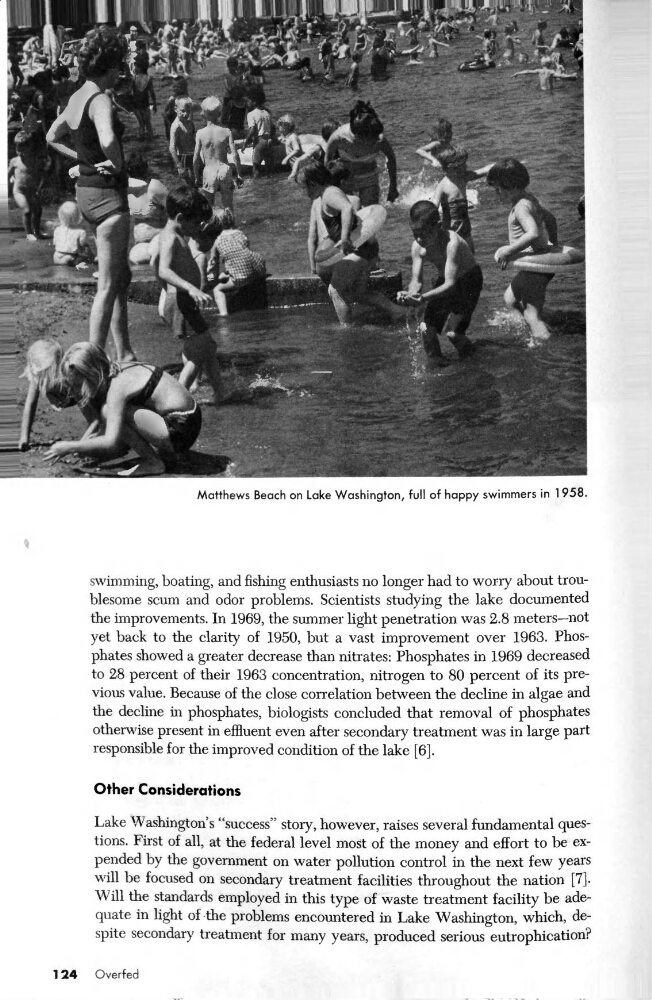
Matthews Beach on Lake Washington, full of happy swimmers in 1958.
swimming, boating, and shing enthusiasts no longer had to worry about trou—
blesome scum and odor problems. Scientists studying the lake documented
'
the improvements. In 1969, the summer light penetration was 2.8 meter—s—not
yet back to the clarity of 1950, but a vast improvement over 1963. Phos—
phates showed a greater decrease than nitrates: Phosphates in 1969 decreased
to 28 percent of their 1963 concentration, nitrogen to 80 percent of its previous value. Because of the close correlation between the decline in algae and
the decline in phosphates, biologists concluded that removal of phosphates
otherwise present in efuent even after secondary treatment was in large part
resp0nsible for the improved condition of the lake [6].
Other ‘Consideralions
Lake Washington’s “success” story, however, raises several fundamental questions. First of all, at the federal level most of the money and effort to be expended by the government on water pollution control in the next few years
will be focused on secondary treatment facilities throughout the nation [7]VVill the standards employed in this type of waste treatment facility be ade—
_
quate in light of—the problems encountered in Lake Washington, which, de—
spite secondary treatment for many years, produced serieus eutrophication?
124
Overfed
.
\
'
*;«
"
—‘..
‘
.
-
.
g
-
‘
15
.
.
.}
_
)
"
È—
»
_
&
a
«.
.
'
\
‘
« î!“
i
_ —
__
,
,
‘
&.
‘
’
”
;
:;îî’:i‘-“îz
...
—
.
'
‘
…
"
‘
;…
—
,
_.
_
.
“"ê&
"
_
_
‘
..
.
“
Matthews Beach on Lake Washington, full of happy swimmers in 1958.
swimming, boating, and shing enthusiasts no longer had to worry about trou—
blesome scum and odor problems. Scientists studying the lake documented
'
the improvements. In 1969, the summer light penetration was 2.8 meter—s—not
yet back to the clarity of 1950, but a vast improvement over 1963. Phos—
phates showed a greater decrease than nitrates: Phosphates in 1969 decreased
to 28 percent of their 1963 concentration, nitrogen to 80 percent of its previous value. Because of the close correlation between the decline in algae and
the decline in phosphates, biologists concluded that removal of phosphates
otherwise present in efuent even after secondary treatment was in large part
resp0nsible for the improved condition of the lake [6].
Other ‘Consideralions
Lake Washington’s “success” story, however, raises several fundamental questions. First of all, at the federal level most of the money and effort to be expended by the government on water pollution control in the next few years
will be focused on secondary treatment facilities throughout the nation [7]VVill the standards employed in this type of waste treatment facility be ade—
_
quate in light of—the problems encountered in Lake Washington, which, de—
spite secondary treatment for many years, produced serieus eutrophication?
124
Overfed
.