

."
g;*
put of raw sewage due to storm—sewer overows, the health problem had apparently been solved. However, by the mid—19505 other problems had devel—
oped and, despite secondary treatment operations, increases in the algal
population forced limitations on recreational uses of the lake.
Scientists have been studying the condition of Lake Washington for many
years. They have monitored the amounts as well as the kinds of algae which
occur there, the lake’s oxygen concentration, its chemicalcharacteristics, and
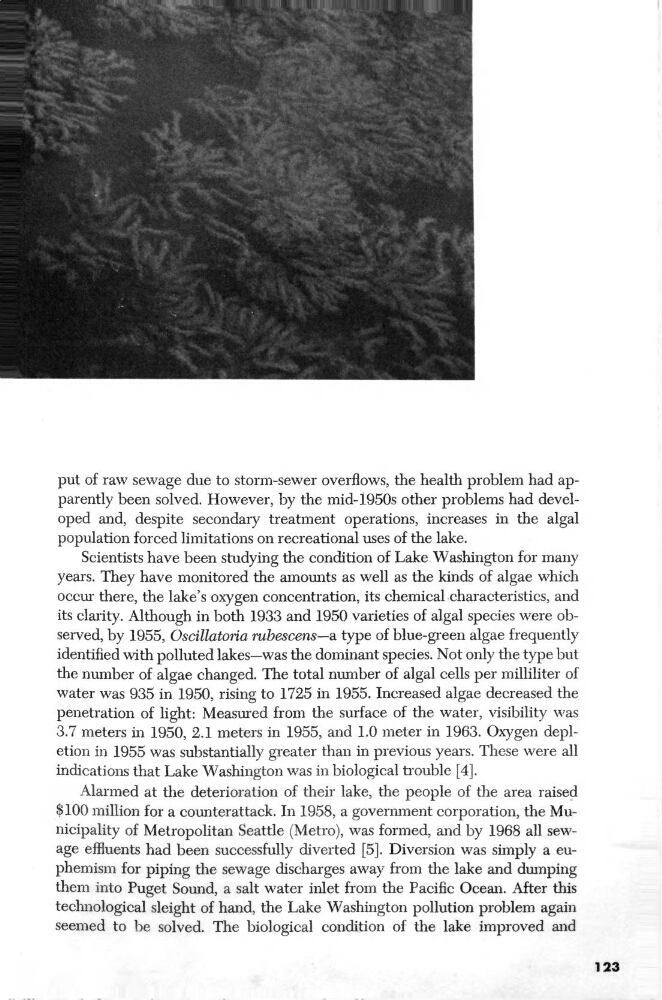
its clarity. Although in both 1933 and 1950 varieties of algal species were observed, by 1955, Oscillaton‘a mbescens—a type of blue-green algae frequently
identied With polluted lakes—was the dominant species. Not only the type but
the number of algae changed. The total number of algal cells per milliliter of
water was 935 in 1950, rising to 1725 in 1955. Increased algae decreased the
penetration of light: Measured from the surface of the water, visibility was
3.7 meters in 1950, 2.1 meters in 1955, and 1.0 meter in 1963. Oxygen depl—
etion in 1955 was substantially greater than in previous years. These were all
indications that Lake Washington was in biological trouble [4].
Alarmed at the deterioration of their lake, the people of the area raised
.$ 100 million for a counterattack. In 1958, a government corporation, the Mu—
nicipality of Metropolitan Seattle (Metro), was formed, and by 1968 all sew—
age effluents had been successfully diverted [5]. Diversion was simply a eu—
phemism for piping the sewage discharges away from the lake and dumping
them into Puget Sound, a salt water inlet from the Pacic Ocean. After this
technological sleight of hand, the Lake Washington pollution problem again
seemed to be solved. The biological condition of the lake improved and
'I 23
g;*
put of raw sewage due to storm—sewer overows, the health problem had apparently been solved. However, by the mid—19505 other problems had devel—
oped and, despite secondary treatment operations, increases in the algal
population forced limitations on recreational uses of the lake.
Scientists have been studying the condition of Lake Washington for many
years. They have monitored the amounts as well as the kinds of algae which
occur there, the lake’s oxygen concentration, its chemicalcharacteristics, and
its clarity. Although in both 1933 and 1950 varieties of algal species were observed, by 1955, Oscillaton‘a mbescens—a type of blue-green algae frequently
identied With polluted lakes—was the dominant species. Not only the type but
the number of algae changed. The total number of algal cells per milliliter of
water was 935 in 1950, rising to 1725 in 1955. Increased algae decreased the
penetration of light: Measured from the surface of the water, visibility was
3.7 meters in 1950, 2.1 meters in 1955, and 1.0 meter in 1963. Oxygen depl—
etion in 1955 was substantially greater than in previous years. These were all
indications that Lake Washington was in biological trouble [4].
Alarmed at the deterioration of their lake, the people of the area raised
.$ 100 million for a counterattack. In 1958, a government corporation, the Mu—
nicipality of Metropolitan Seattle (Metro), was formed, and by 1968 all sew—
age effluents had been successfully diverted [5]. Diversion was simply a eu—
phemism for piping the sewage discharges away from the lake and dumping
them into Puget Sound, a salt water inlet from the Pacic Ocean. After this
technological sleight of hand, the Lake Washington pollution problem again
seemed to be solved. The biological condition of the lake improved and
'I 23