

_,/.
»
_
..
,
'
—
‘
‘
4}£;
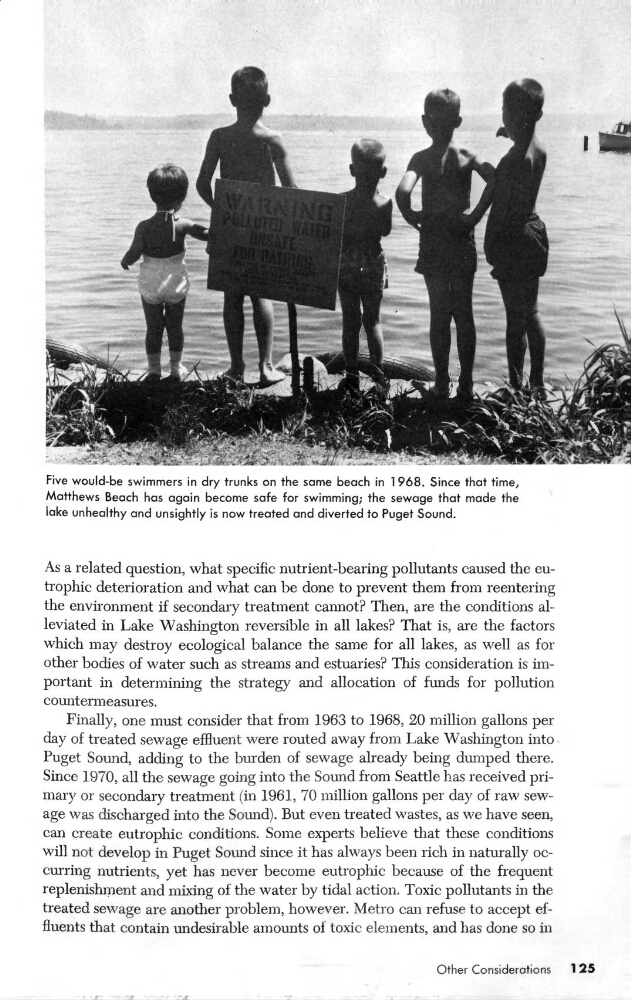
Five would-be swimmers in dry trunks on the same beach in 1968. Since that time,
Matthews Beach has again become safe for swimming; the sewage that made the
lake unhealthy and unsightiy is now treated and diverted to Puget Sound.
As a related question, what specic nutrient—bearing pollutants caused the eu—
trophic deterioration and what can be d0ne to prevent them from reentering
the environment if secondary treatment cam10t? Then, are the conditions al—
leviated in Lake Washington reversible in all lakes? That is, are the factors
Which may destroy ecological balance the same for all lakes, as well as for
other bodies of water such as streams and estuaries? This consideration is important in determining the strategy and allocation of funds for pollution
countermeasures.
Finally, one must consider that from 1963 to 1968, 20 million gallons per
day of treated sewage efuent were routed away from Lake Washington into
Puget Sound, adding to the burden of sewage already being dumped there.
Since 1970, all the sewage going into the Sound from Seattle has received pri—
mary or secondary treatment (in 1961, 70 million gallons per day of raw sew—
.
age was discharged into the Sound). But even treated wastes, as we have seen,
can create eutrophic conditions. Some experts believe that these conditions
Will not develop in Puget Sound since it has always been rich in naturally occurring nutrients, yet has never become eutrophic because of “the frequent
replenishment and mixing of the water by tidal action. Toxic pollutants in the
'
treated sewage are another problem, however. Metro can refuse to accept ef—
uents that contain undesirable amounts of toxic elements, and has done so in
'
.
Other Considerations
125
»
_
..
,
'
—
‘
‘
4}£;
Five would-be swimmers in dry trunks on the same beach in 1968. Since that time,
Matthews Beach has again become safe for swimming; the sewage that made the
lake unhealthy and unsightiy is now treated and diverted to Puget Sound.
As a related question, what specic nutrient—bearing pollutants caused the eu—
trophic deterioration and what can be d0ne to prevent them from reentering
the environment if secondary treatment cam10t? Then, are the conditions al—
leviated in Lake Washington reversible in all lakes? That is, are the factors
Which may destroy ecological balance the same for all lakes, as well as for
other bodies of water such as streams and estuaries? This consideration is important in determining the strategy and allocation of funds for pollution
countermeasures.
Finally, one must consider that from 1963 to 1968, 20 million gallons per
day of treated sewage efuent were routed away from Lake Washington into
Puget Sound, adding to the burden of sewage already being dumped there.
Since 1970, all the sewage going into the Sound from Seattle has received pri—
mary or secondary treatment (in 1961, 70 million gallons per day of raw sew—
.
age was discharged into the Sound). But even treated wastes, as we have seen,
can create eutrophic conditions. Some experts believe that these conditions
Will not develop in Puget Sound since it has always been rich in naturally occurring nutrients, yet has never become eutrophic because of “the frequent
replenishment and mixing of the water by tidal action. Toxic pollutants in the
'
treated sewage are another problem, however. Metro can refuse to accept ef—
uents that contain undesirable amounts of toxic elements, and has done so in
'
.
Other Considerations
125