

296
12: Teerasit Kasetkasem, Pramod K. Varshney
12.4.1.2
Optimum Image Fusion
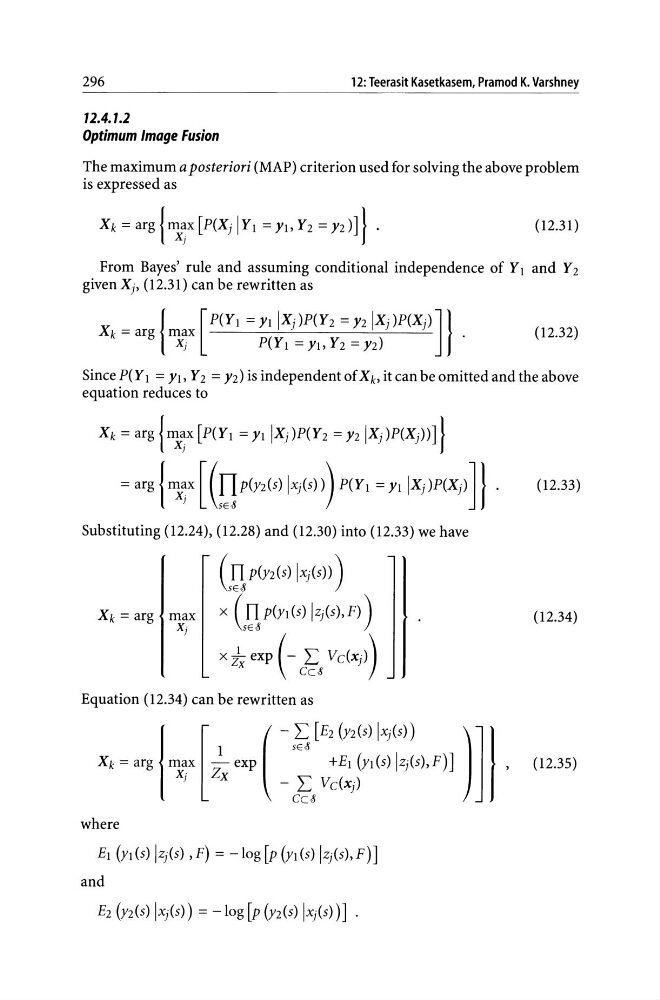
The maximum a posteriori (MAP) criterion used for solving the above problem
is expressed as
(l2.31 )
From Bayes' rule and assuming conditional independence of Y 1 and Y 2
given Xj' (l2.31) can be rewritten as
(l2.32)
Since P(Y1 = YI, Y2 = Y2) is independent OfXb it can be omitted and the above
equation reduces to
Xk = arg {~~ [P(YI = YI IXj )P(Y2 = Y21Xj )P(Xj»]}
= "g h,:x [ (!J ply, (,) 1'1('))) pry 1 = Yl IXj )P(Xj) ] )
Substituting (l2.24), (l2.28) and (l2.30) into (l2.33) we have
max
Xj
( 0 P(Y2(S) Ix/s»)
SES
x (0 P(YI(S) IZ/S),F»)
SES
x ix exp (- L VdXj »)
ccs
Equation (l2.34) can be rewritten as
where
EI (yl (s) IZj(s) ,F) = -log [p (yl (s) IZj(s), F)]
and
(l2.33)
(l2.34)
(l2.35)
12: Teerasit Kasetkasem, Pramod K. Varshney
12.4.1.2
Optimum Image Fusion
The maximum a posteriori (MAP) criterion used for solving the above problem
is expressed as
(l2.31 )
From Bayes' rule and assuming conditional independence of Y 1 and Y 2
given Xj' (l2.31) can be rewritten as
(l2.32)
Since P(Y1 = YI, Y2 = Y2) is independent OfXb it can be omitted and the above
equation reduces to
Xk = arg {~~ [P(YI = YI IXj )P(Y2 = Y21Xj )P(Xj»]}
= "g h,:x [ (!J ply, (,) 1'1('))) pry 1 = Yl IXj )P(Xj) ] )
Substituting (l2.24), (l2.28) and (l2.30) into (l2.33) we have
max
Xj
( 0 P(Y2(S) Ix/s»)
SES
x (0 P(YI(S) IZ/S),F»)
SES
x ix exp (- L VdXj »)
ccs
Equation (l2.34) can be rewritten as
where
EI (yl (s) IZj(s) ,F) = -log [p (yl (s) IZj(s), F)]
and
(l2.33)
(l2.34)
(l2.35)