

Image Change Detection and Fusion Using MRF Models
295
to characterize the Gibbs potential function since natural images usually have
a smooth texture. Hence, we have
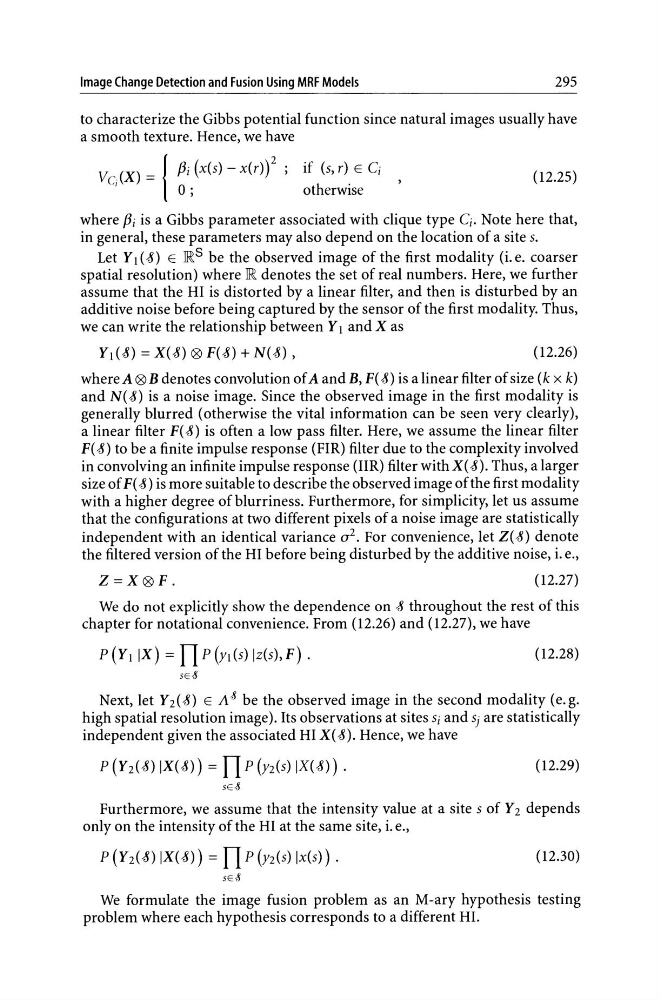
Vd X ) :::: I fJi (x(s) - x(r))2; if (s, r), E Ci
o ;
otherwise
(12.25)
where fJi is a Gibbs parameter associated with clique type Ci. Note here that,
in general, these parameters may also depend on the location of a site s.
Let Y 1 (-8) E IRS be the observed image of the first modality (i. e. coarser
spatial resolution) where IR denotes the set of real numbers. Here, we further
assume that the HI is distorted by a linear filter, and then is disturbed by an
additive noise before being captured by the sensor of the first modality. Thus,
we can write the relationship between Y 1 and X as
Y1 (8) ::::X(0)0F(0)+N(0) ,
(12.26)
where A 0 B denotes convolution of A and B, F( 0) is a linear filter of size (k x k)
and N(0) is a noise image. Since the observed image in the first modality is
generally blurred (otherwise the vital information can be seen very clearly),
a linear filter F( 0) is often a low pass filter. Here, we assume the linear filter
F( 0) to be a finite impulse response (FIR) filter due to the complexity involved
in convolving an infinite impulse response (IIR) filter with X( 0). Thus, a larger
size of F( 0) is more suitable to describe the observed image of the first modality
with a higher degree of blurriness. Furthermore, for simplicity, let us assume
that the configurations at two different pixels of a noise image are statistically
independent with an identical variance 0 2 . For convenience, let Z( 0) denote
the filtered version of the HI before being disturbed by the additive noise, i. e.,
Z::::X0F.
(12.27)
We do not explicitly show the dependence on 0 throughout the rest of this
chapter for notational convenience. From (12.26) and (12.27), we have
p(YIIX):::: n P(Yl(S) Iz(s),F).
(12.28)
SES
Next, let Y 2 (0) E A S be the observed image in the second modality (e. g.
high spatial resolution image). Its observations at sites Si and Sj are statistically
independent given the associated HI X( 0). Hence, we have
P(Y2(0) IX(0)):::: n P(Y2(S) IX(0)).
(12.29)
SEIi
Furthermore, we assume that the intensity value at a site S of Y 2 depends
only on the intensity of the HI at the same site, i. e.,
P (Y2(0) IX(0)) :::: n P (y2(S) Ix(s)) .
(12.30)
SEIi
We formulate the image fusion problem as an M -ary hypothesis testing
problem where each hypothesis corresponds to a different HI.
295
to characterize the Gibbs potential function since natural images usually have
a smooth texture. Hence, we have
Vd X ) :::: I fJi (x(s) - x(r))2; if (s, r), E Ci
o ;
otherwise
(12.25)
where fJi is a Gibbs parameter associated with clique type Ci. Note here that,
in general, these parameters may also depend on the location of a site s.
Let Y 1 (-8) E IRS be the observed image of the first modality (i. e. coarser
spatial resolution) where IR denotes the set of real numbers. Here, we further
assume that the HI is distorted by a linear filter, and then is disturbed by an
additive noise before being captured by the sensor of the first modality. Thus,
we can write the relationship between Y 1 and X as
Y1 (8) ::::X(0)0F(0)+N(0) ,
(12.26)
where A 0 B denotes convolution of A and B, F( 0) is a linear filter of size (k x k)
and N(0) is a noise image. Since the observed image in the first modality is
generally blurred (otherwise the vital information can be seen very clearly),
a linear filter F( 0) is often a low pass filter. Here, we assume the linear filter
F( 0) to be a finite impulse response (FIR) filter due to the complexity involved
in convolving an infinite impulse response (IIR) filter with X( 0). Thus, a larger
size of F( 0) is more suitable to describe the observed image of the first modality
with a higher degree of blurriness. Furthermore, for simplicity, let us assume
that the configurations at two different pixels of a noise image are statistically
independent with an identical variance 0 2 . For convenience, let Z( 0) denote
the filtered version of the HI before being disturbed by the additive noise, i. e.,
Z::::X0F.
(12.27)
We do not explicitly show the dependence on 0 throughout the rest of this
chapter for notational convenience. From (12.26) and (12.27), we have
p(YIIX):::: n P(Yl(S) Iz(s),F).
(12.28)
SES
Next, let Y 2 (0) E A S be the observed image in the second modality (e. g.
high spatial resolution image). Its observations at sites Si and Sj are statistically
independent given the associated HI X( 0). Hence, we have
P(Y2(0) IX(0)):::: n P(Y2(S) IX(0)).
(12.29)
SEIi
Furthermore, we assume that the intensity value at a site S of Y 2 depends
only on the intensity of the HI at the same site, i. e.,
P (Y2(0) IX(0)) :::: n P (y2(S) Ix(s)) .
(12.30)
SEIi
We formulate the image fusion problem as an M -ary hypothesis testing
problem where each hypothesis corresponds to a different HI.