

294
12: Teerasit Kasetkasem, Pramod K. Varshney
age (PI) and there is a pixel-to-pixel statistical relationship between a high
resolution multispectral image (HRMI) and a PI. This assumption implies
that observations of any two or more pixels in the PI are statistically independent when the HRMI is given. Next, we assume that the HRMI is distorted by a linear filter and then disturbed by noise before being captured
by multispectral sensors. Furthermore, the HRMI is assumed to satisfy the
Gaussian MRF properties since images can be very well described by the
MRF model and the Gaussian MRF is suitable for images with a large number of intensity levels. The MAP criterion together with the Metropolis algorithm is used to search for the optimum HRMI image. We test our algorithm with two actual datasets. Visual inspection is used for performance
evaluation.
12.4.1
Image Fusion Algorithm
In this section, we develop an image fusion algorithm based on an MRF model
for spatial enhancement. The algorithm employs the MAP criterion to pick the
"best" fused image from given observed images. The Metropolis optimization
algorithm is used to search for the solution of the MAP equation.
12.4.1.1
Image Model
In this problem, we are interested in fusing two images coming from different
sensing modalities and with different resolutions. The image from the first
modality is assumed to have low resolution while the image from the second
modality has high resolution. The goal is to obtain an enhanced image in the
first modality at the same resolution as the image in the second modality (high
resolution). Here, let -8 be a set of sites (pixels) s, and 11 = {O, 1, ... , L - I} be
the phase space. Note that L is the number of intensity values in the image
(for example, 256 for an 8-bit gray-scaled image.) Furthermore, let X( -8) E 11-8
denote the high-resolution image (HI) vector, or the enhanced image vector of the first modality (e.g. multispectral image) whose element x(s) E 11
is a configuration (intensity value) of a site (pixel) s in the HI. We assume
that X(-8) satisfies the MRF properties with Gibbs potential function Vdx),
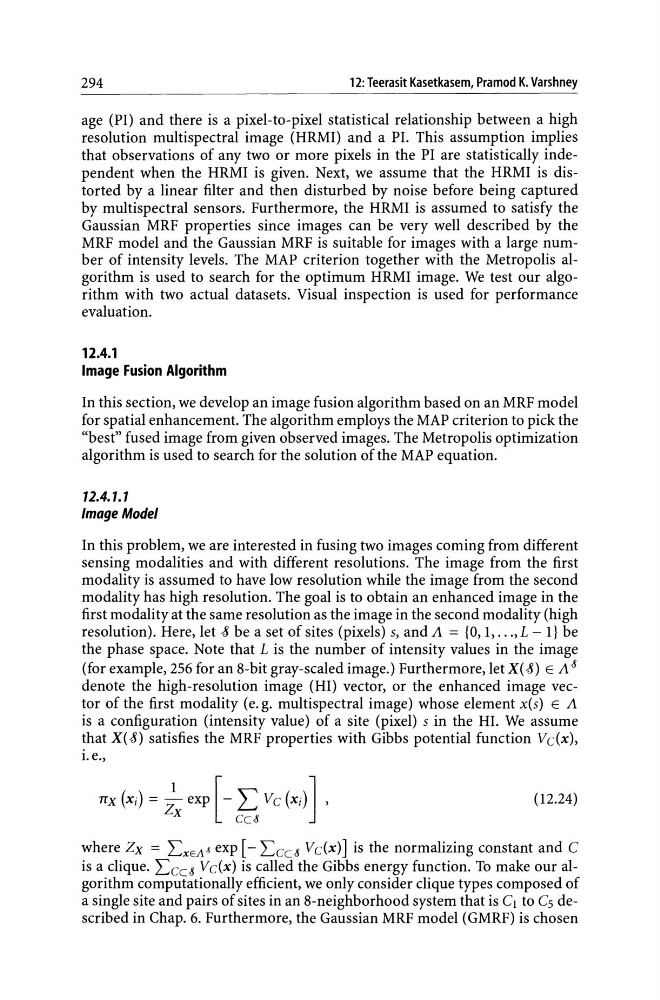
i. e.,
(12.24)
where Zx = LXEA8 exp [- Lcc-8 Vdx)] is the normalizing constant and C
is a clique. Lcc-8 Vdx) is called the Gibbs energy function. To make our algorithm computationally efficient, we only consider clique types composed of
a single site and pairs of sites in an 8-neighborhood system that is C1 to Cs described in Chap. 6. Furthermore, the Gaussian MRF model (GMRF) is chosen
12: Teerasit Kasetkasem, Pramod K. Varshney
age (PI) and there is a pixel-to-pixel statistical relationship between a high
resolution multispectral image (HRMI) and a PI. This assumption implies
that observations of any two or more pixels in the PI are statistically independent when the HRMI is given. Next, we assume that the HRMI is distorted by a linear filter and then disturbed by noise before being captured
by multispectral sensors. Furthermore, the HRMI is assumed to satisfy the
Gaussian MRF properties since images can be very well described by the
MRF model and the Gaussian MRF is suitable for images with a large number of intensity levels. The MAP criterion together with the Metropolis algorithm is used to search for the optimum HRMI image. We test our algorithm with two actual datasets. Visual inspection is used for performance
evaluation.
12.4.1
Image Fusion Algorithm
In this section, we develop an image fusion algorithm based on an MRF model
for spatial enhancement. The algorithm employs the MAP criterion to pick the
"best" fused image from given observed images. The Metropolis optimization
algorithm is used to search for the solution of the MAP equation.
12.4.1.1
Image Model
In this problem, we are interested in fusing two images coming from different
sensing modalities and with different resolutions. The image from the first
modality is assumed to have low resolution while the image from the second
modality has high resolution. The goal is to obtain an enhanced image in the
first modality at the same resolution as the image in the second modality (high
resolution). Here, let -8 be a set of sites (pixels) s, and 11 = {O, 1, ... , L - I} be
the phase space. Note that L is the number of intensity values in the image
(for example, 256 for an 8-bit gray-scaled image.) Furthermore, let X( -8) E 11-8
denote the high-resolution image (HI) vector, or the enhanced image vector of the first modality (e.g. multispectral image) whose element x(s) E 11
is a configuration (intensity value) of a site (pixel) s in the HI. We assume
that X(-8) satisfies the MRF properties with Gibbs potential function Vdx),
i. e.,
(12.24)
where Zx = LXEA8 exp [- Lcc-8 Vdx)] is the normalizing constant and C
is a clique. Lcc-8 Vdx) is called the Gibbs energy function. To make our algorithm computationally efficient, we only consider clique types composed of
a single site and pairs of sites in an 8-neighborhood system that is C1 to Cs described in Chap. 6. Furthermore, the Gaussian MRF model (GMRF) is chosen