

Image Change Detection and Fusion Using MRF Models
293
specifically for concealed weapons detection by using wavelet decomposition.
In their work, infrared (IR) and millimeter wave (MMW) imaging are used
to capture images of a suspect. IR images have high resolution, but are not
sensitive to concealed weapons because IR does not penetrate clothing. MMW
images are highly sensitive to concealed weapons, but have very poor resolution. As a result, any concealed weapon detection algorithm that utilizes only
either an IR or a MMW image is likely to perform poorly and will be unreliable. To increase reliability, IR and MMW images should be fused to a single
image in such a manner that high resolution information of IR images and
high contrast information of MMW images are retained.
The goal of resolution merging in remote sensing applications is slightly
different from the concealed weapon detection problem. Unlike the concealed
weapon detection problems where the only goal is to detect weapons by enhancing their shape, remote sensing applications are concerned more with
the mixed-pixel problem (see Sect. 2.6.4 of Chap. 2) where the observed data
corresponding to a pixel is a mixture of several materials such as grass and
soil. In crisp image classification, the general assumption that a pixel can only
be occupied by a single type of material is violated in mixed-pixel cases. As
a result, these mixed pixels severely degrade performance of many hard image
analysis tools including image classification. To avoid this mixed-pixel problem, multispectral images must be taken at very high resolution which may not
be possible or too expensive to obtain with current photographic technologies.
For instance, the IKONOS satellite provides the multispectral images in red,
green, blue, and near IR spectra at 4 x 4 meter resolution and panchromatic
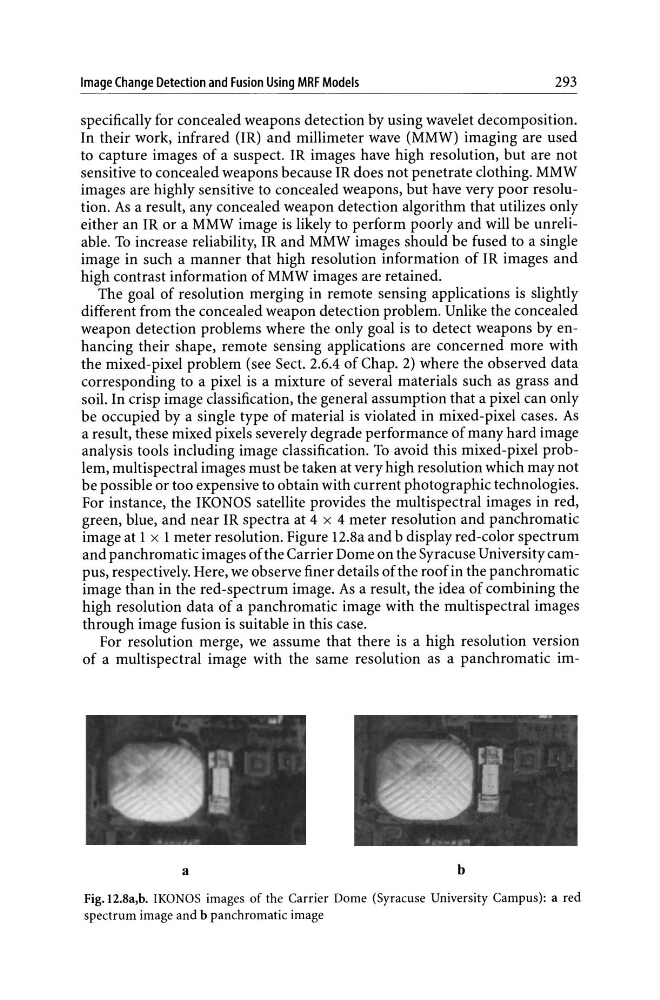
image at 1 x 1 meter resolution. Figure 12.8a and b display red-color spectrum
and panchromatic images of the Carrier Dome on the Syracuse University campus, respectively. Here, we observe finer details of the roof in the panchromatic
image than in the red-spectrum image. As a result, the idea of combining the
high resolution data of a panchromatic image with the multispectral images
through image fusion is suitable in this case.
For resolution merge, we assume that there is a high resolution version
of a multispectral image with the same resolution as a panchromatic ima
b
Fig.12.8a,b. IKONOS images of the Carrier Dome (Syracuse University Campus): a red
spectrum image and b panchromatic image
293
specifically for concealed weapons detection by using wavelet decomposition.
In their work, infrared (IR) and millimeter wave (MMW) imaging are used
to capture images of a suspect. IR images have high resolution, but are not
sensitive to concealed weapons because IR does not penetrate clothing. MMW
images are highly sensitive to concealed weapons, but have very poor resolution. As a result, any concealed weapon detection algorithm that utilizes only
either an IR or a MMW image is likely to perform poorly and will be unreliable. To increase reliability, IR and MMW images should be fused to a single
image in such a manner that high resolution information of IR images and
high contrast information of MMW images are retained.
The goal of resolution merging in remote sensing applications is slightly
different from the concealed weapon detection problem. Unlike the concealed
weapon detection problems where the only goal is to detect weapons by enhancing their shape, remote sensing applications are concerned more with
the mixed-pixel problem (see Sect. 2.6.4 of Chap. 2) where the observed data
corresponding to a pixel is a mixture of several materials such as grass and
soil. In crisp image classification, the general assumption that a pixel can only
be occupied by a single type of material is violated in mixed-pixel cases. As
a result, these mixed pixels severely degrade performance of many hard image
analysis tools including image classification. To avoid this mixed-pixel problem, multispectral images must be taken at very high resolution which may not
be possible or too expensive to obtain with current photographic technologies.
For instance, the IKONOS satellite provides the multispectral images in red,
green, blue, and near IR spectra at 4 x 4 meter resolution and panchromatic
image at 1 x 1 meter resolution. Figure 12.8a and b display red-color spectrum
and panchromatic images of the Carrier Dome on the Syracuse University campus, respectively. Here, we observe finer details of the roof in the panchromatic
image than in the red-spectrum image. As a result, the idea of combining the
high resolution data of a panchromatic image with the multispectral images
through image fusion is suitable in this case.
For resolution merge, we assume that there is a high resolution version
of a multispectral image with the same resolution as a panchromatic ima
b
Fig.12.8a,b. IKONOS images of the Carrier Dome (Syracuse University Campus): a red
spectrum image and b panchromatic image