

Image Change Detection and Fusion Using MRF Models
297
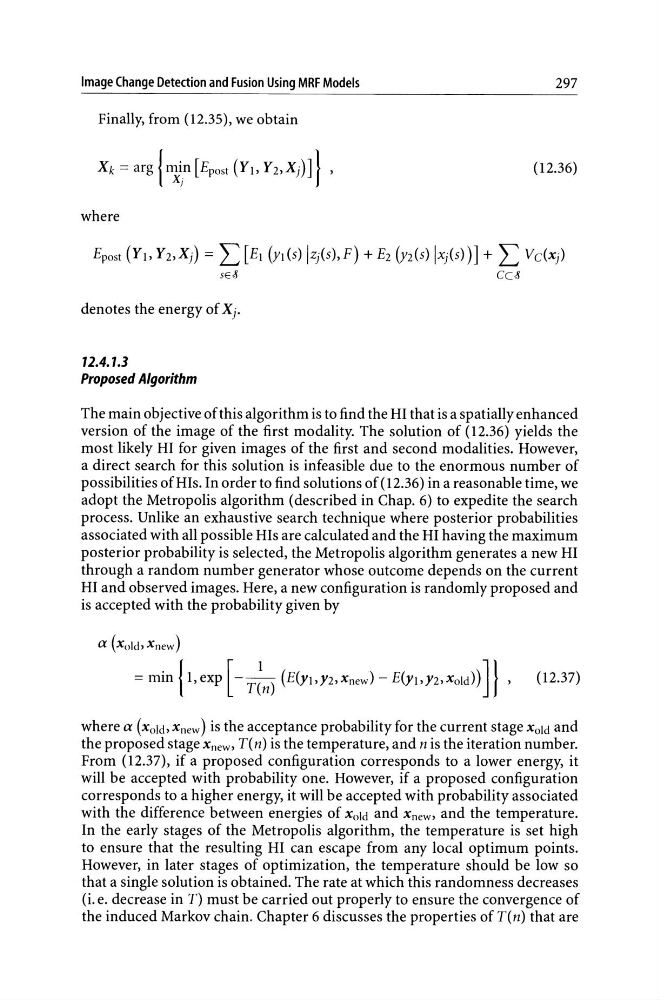
Finally, from (12.35), we obtain
(12.36)
where
denotes the energy of Xj.
12.4.1.3
Proposed Algorithm
The main objective of this algorithm is to find the HI that is a spatially enhanced
version of the image of the first modality. The solution of (12.36) yields the
most likely HI for given images of the first and second modalities. However,
a direct search for this solution is infeasible due to the enormous number of
possibilities of HIs. In order to find solutions of (12.36) in a reasonable time, we
adopt the Metropolis algorithm (described in Chap. 6) to expedite the search
process. Unlike an exhaustive search technique where posterior probabilities
associated with all possible HIs are calculated and the HI having the maximum
posterior probability is selected, the Metropolis algorithm generates a new HI
through a random number generator whose outcome depends on the current
HI and observed images. Here, a new configuration is randomly proposed and
is accepted with the probability given by
a (Xold,Xnew )
= min { 1, exp [- T;n) (E(Yl>Y2,Xnew ) - E(Y!,Y2,XOld»)]} ,
(12.37)
where a (Xold' Xnew) is the acceptance probability for the current stage Xold and
the proposed stage Xnew, T(n) is the temperature, and n is the iteration number.
From (12.37), if a proposed configuration corresponds to a lower energy, it
will be accepted with probability one. However, if a proposed configuration
corresponds to a higher energy, it will be accepted with probability associated
with the difference between energies of Xold and Xnew , and the temperature.
In the early stages of the Metropolis algorithm, the temperature is set high
to ensure that the resulting HI can escape from any local optimum points.
However, in later stages of optimization, the temperature should be low so
that a single solution is obtained. The rate at which this randomness decreases
(i. e. decrease in T) must be carried out properly to ensure the convergence of
the induced Markov chain. Chapter 6 discusses the properties of T(n) that are
297
Finally, from (12.35), we obtain
(12.36)
where
denotes the energy of Xj.
12.4.1.3
Proposed Algorithm
The main objective of this algorithm is to find the HI that is a spatially enhanced
version of the image of the first modality. The solution of (12.36) yields the
most likely HI for given images of the first and second modalities. However,
a direct search for this solution is infeasible due to the enormous number of
possibilities of HIs. In order to find solutions of (12.36) in a reasonable time, we
adopt the Metropolis algorithm (described in Chap. 6) to expedite the search
process. Unlike an exhaustive search technique where posterior probabilities
associated with all possible HIs are calculated and the HI having the maximum
posterior probability is selected, the Metropolis algorithm generates a new HI
through a random number generator whose outcome depends on the current
HI and observed images. Here, a new configuration is randomly proposed and
is accepted with the probability given by
a (Xold,Xnew )
= min { 1, exp [- T;n) (E(Yl>Y2,Xnew ) - E(Y!,Y2,XOld»)]} ,
(12.37)
where a (Xold' Xnew) is the acceptance probability for the current stage Xold and
the proposed stage Xnew, T(n) is the temperature, and n is the iteration number.
From (12.37), if a proposed configuration corresponds to a lower energy, it
will be accepted with probability one. However, if a proposed configuration
corresponds to a higher energy, it will be accepted with probability associated
with the difference between energies of Xold and Xnew , and the temperature.
In the early stages of the Metropolis algorithm, the temperature is set high
to ensure that the resulting HI can escape from any local optimum points.
However, in later stages of optimization, the temperature should be low so
that a single solution is obtained. The rate at which this randomness decreases
(i. e. decrease in T) must be carried out properly to ensure the convergence of
the induced Markov chain. Chapter 6 discusses the properties of T(n) that are