

286
12: Teerasit Kasetkasem, Pramod K. Varshney
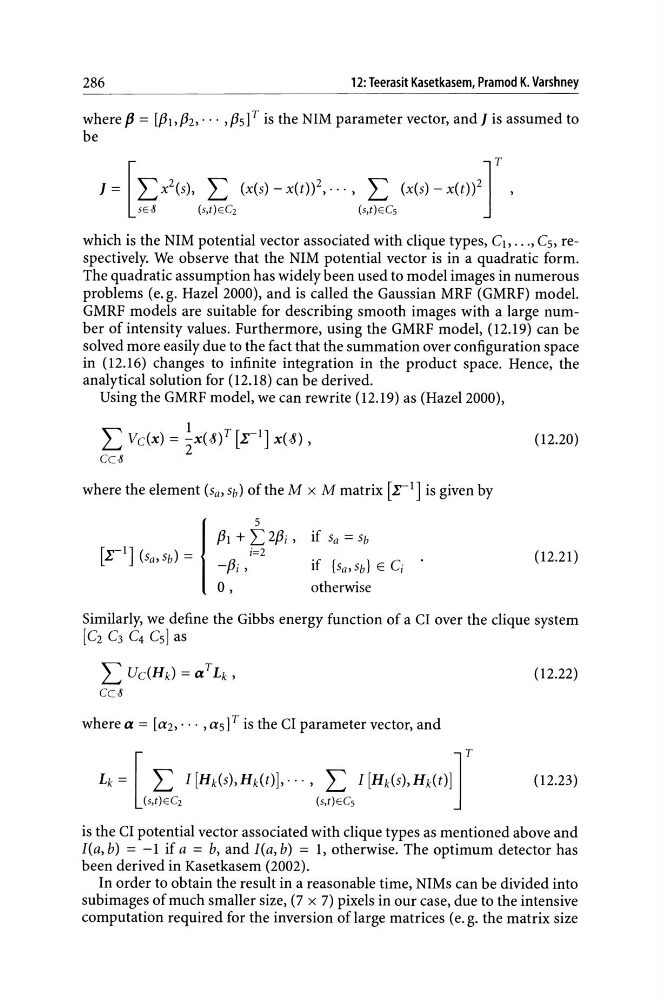
where /3 = [/31>/32,· .. ,/3s1 T is the NIM parameter vector, and J is assumed to
be
J= [LX 2 (S)' L
(x(s)-x(t»2, .. 0, L (X(S)_X(t»2]T,
SES
(S,t)EC2
(s,t)ECs
which is the NIM potential vector associated with clique types, C1> ... , Cs, respectively. We observe that the NIM potential vector is in a quadratic form.
The quadratic assumption has widely been used to model images in numerous
problems (e.g. Hazel 2000), and is called the Gaussian MRF (GMRF) model.
GMRF models are suitable for describing smooth images with a large number of intensity values. Furthermore, using the GMRF model, (12.19) can be
solved more easily due to the fact that the summation over configuration space
in (12.16) changes to infinite integration in the product space. Hence, the
analytical solution for (12.18) can be derived.
Using the GMRF model, we can rewrite (12.19) as (Hazel 2000),
1
L Vc(x) = "lx(-8)T [I-I] x(-8) ,
CcS
(12.20)
where the element (sa> Sb) of the M x M matrix [Io-I] is given by
I
5
f31 + L 2f3i' if Sa = Sb
[I-I] (Sa,Sb) = -f3o i=2
Of {
} Co
I ,
1
Sa, Sb E I
o ,
otherwise
(12.21)
Similarly, we define the Gibbs energy function of a CI over the clique system
[C2 C3 C4 Csl as
L Uc(Hk) = aTLk ,
(12.22)
CCS
where a = [a2, 0 0 0 ,asl T is the CI parameter vector, and
(12.23)
is the CI potential vector associated with clique types as mentioned above and
I(a, b) = -1 if a = b, and I(a, b) = 1, otherwise. The optimum detector has
been derived in Kasetkasem (2002).
In order to obtain the result in a reasonable time, NIMs can be divided into
subimages of much smaller size, (7 x 7) pixels in our case, due to the intensive
computation required for the inversion of large matrices (e. g. the matrix size
12: Teerasit Kasetkasem, Pramod K. Varshney
where /3 = [/31>/32,· .. ,/3s1 T is the NIM parameter vector, and J is assumed to
be
J= [LX 2 (S)' L
(x(s)-x(t»2, .. 0, L (X(S)_X(t»2]T,
SES
(S,t)EC2
(s,t)ECs
which is the NIM potential vector associated with clique types, C1> ... , Cs, respectively. We observe that the NIM potential vector is in a quadratic form.
The quadratic assumption has widely been used to model images in numerous
problems (e.g. Hazel 2000), and is called the Gaussian MRF (GMRF) model.
GMRF models are suitable for describing smooth images with a large number of intensity values. Furthermore, using the GMRF model, (12.19) can be
solved more easily due to the fact that the summation over configuration space
in (12.16) changes to infinite integration in the product space. Hence, the
analytical solution for (12.18) can be derived.
Using the GMRF model, we can rewrite (12.19) as (Hazel 2000),
1
L Vc(x) = "lx(-8)T [I-I] x(-8) ,
CcS
(12.20)
where the element (sa> Sb) of the M x M matrix [Io-I] is given by
I
5
f31 + L 2f3i' if Sa = Sb
[I-I] (Sa,Sb) = -f3o i=2
Of {
} Co
I ,
1
Sa, Sb E I
o ,
otherwise
(12.21)
Similarly, we define the Gibbs energy function of a CI over the clique system
[C2 C3 C4 Csl as
L Uc(Hk) = aTLk ,
(12.22)
CCS
where a = [a2, 0 0 0 ,asl T is the CI parameter vector, and
(12.23)
is the CI potential vector associated with clique types as mentioned above and
I(a, b) = -1 if a = b, and I(a, b) = 1, otherwise. The optimum detector has
been derived in Kasetkasem (2002).
In order to obtain the result in a reasonable time, NIMs can be divided into
subimages of much smaller size, (7 x 7) pixels in our case, due to the intensive
computation required for the inversion of large matrices (e. g. the matrix size