

An MRF Model Based Approachfor Sub-pixel Mapping from Hyperspectral Data
267
Grass
Roof 1
Tree
Shadow
.,.... .....
I
.J.
. .
Road
Roof 2
·"1 " . ,
. ........ . ~, ' -
..
.
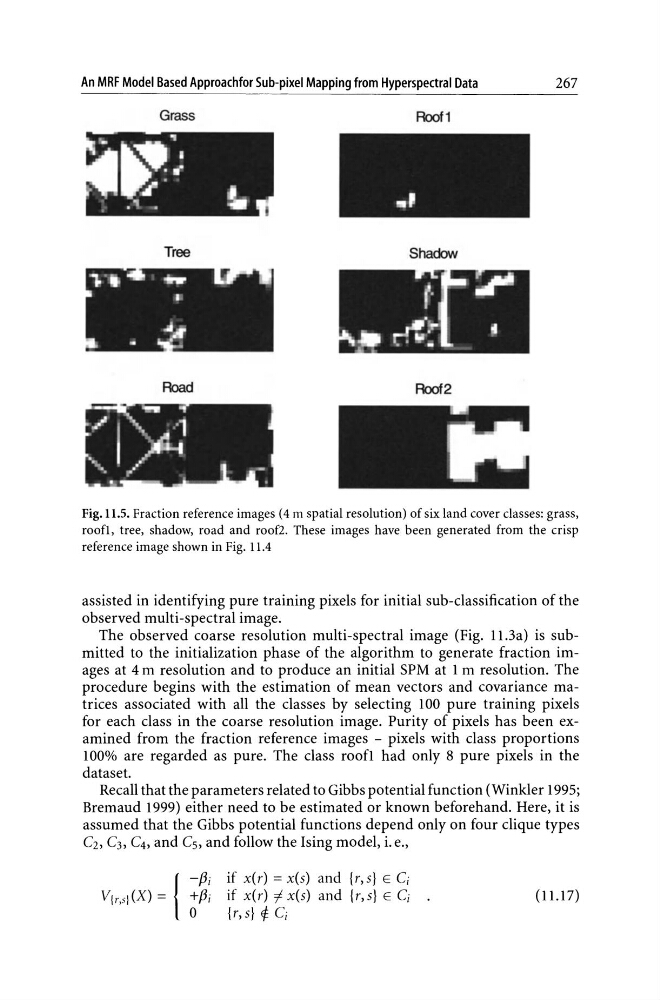
Fig. 11.5. Fraction reference images (4 m spatial resolution) of six land cover classes: grass,
roof!, tree, shadow, road and roof2. These images have been generated from the crisp
reference image shown in Fig. 11.4
assisted in identifying pure training pixels for initial sub-classification of the
observed multi-spectral image.
The observed coarse resolution multi-spectral image (Fig. 11.3a) is submitted to the initialization phase of the algorithm to generate fraction images at 4 m resolution and to produce an initial SPM at 1 m resolution. The
procedure begins with the estimation of mean vectors and covariance matrices associated with all the classes by selecting 100 pure training pixels
for each class in the coarse resolution image. Purity of pixels has been examined from the fraction reference images - pixels with class proportions
100% are regarded as pure. The class roofl had only 8 pure pixels in the
dataset.
Recall that the parameters related to Gibbs potential function (Winkler 1995;
Bremaud 1999) either need to be estimated or known beforehand. Here, it is
assumed that the Gibbs potential functions depend only on four clique types
C2, C3, C4, and Cs, and follow the Ising model, i. e.,
if x(r) = x(s) and Ir,s} E C
if x(r) ¥ x(s) and Ir,s} E C;
Ir,s} i C;
(11.17)
267
Grass
Roof 1
Tree
Shadow
.,.... .....
I
.J.
. .
Road
Roof 2
·"1 " . ,
. ........ . ~, ' -
..
.
Fig. 11.5. Fraction reference images (4 m spatial resolution) of six land cover classes: grass,
roof!, tree, shadow, road and roof2. These images have been generated from the crisp
reference image shown in Fig. 11.4
assisted in identifying pure training pixels for initial sub-classification of the
observed multi-spectral image.
The observed coarse resolution multi-spectral image (Fig. 11.3a) is submitted to the initialization phase of the algorithm to generate fraction images at 4 m resolution and to produce an initial SPM at 1 m resolution. The
procedure begins with the estimation of mean vectors and covariance matrices associated with all the classes by selecting 100 pure training pixels
for each class in the coarse resolution image. Purity of pixels has been examined from the fraction reference images - pixels with class proportions
100% are regarded as pure. The class roofl had only 8 pure pixels in the
dataset.
Recall that the parameters related to Gibbs potential function (Winkler 1995;
Bremaud 1999) either need to be estimated or known beforehand. Here, it is
assumed that the Gibbs potential functions depend only on four clique types
C2, C3, C4, and Cs, and follow the Ising model, i. e.,
if x(r) = x(s) and Ir,s} E C
if x(r) ¥ x(s) and Ir,s} E C;
Ir,s} i C;
(11.17)