

An MRF Model Based Approachfor Sub-pixel Mapping from Hyperspectral Data
265
where LCOlt! denotes the summation over all the cliques to which tl belongs,
St! is the site in the observed image corresponding to tl, and r is due to
the remaining terms in (11.12) that are independent of the configuration of tl.
Note that depending upon the neighborhood system considered in a particular
problem, different types of cliques could be employed. Since r is independent
of X(tl), a list of probabilities associated with all possible configuration values
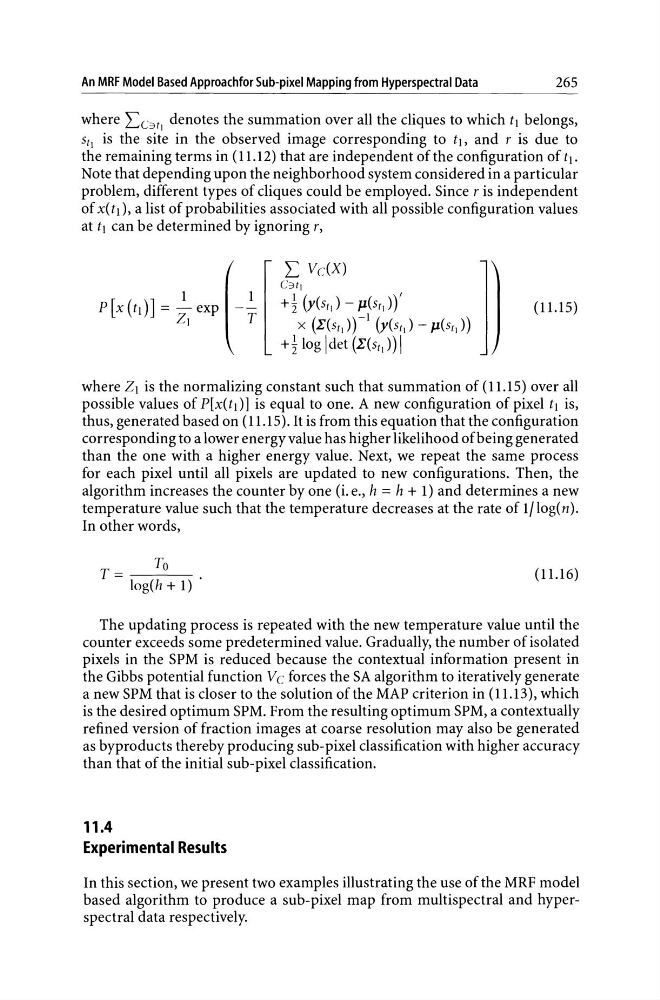
at tl can be determined by ignoring r,
L VdX)
COlt!
+! (y(St!) - p(St!»)'
x (I(St!)r 1 (y(St!) - p(St!»
+! log Idet (I(St!») I
(11.15)
where ZI is the normalizing constant such that summation of (11.15) over all
possible values of P[x(tdl is equal to one. A new configuration of pixel tl is,
thus, generated based on (11.15). It is from this equation that the configuration
corresponding to a lower energy value has higher likelihood of being generated
than the one with a higher energy value. Next, we repeat the same process
for each pixel until all pixels are updated to new configurations. Then, the
algorithm increases the counter by one (i. e., h = h + 1) and determines a new
temperature value such that the temperature decreases at the rate of l/log(n).
In other words,
To
T = - - - -
log(h + 1)
(11.16)
The updating process is repeated with the new temperature value until the
counter exceeds some predetermined value. Gradually, the number of isolated
pixels in the SPM is reduced because the contextual information present in
the Gibbs potential function V C forces the SA algorithm to iteratively generate
a new SPM that is closer to the solution of the MAP criterion in (11.13), which
is the desired optimum SPM. From the resulting optimum SPM, a contextually
refined version of fraction images at coarse resolution may also be generated
as bypro ducts thereby producing sub-pixel classification with higher accuracy
than that of the initial sub-pixel classification.
11.4
Experimental Results
In this section, we present two examples illustrating the use of the MRF model
based algorithm to produce a sub-pixel map from multispectral and hyperspectral data respectively.
265
where LCOlt! denotes the summation over all the cliques to which tl belongs,
St! is the site in the observed image corresponding to tl, and r is due to
the remaining terms in (11.12) that are independent of the configuration of tl.
Note that depending upon the neighborhood system considered in a particular
problem, different types of cliques could be employed. Since r is independent
of X(tl), a list of probabilities associated with all possible configuration values
at tl can be determined by ignoring r,
L VdX)
COlt!
+! (y(St!) - p(St!»)'
x (I(St!)r 1 (y(St!) - p(St!»
+! log Idet (I(St!») I
(11.15)
where ZI is the normalizing constant such that summation of (11.15) over all
possible values of P[x(tdl is equal to one. A new configuration of pixel tl is,
thus, generated based on (11.15). It is from this equation that the configuration
corresponding to a lower energy value has higher likelihood of being generated
than the one with a higher energy value. Next, we repeat the same process
for each pixel until all pixels are updated to new configurations. Then, the
algorithm increases the counter by one (i. e., h = h + 1) and determines a new
temperature value such that the temperature decreases at the rate of l/log(n).
In other words,
To
T = - - - -
log(h + 1)
(11.16)
The updating process is repeated with the new temperature value until the
counter exceeds some predetermined value. Gradually, the number of isolated
pixels in the SPM is reduced because the contextual information present in
the Gibbs potential function V C forces the SA algorithm to iteratively generate
a new SPM that is closer to the solution of the MAP criterion in (11.13), which
is the desired optimum SPM. From the resulting optimum SPM, a contextually
refined version of fraction images at coarse resolution may also be generated
as bypro ducts thereby producing sub-pixel classification with higher accuracy
than that of the initial sub-pixel classification.
11.4
Experimental Results
In this section, we present two examples illustrating the use of the MRF model
based algorithm to produce a sub-pixel map from multispectral and hyperspectral data respectively.