

264
11: Teerasit Kasetkasem, Manoj K. Arora, Pramod K. Varshney
SPM. A similar procedure is adopted for each fraction image and the pixels in
the set 7 j are, then, randomly labeled with all the classes. This is referred to as
the initial SPM. It is expected that the initial SPM will have a large number of
isolated pixels since their neighboring pixels may belong to different classes.
The initial SPM is used as the starting point in the iteration phase of the search
process. An appropriate starting point (which is often difficult to obtain) may
result in a faster convergence rate of the SA algorithm.
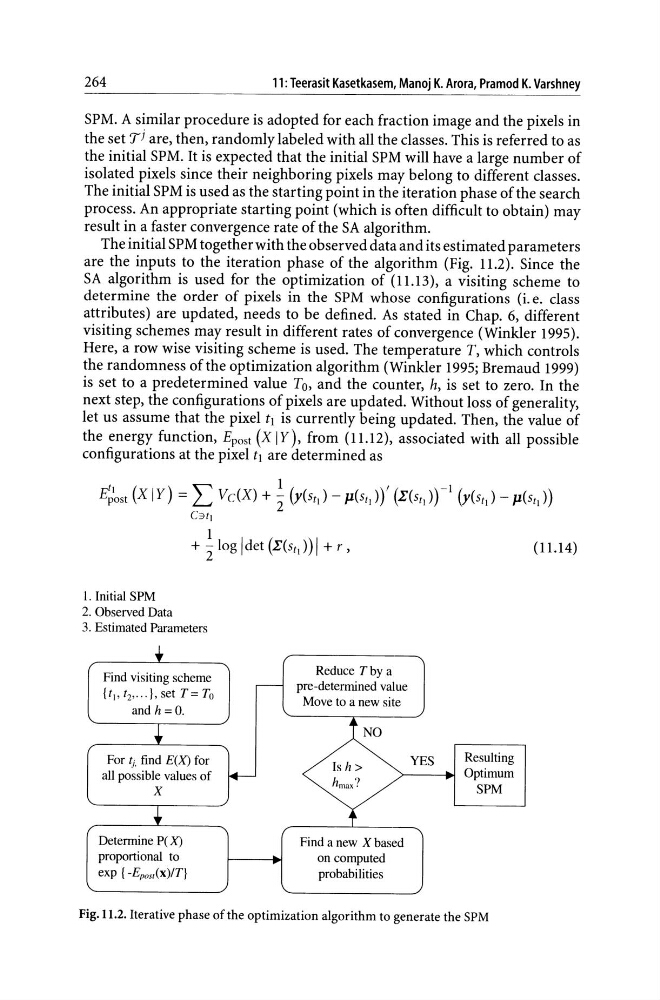
The initial SPM together with the observed data and its estimated parameters
are the inputs to the iteration phase of the algorithm (Fig. 11.2). Since the
SA algorithm is used for the optimization of (11.l3), a visiting scheme to
determine the order of pixels in the SPM whose configurations (i. e. class
attributes) are updated, needs to be defined. As stated in Chap. 6, different
visiting schemes may result in different rates of convergence (Winkler 1995).
Here, a row wise visiting scheme is used. The temperature T, which controls
the randomness of the optimization algorithm (Winkler 1995; Bremaud 1999)
is set to a predetermined value To, and the counter, h, is set to zero. In the
next step, the configurations of pixels are updated. Without loss of generality,
let us assume that the pixel tl is currently being updated. Then, the value of
the energy function, Epost (X I y), from (11.12), associated with all possible
configurations at the pixel tl are determined as
E~]ost (X I Y) = L Vc(X) + ~ (y(St]) - p(St]))' (..r(St])) -I (y(St]) - p(St]))
C3t]
1. Initial SPM
2. Observed Data
3. Estimated Parameters
Find visiting scheme
{t" t 2 , ... }, set T= To
and h =0.
For tj. find E(X) for
all possible values of
X
Determine P( X)
proportional to
exp { -Epos/(x)/T}
Reduce Tby a
pre-determined value
Move to a new site
Is h >
hmax ?
NO
Find a new X based
on computed
probabilities
YES
Resulting
Optimum
SPM
Fig. 11.2. Iterative phase of the optimization algorithm to generate the SPM
(11.14)
11: Teerasit Kasetkasem, Manoj K. Arora, Pramod K. Varshney
SPM. A similar procedure is adopted for each fraction image and the pixels in
the set 7 j are, then, randomly labeled with all the classes. This is referred to as
the initial SPM. It is expected that the initial SPM will have a large number of
isolated pixels since their neighboring pixels may belong to different classes.
The initial SPM is used as the starting point in the iteration phase of the search
process. An appropriate starting point (which is often difficult to obtain) may
result in a faster convergence rate of the SA algorithm.
The initial SPM together with the observed data and its estimated parameters
are the inputs to the iteration phase of the algorithm (Fig. 11.2). Since the
SA algorithm is used for the optimization of (11.l3), a visiting scheme to
determine the order of pixels in the SPM whose configurations (i. e. class
attributes) are updated, needs to be defined. As stated in Chap. 6, different
visiting schemes may result in different rates of convergence (Winkler 1995).
Here, a row wise visiting scheme is used. The temperature T, which controls
the randomness of the optimization algorithm (Winkler 1995; Bremaud 1999)
is set to a predetermined value To, and the counter, h, is set to zero. In the
next step, the configurations of pixels are updated. Without loss of generality,
let us assume that the pixel tl is currently being updated. Then, the value of
the energy function, Epost (X I y), from (11.12), associated with all possible
configurations at the pixel tl are determined as
E~]ost (X I Y) = L Vc(X) + ~ (y(St]) - p(St]))' (..r(St])) -I (y(St]) - p(St]))
C3t]
1. Initial SPM
2. Observed Data
3. Estimated Parameters
Find visiting scheme
{t" t 2 , ... }, set T= To
and h =0.
For tj. find E(X) for
all possible values of
X
Determine P( X)
proportional to
exp { -Epos/(x)/T}
Reduce Tby a
pre-determined value
Move to a new site
Is h >
hmax ?
NO
Find a new X based
on computed
probabilities
YES
Resulting
Optimum
SPM
Fig. 11.2. Iterative phase of the optimization algorithm to generate the SPM
(11.14)