

An MRF Model Based Approachfor Sub-pixel Mapping from Hyperspectral Data
Parameter
Estimation
Estimated
parameters
Principal
components of the
image treated as the
observed image
Initial SPM
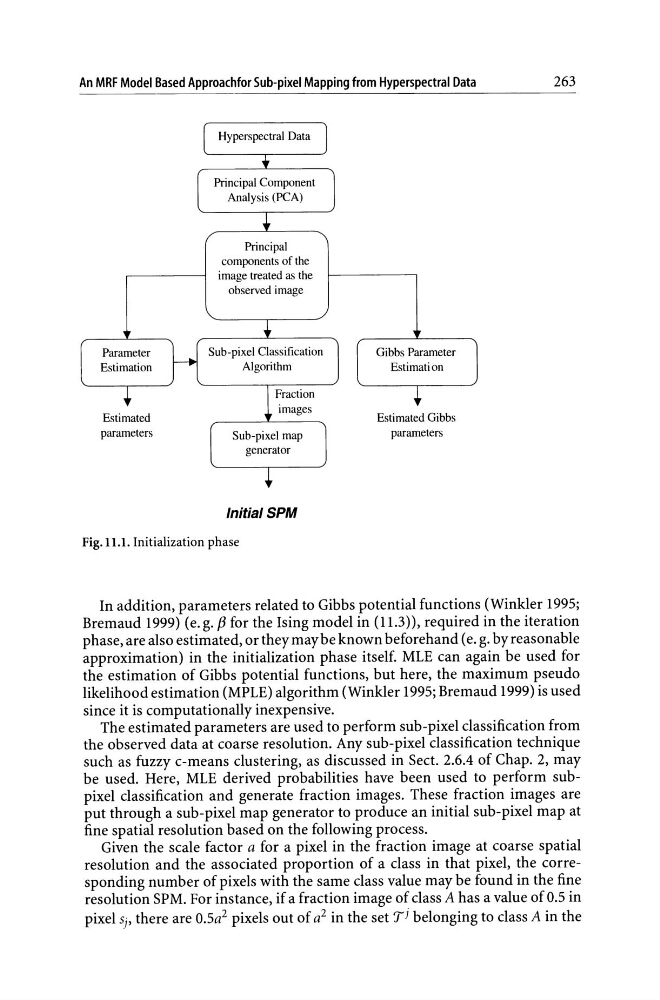
Fig. 11.1. Initialization phase
Gibbs Parameter
Estimation
Estimated Gibbs
parameters
263
In addition, parameters related to Gibbs potential functions (Winkler 1995;
Bremaud 1999) (e. g. f3 for the Ising model in (11.3)), required in the iteration
phase, are also estimated, or they may be known beforehand (e. g. by reasonable
approximation) in the initialization phase itself. MLE can again be used for
the estimation of Gibbs potential functions, but here, the maximum pseudo
likelihood estimation (MPLE) algorithm (Winkler 1995; Bremaud 1999) is used
since it is computationally inexpensive.
The estimated parameters are used to perform sub-pixel classification from
the observed data at coarse resolution. Any sub-pixel classification technique
such as fuzzy c-means clustering, as discussed in Sect. 2.6.4 of Chap. 2, may
be used. Here, MLE derived probabilities have been used to perform subpixel classification and generate fraction images. These fraction images are
put through a sub-pixel map generator to produce an initial sub-pixel map at
fine spatial resolution based on the following process.
Given the scale factor a for a pixel in the fraction image at coarse spatial
resolution and the associated proportion of a class in that pixel, the corresponding number of pixels with the same class value may be found in the fine
resolution SPM. For instance, if a fraction image of class A has a value of 0.5 in
pixel Sj' there are 0.5a 2 pixels out of a 2 in the set Tj belonging to class A in the
Parameter
Estimation
Estimated
parameters
Principal
components of the
image treated as the
observed image
Initial SPM
Fig. 11.1. Initialization phase
Gibbs Parameter
Estimation
Estimated Gibbs
parameters
263
In addition, parameters related to Gibbs potential functions (Winkler 1995;
Bremaud 1999) (e. g. f3 for the Ising model in (11.3)), required in the iteration
phase, are also estimated, or they may be known beforehand (e. g. by reasonable
approximation) in the initialization phase itself. MLE can again be used for
the estimation of Gibbs potential functions, but here, the maximum pseudo
likelihood estimation (MPLE) algorithm (Winkler 1995; Bremaud 1999) is used
since it is computationally inexpensive.
The estimated parameters are used to perform sub-pixel classification from
the observed data at coarse resolution. Any sub-pixel classification technique
such as fuzzy c-means clustering, as discussed in Sect. 2.6.4 of Chap. 2, may
be used. Here, MLE derived probabilities have been used to perform subpixel classification and generate fraction images. These fraction images are
put through a sub-pixel map generator to produce an initial sub-pixel map at
fine spatial resolution based on the following process.
Given the scale factor a for a pixel in the fraction image at coarse spatial
resolution and the associated proportion of a class in that pixel, the corresponding number of pixels with the same class value may be found in the fine
resolution SPM. For instance, if a fraction image of class A has a value of 0.5 in
pixel Sj' there are 0.5a 2 pixels out of a 2 in the set Tj belonging to class A in the