

An MRF Model Based Approachfor Sub-pixel Mapping from Hyperspectral Data
261
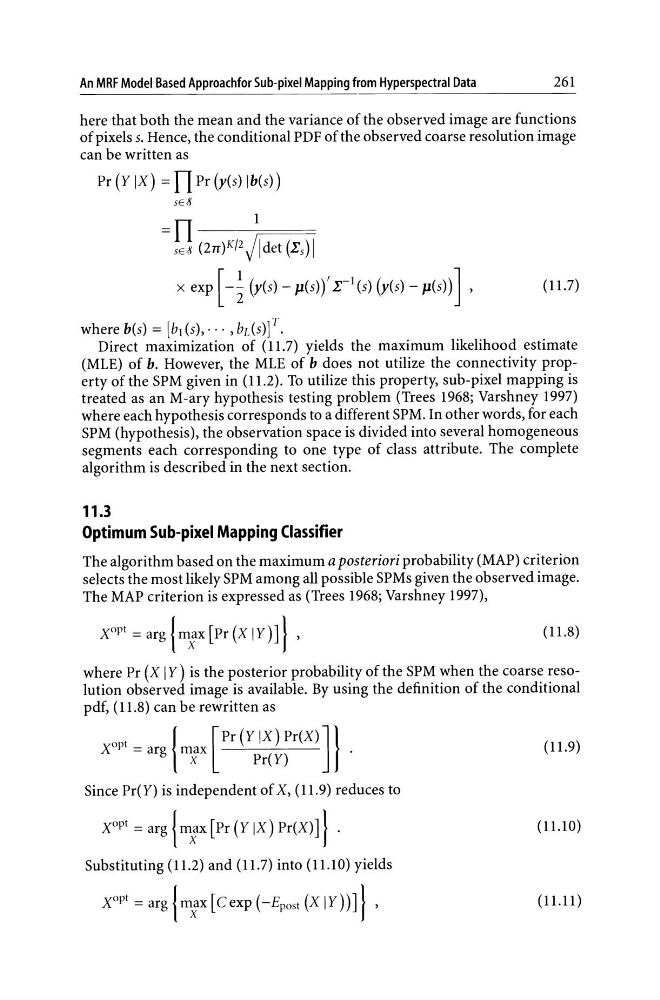
here that both the mean and the variance of the observed image are functions
of pixels s. Hence, the conditional PDF of the observed coarse resolution image
can be written as
Pr (Y IX) = Tl Pr (y(s) Ib(s))
SES
=Tl
1
SES (2rr)K/2 jldet (2's) I
x exp [ -~ (y(s) - p(s))' 2'-1 (s) (y(s) - P(S))] ,
(11.7)
whereb(s) = [b 1(s),.·· ,bt(s)f
Direct maximization of (11.7) yields the maximum likelihood estimate
(MLE) of b. However, the MLE of b does not utilize the connectivity property of the SPM given in (11.2). To utilize this property, sub-pixel mapping is
treated as an M-ary hypothesis testing problem (Trees 1968; Varshney 1997)
where each hypothesis corresponds to a different SPM. In other words, for each
SPM (hypothesis), the observation space is divided into several homogeneous
segments each corresponding to one type of class attribute. The complete
algorithm is described in the next section.
11.3
Optimum Sub-pixel Mapping Classifier
The algorithm based on the maximum a posteriori probability (MAP) criterion
selects the most likely SPM among all possible SPMs given the observed image.
The MAP criterion is expressed as (Trees 1968; Varshney 1997),
xopt = arg { m;x [Pr (X I Y)]} ,
(11.8)
where Pr (X I Y) is the posterior probability of the SPM when the coarse resolution observed image is available. By using the definition of the conditional
pdf, (11.8) can be rewritten as
X o , = arg max
.
)t
I [pr (Y IX) pr(X)] I
x
PreY)
Since Prey) is independent of X, (11.9) reduces to
xopt = arg {m;x [Pr (Y IX) pr(X)]} .
Substituting (11.2) and (11.7) into (11.10) yields
Xopt = arg { m;x [ C exp ( - Epost (X I Y) )]} ,
(11.9)
(11.10)
(11.11)
261
here that both the mean and the variance of the observed image are functions
of pixels s. Hence, the conditional PDF of the observed coarse resolution image
can be written as
Pr (Y IX) = Tl Pr (y(s) Ib(s))
SES
=Tl
1
SES (2rr)K/2 jldet (2's) I
x exp [ -~ (y(s) - p(s))' 2'-1 (s) (y(s) - P(S))] ,
(11.7)
whereb(s) = [b 1(s),.·· ,bt(s)f
Direct maximization of (11.7) yields the maximum likelihood estimate
(MLE) of b. However, the MLE of b does not utilize the connectivity property of the SPM given in (11.2). To utilize this property, sub-pixel mapping is
treated as an M-ary hypothesis testing problem (Trees 1968; Varshney 1997)
where each hypothesis corresponds to a different SPM. In other words, for each
SPM (hypothesis), the observation space is divided into several homogeneous
segments each corresponding to one type of class attribute. The complete
algorithm is described in the next section.
11.3
Optimum Sub-pixel Mapping Classifier
The algorithm based on the maximum a posteriori probability (MAP) criterion
selects the most likely SPM among all possible SPMs given the observed image.
The MAP criterion is expressed as (Trees 1968; Varshney 1997),
xopt = arg { m;x [Pr (X I Y)]} ,
(11.8)
where Pr (X I Y) is the posterior probability of the SPM when the coarse resolution observed image is available. By using the definition of the conditional
pdf, (11.8) can be rewritten as
X o , = arg max
.
)t
I [pr (Y IX) pr(X)] I
x
PreY)
Since Prey) is independent of X, (11.9) reduces to
xopt = arg {m;x [Pr (Y IX) pr(X)]} .
Substituting (11.2) and (11.7) into (11.10) yields
Xopt = arg { m;x [ C exp ( - Epost (X I Y) )]} ,
(11.9)
(11.10)
(11.11)