

230
9: Chintan A. Shah
a
b
c
d
e
g
h
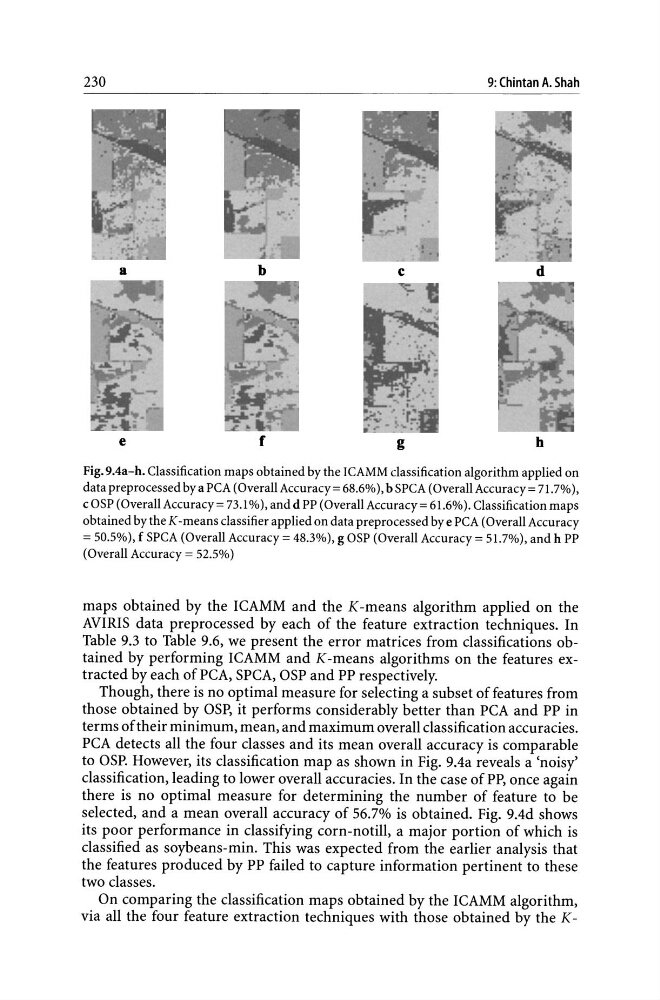
Fig. 9.4a-h. Classification maps obtained by the ICAMM classification algorithm applied on
data preprocessed by a PCA (Overall Accuracy = 68.6%), b SPCA (Overall Accuracy = 71.7%),
c OSP (Overall Accuracy = 73.1 %), and d PP (Overall Accuracy = 61.6%). Classification maps
obtained by the K -means classifier applied on data preprocessed by e PCA (Overall Accuracy
= 50.5%), f SPCA (Overall Accuracy = 48.3%), g OSP (Overall Accuracy = 51.7%), and h PP
(Overall Accuracy = 52.5%)
maps obtained by the ICAMM and the K-means algorithm applied on the
AVIRIS data preprocessed by each of the feature extraction techniques. In
Table 9.3 to Table 9.6, we present the error matrices from classifications obtained by performing ICAMM and K-means algorithms on the features extracted by each of PCA, SPCA, asp and PP respectively.
Though, there is no optimal measure for selecting a subset of features from
those obtained by asp, it performs considerably better than PCA and PP in
terms of their minimum, mean, and maximum overall classification accuracies.
PCA detects all the four classes and its mean overall accuracy is comparable
to asp. However, its classification map as shown in Fig. 9.4a reveals a 'noisy'
classification, leading to lower overall accuracies. In the case of PP, once again
there is no optimal measure for determining the number of feature to be
selected, and a mean overall accuracy of 56.7% is obtained. Fig. 9.4d shows
its poor performance in classifying corn-notill, a major portion of which is
classified as soybeans-min. This was expected from the earlier analysis that
the features produced by PP failed to capture information pertinent to these
two classes.
an comparing the classification maps obtained by the ICAMM algorithm,
via all the four feature extraction techniques with those obtained by the K-
9: Chintan A. Shah
a
b
c
d
e
g
h
Fig. 9.4a-h. Classification maps obtained by the ICAMM classification algorithm applied on
data preprocessed by a PCA (Overall Accuracy = 68.6%), b SPCA (Overall Accuracy = 71.7%),
c OSP (Overall Accuracy = 73.1 %), and d PP (Overall Accuracy = 61.6%). Classification maps
obtained by the K -means classifier applied on data preprocessed by e PCA (Overall Accuracy
= 50.5%), f SPCA (Overall Accuracy = 48.3%), g OSP (Overall Accuracy = 51.7%), and h PP
(Overall Accuracy = 52.5%)
maps obtained by the ICAMM and the K-means algorithm applied on the
AVIRIS data preprocessed by each of the feature extraction techniques. In
Table 9.3 to Table 9.6, we present the error matrices from classifications obtained by performing ICAMM and K-means algorithms on the features extracted by each of PCA, SPCA, asp and PP respectively.
Though, there is no optimal measure for selecting a subset of features from
those obtained by asp, it performs considerably better than PCA and PP in
terms of their minimum, mean, and maximum overall classification accuracies.
PCA detects all the four classes and its mean overall accuracy is comparable
to asp. However, its classification map as shown in Fig. 9.4a reveals a 'noisy'
classification, leading to lower overall accuracies. In the case of PP, once again
there is no optimal measure for determining the number of feature to be
selected, and a mean overall accuracy of 56.7% is obtained. Fig. 9.4d shows
its poor performance in classifying corn-notill, a major portion of which is
classified as soybeans-min. This was expected from the earlier analysis that
the features produced by PP failed to capture information pertinent to these
two classes.
an comparing the classification maps obtained by the ICAMM algorithm,
via all the four feature extraction techniques with those obtained by the K-