

MI Based Registration of Multi-Sensor and Multi-Temporal Images
189
a
b
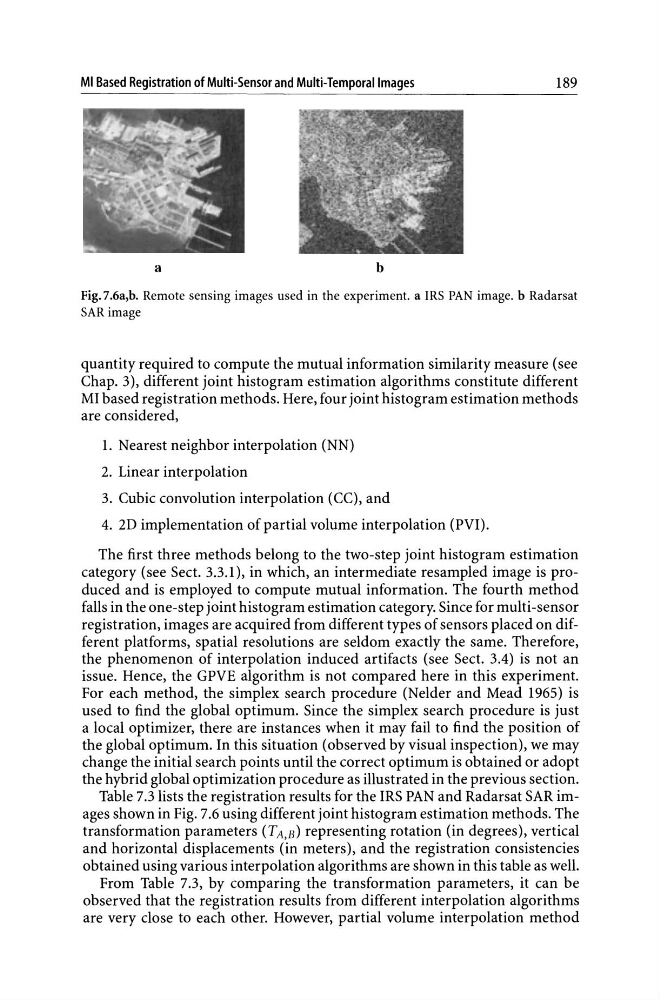
Fig.7.6a,b. Remote sensing images used in the experiment. a IRS PAN image. b Radarsat
SARimage
quantity required to compute the mutual information similarity measure (see
Chap. 3), different joint histogram estimation algorithms constitute different
MI based registration methods. Here, four joint histogram estimation methods
are considered,
1. Nearest neighbor interpolation (NN)
2. Linear interpolation
3. Cubic convolution interpolation (CC), and
4. 2D implementation of partial volume interpolation (PVI).
The first three methods belong to the two-step joint histogram estimation
category (see Sect. 3.3.1), in which, an intermediate resampled image is produced and is employed to compute mutual information. The fourth method
falls in the one-step joint histogram estimation category. Since for multi-sensor
registration, images are acquired from different types of sensors placed on different platforms, spatial resolutions are seldom exactly the same. Therefore,
the phenomenon of interpolation induced artifacts (see Sect. 3.4) is not an
issue. Hence, the GPVE algorithm is not compared here in this experiment.
For each method, the simplex search procedure (NeIder and Mead 1965) is
used to find the global optimum. Since the simplex search procedure is just
a local optimizer, there are instances when it may fail to find the position of
the global optimum. In this situation (observed by visual inspection), we may
change the initial search points until the correct optimum is obtained or adopt
the hybrid global optimization procedure as illustrated in the previous section.
Table 7.3 lists the registration results for the IRS PAN and Radarsat SAR images shown in Fig. 7.6 using different joint histogram estimation methods. The
transformation parameters (TA.B) representing rotation (in degrees), vertical
and horizontal displacements (in meters), and the registration consistencies
obtained using various interpolation algorithms are shown in this table as well.
From Table 7.3, by comparing the transformation parameters, it can be
observed that the registration results from different interpolation algorithms
are very close to each other. However, partial volume interpolation method
189
a
b
Fig.7.6a,b. Remote sensing images used in the experiment. a IRS PAN image. b Radarsat
SARimage
quantity required to compute the mutual information similarity measure (see
Chap. 3), different joint histogram estimation algorithms constitute different
MI based registration methods. Here, four joint histogram estimation methods
are considered,
1. Nearest neighbor interpolation (NN)
2. Linear interpolation
3. Cubic convolution interpolation (CC), and
4. 2D implementation of partial volume interpolation (PVI).
The first three methods belong to the two-step joint histogram estimation
category (see Sect. 3.3.1), in which, an intermediate resampled image is produced and is employed to compute mutual information. The fourth method
falls in the one-step joint histogram estimation category. Since for multi-sensor
registration, images are acquired from different types of sensors placed on different platforms, spatial resolutions are seldom exactly the same. Therefore,
the phenomenon of interpolation induced artifacts (see Sect. 3.4) is not an
issue. Hence, the GPVE algorithm is not compared here in this experiment.
For each method, the simplex search procedure (NeIder and Mead 1965) is
used to find the global optimum. Since the simplex search procedure is just
a local optimizer, there are instances when it may fail to find the position of
the global optimum. In this situation (observed by visual inspection), we may
change the initial search points until the correct optimum is obtained or adopt
the hybrid global optimization procedure as illustrated in the previous section.
Table 7.3 lists the registration results for the IRS PAN and Radarsat SAR images shown in Fig. 7.6 using different joint histogram estimation methods. The
transformation parameters (TA.B) representing rotation (in degrees), vertical
and horizontal displacements (in meters), and the registration consistencies
obtained using various interpolation algorithms are shown in this table as well.
From Table 7.3, by comparing the transformation parameters, it can be
observed that the registration results from different interpolation algorithms
are very close to each other. However, partial volume interpolation method