

190
7: Hua-mei Chen, Pramod K. Varshney
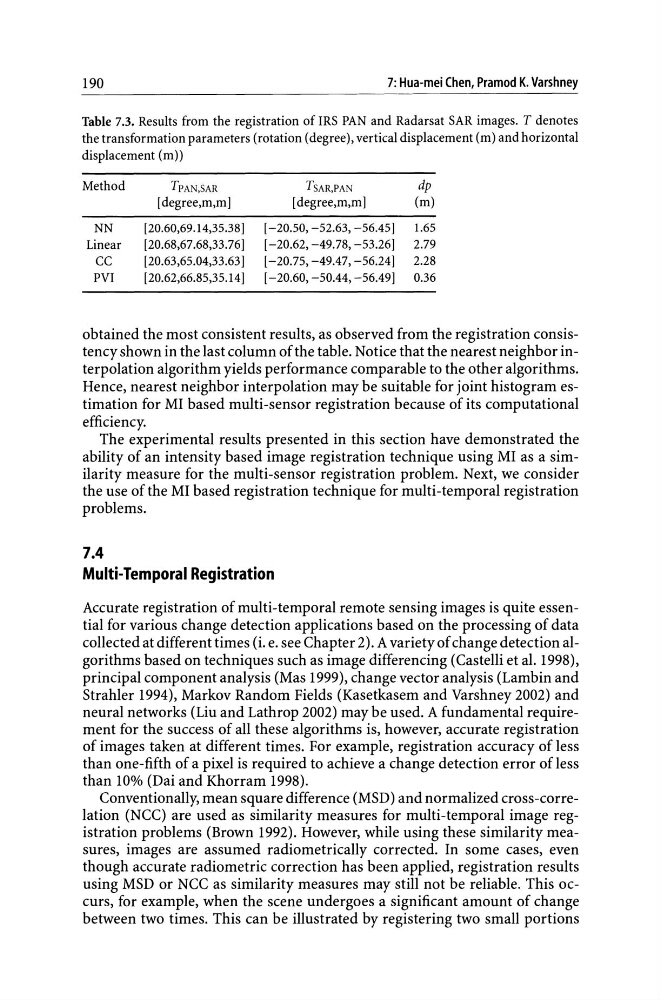
Table 7.3. Results from the registration of IRS PAN and Radarsat SAR images. T denotes
the transformation parameters (rotation (degree), vertical displacement (m) and horizontal
displacement (m))
Method
TpAN.SAR
TSAR.PAN
dp
[ degree,m,m]
[ degree,m,m]
(m)
NN
[ 20.60,69.14,35.38]
[-20.50, -52.63, -56.45]
1.65
Linear
[20.68,67.68,33.76]
[-20.62, -49.78, -53.26] 2.79
CC
[20.63,65.04,33.63]
[-20.75, -49.47, -56.24] 2.28
PVI
[ 20.62,66.85,35.14]
[-20.60, -50.44, -56.49] 0.36
obtained the most consistent results, as observed from the registration consistency shown in the last column of the table. Notice that the nearest neighbor interpolation algorithm yields performance comparable to the other algorithms.
Hence, nearest neighbor interpolation may be suitable for joint histogram estimation for MI based multi-sensor registration because of its computational
efficiency.
The experimental results presented in this section have demonstrated the
ability of an intensity based image registration technique using MI as a similarity measure for the multi-sensor registration problem. Next, we consider
the use of the MI based registration technique for multi-temporal registration
problems.
7.4
Multi-Temporal Registration
Accurate registration of multi-temporal remote sensing images is quite essential for various change detection applications based on the processing of data
collected at differenttimes (i. e. see Chapter 2). A variety of change detection algorithms based on techniques such as image differencing (Castelli et al. 1998),
principal component analysis (Mas 1999), change vector analysis (Lambin and
Strahler 1994), Markov Random Fields (Kasetkasem and Varshney 2002) and
neural networks (Liu and Lathrop 2002) may be used. A fundamental requirement for the success of all these algorithms is, however, accurate registration
of images taken at different times. For example, registration accuracy of less
than one-fifth of a pixel is required to achieve a change detection error ofless
than 10% (Dai and Khorram 1998).
Conventionally, mean square difference (MSD) and normalized cross-correlation (NCC) are used as similarity measures for multi-temporal image registration problems (Brown 1992). However, while using these similarity measures, images are assumed radiometrically corrected. In some cases, even
though accurate radiometric correction has been applied, registration results
using MSD or NCC as similarity measures may still not be reliable. This occurs, for example, when the scene undergoes a significant amount of change
between two times. This can be illustrated by registering two small portions
7: Hua-mei Chen, Pramod K. Varshney
Table 7.3. Results from the registration of IRS PAN and Radarsat SAR images. T denotes
the transformation parameters (rotation (degree), vertical displacement (m) and horizontal
displacement (m))
Method
TpAN.SAR
TSAR.PAN
dp
[ degree,m,m]
[ degree,m,m]
(m)
NN
[ 20.60,69.14,35.38]
[-20.50, -52.63, -56.45]
1.65
Linear
[20.68,67.68,33.76]
[-20.62, -49.78, -53.26] 2.79
CC
[20.63,65.04,33.63]
[-20.75, -49.47, -56.24] 2.28
PVI
[ 20.62,66.85,35.14]
[-20.60, -50.44, -56.49] 0.36
obtained the most consistent results, as observed from the registration consistency shown in the last column of the table. Notice that the nearest neighbor interpolation algorithm yields performance comparable to the other algorithms.
Hence, nearest neighbor interpolation may be suitable for joint histogram estimation for MI based multi-sensor registration because of its computational
efficiency.
The experimental results presented in this section have demonstrated the
ability of an intensity based image registration technique using MI as a similarity measure for the multi-sensor registration problem. Next, we consider
the use of the MI based registration technique for multi-temporal registration
problems.
7.4
Multi-Temporal Registration
Accurate registration of multi-temporal remote sensing images is quite essential for various change detection applications based on the processing of data
collected at differenttimes (i. e. see Chapter 2). A variety of change detection algorithms based on techniques such as image differencing (Castelli et al. 1998),
principal component analysis (Mas 1999), change vector analysis (Lambin and
Strahler 1994), Markov Random Fields (Kasetkasem and Varshney 2002) and
neural networks (Liu and Lathrop 2002) may be used. A fundamental requirement for the success of all these algorithms is, however, accurate registration
of images taken at different times. For example, registration accuracy of less
than one-fifth of a pixel is required to achieve a change detection error ofless
than 10% (Dai and Khorram 1998).
Conventionally, mean square difference (MSD) and normalized cross-correlation (NCC) are used as similarity measures for multi-temporal image registration problems (Brown 1992). However, while using these similarity measures, images are assumed radiometrically corrected. In some cases, even
though accurate radiometric correction has been applied, registration results
using MSD or NCC as similarity measures may still not be reliable. This occurs, for example, when the scene undergoes a significant amount of change
between two times. This can be illustrated by registering two small portions