

Quantitative Measurement of the mRNA Expression of the Tumor-Associated Antigen PRAME mJ
. '100
~
00
1D
Sl
/L!ij
.co
II
2Il
10
o I , I , I , I , I , I I 1 I I ' I I I ' I I I I I I t I I I I
0
2
4
6
8
10
12
14
16
18
2Il
22
24
26
28
II
1 MIlCI: 1.625 mM
2 MgCl: 2.0 mM
J MgCl~ 2.25 mM
- - 4 4 MgCI2 2.5 mM
5 s ow
Cycles
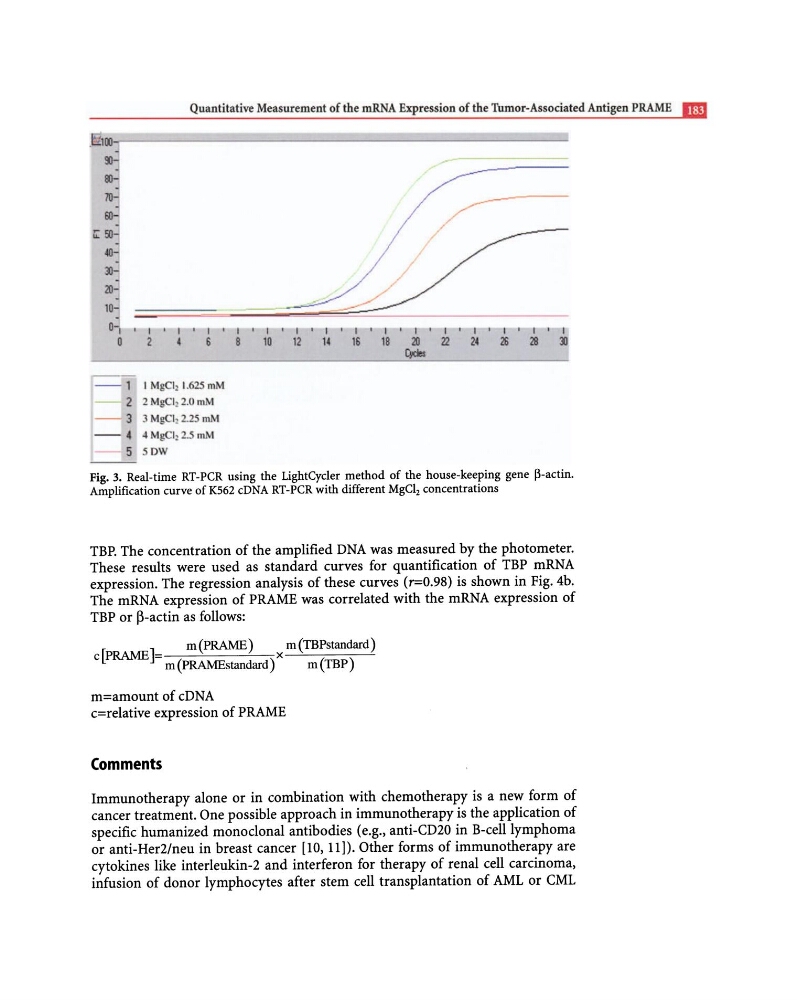
Fig. 3. Real-time RT-PCR using the LightCycler method of the house-keeping gene ~-actin.
Amplification curve of K562 cDNA RT-PCR with different MgC12 concentrations
TBP. The concentration of the amplified DNA was measured by the photometer.
These results were used as standard curves for quantification of TBP mRNA
expression. The regression analysis of these curves (r=0.98) is shown in Fig. 4b.
The mRNA expression of PRAME was correlated with the mRNA expression of
TBP or ~-actin as follows:
[
]
m (PRAME)
m (TBPstandard)
c PRAME =
x --'----;---;----'m (PRAMEstandard)
m (TBP)
m=amount of cDNA
c=relative expression of PRAME
Comments
Immunotherapy alone or in combination with chemotherapy is a new form of
cancer treatment. One possible approach in immunotherapy is the application of
specific humanized monoclonal antibodies (e.g., anti-CD20 in B-celllymphoma
or anti-Her2/neu in breast cancer [10, 11]). Other forms of immunotherapy are
cytokines like interleukin-2 and interferon for therapy of renal cell carcinoma,
infusion of donor lymphocytes after stem cell transplantation of AML or CML
. '100
~
00
1D
Sl
/L!ij
.co
II
2Il
10
o I , I , I , I , I , I I 1 I I ' I I I ' I I I I I I t I I I I
0
2
4
6
8
10
12
14
16
18
2Il
22
24
26
28
II
1 MIlCI: 1.625 mM
2 MgCl: 2.0 mM
J MgCl~ 2.25 mM
- - 4 4 MgCI2 2.5 mM
5 s ow
Cycles
Fig. 3. Real-time RT-PCR using the LightCycler method of the house-keeping gene ~-actin.
Amplification curve of K562 cDNA RT-PCR with different MgC12 concentrations
TBP. The concentration of the amplified DNA was measured by the photometer.
These results were used as standard curves for quantification of TBP mRNA
expression. The regression analysis of these curves (r=0.98) is shown in Fig. 4b.
The mRNA expression of PRAME was correlated with the mRNA expression of
TBP or ~-actin as follows:
[
]
m (PRAME)
m (TBPstandard)
c PRAME =
x --'----;---;----'m (PRAMEstandard)
m (TBP)
m=amount of cDNA
c=relative expression of PRAME
Comments
Immunotherapy alone or in combination with chemotherapy is a new form of
cancer treatment. One possible approach in immunotherapy is the application of
specific humanized monoclonal antibodies (e.g., anti-CD20 in B-celllymphoma
or anti-Her2/neu in breast cancer [10, 11]). Other forms of immunotherapy are
cytokines like interleukin-2 and interferon for therapy of renal cell carcinoma,
infusion of donor lymphocytes after stem cell transplantation of AML or CML