

Two Color Multiplexing and Typing of Human Papillomavirus Types 16,18 and 45 on LightCycler 1m
To test the specificity of the probes, nine HPV types served as controls and were
amplified separately with the same primer set in the presence of the anchor and
the two sensor probes. Each HPV control had a starting concentration of 10 5
copieslll and was amplified in a background of 50ng/ll of human genomic DNA.
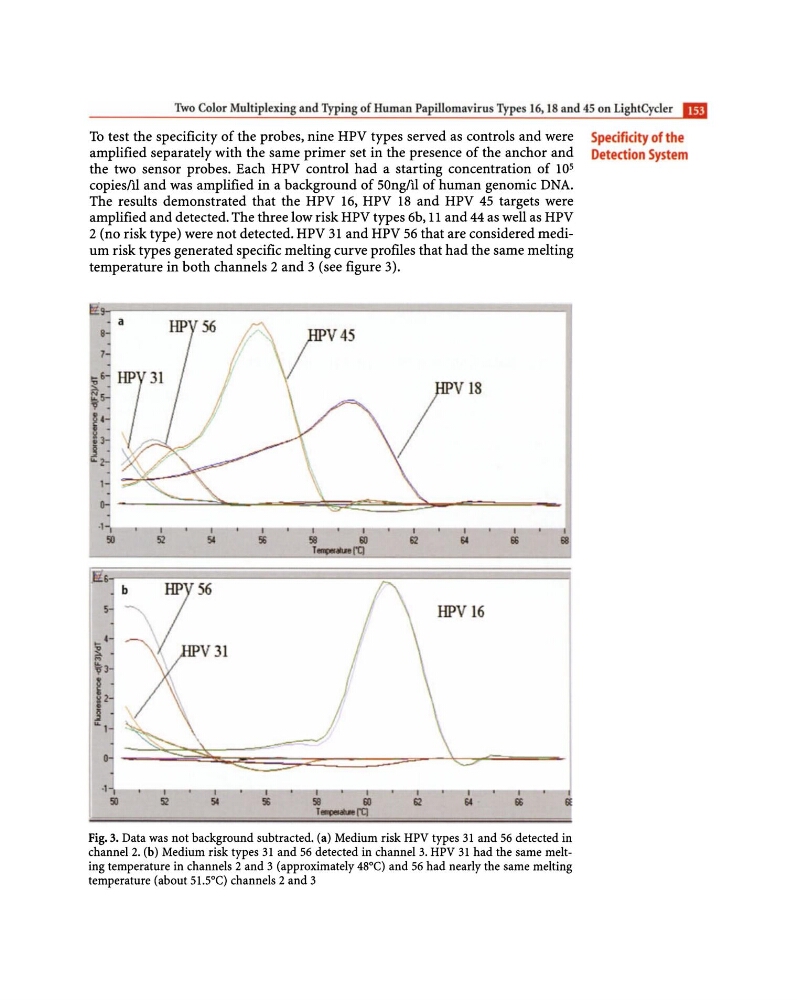
The results demonstrated that the HPV 16, HPV 18 and HPV 45 targets were
amplified and detected. The three low risk HPV types 6b, 11 and 44 as well as HPV
2 (no risk type) were not detected. HPV 31 and HPV 56 that are considered medium risk types generated specific melting curve profiles that had the same melting
temperature in both channels 2 and 3 (see figure 3).
~
8
'0 6
~
1
4 •
• 3.9 .
,~
·1-,
50
.. 4
..,
~
~3.,
e .
¥
j
"",
a
b
,
52
1
52
I
5(
I
5(
T
56
I
56
I
58
T
I
60
I
I
58
60
T _ _ ("CI
I
62
I
62
I
64
HPV 16
I
64
I
66
I
66
I
68
Fig. 3. Data was not background subtracted. (a) Medium risk HPV types 31 and 56 detected in
channel 2. (b) Medium risk types 31 and 56 detected in channel 3. HPV 31 had the same melting temperature in channels 2 and 3 (approximately 48°C) and 56 had nearly the same melting
temperature (about 51.5°C) channels 2 and 3
Spedfi(ity of the
Detection System
To test the specificity of the probes, nine HPV types served as controls and were
amplified separately with the same primer set in the presence of the anchor and
the two sensor probes. Each HPV control had a starting concentration of 10 5
copieslll and was amplified in a background of 50ng/ll of human genomic DNA.
The results demonstrated that the HPV 16, HPV 18 and HPV 45 targets were
amplified and detected. The three low risk HPV types 6b, 11 and 44 as well as HPV
2 (no risk type) were not detected. HPV 31 and HPV 56 that are considered medium risk types generated specific melting curve profiles that had the same melting
temperature in both channels 2 and 3 (see figure 3).
~
8
'0 6
~
1
4 •
• 3.9 .
,~
·1-,
50
.. 4
..,
~
~3.,
e .
¥
j
"",
a
b
,
52
1
52
I
5(
I
5(
T
56
I
56
I
58
T
I
60
I
I
58
60
T _ _ ("CI
I
62
I
62
I
64
HPV 16
I
64
I
66
I
66
I
68
Fig. 3. Data was not background subtracted. (a) Medium risk HPV types 31 and 56 detected in
channel 2. (b) Medium risk types 31 and 56 detected in channel 3. HPV 31 had the same melting temperature in channels 2 and 3 (approximately 48°C) and 56 had nearly the same melting
temperature (about 51.5°C) channels 2 and 3
Spedfi(ity of the
Detection System