

mil Applications in Oncology
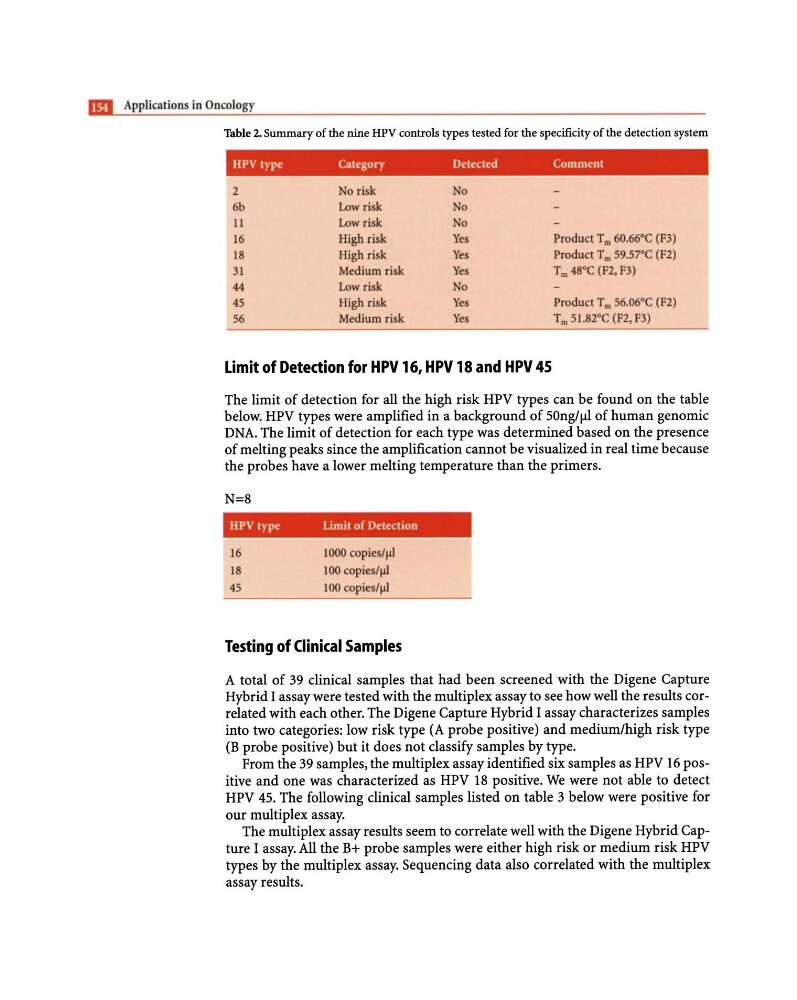
Table 2. Summary of the nine HPV controls types tested for the specificity of the detection system
HPV type
Categor),
Detected
Comment
2
No risk
No
6b
Low risk
No
11
Low risk
No
16
High risk
Yes
Product T m 60.66°C (P3)
L8
High risk
Yes
Product Tm 59.57°C (F2)
31
Medium risk
Yes
Tm 48°C (F2, F3)
44
Low risk
No
45
High risk
Yes
Product T m 56.06°C (F2)
56
Medium risk
Yes
Tm 51.82°C (F2. F3)
Limit of Detection for HPV 16, HPV 18 and HPV 45
The limit of detection for all the high risk HPV types can be found on the table
below. HPV types were amplified in a background of 50ng/J.ll of human genomic
DNA. The limit of detection for each type was determined based on the presence
of melting peaks since the amplification cannot be visualized in real time because
the probes have a lower melting temperature than the primers.
N=8
HPV t)'pe
Limit of Detection
16
18
45
1000 copies/~
100 copieS/ill
100 copies/~
Testing of Clinical Samples
A total of 39 clinical samples that had been screened with the Digene Capture
Hybrid I assay were tested with the multiplex assay to see how well the results correlated with each other. The Digene Capture Hybrid I assay characterizes samples
into two categories: low risk type (A probe positive) and medium/high risk type
(B probe positive) but it does not classify samples by type.
From the 39 samples. the multiplex assay identified six samples as HPV 16 positive and one was characterized as HPV 18 positive. We were not able to detect
HPV 45. The following clinical samples listed on table 3 below were positive for
our multiplex assay.
The multiplex assay results seem to correlate well with the Digene Hybrid Capture I assay. All the B+ probe samples were either high risk or medium risk HPV
types by the multiplex assay. Sequencing data also correlated with the multiplex
assay results.
Table 2. Summary of the nine HPV controls types tested for the specificity of the detection system
HPV type
Categor),
Detected
Comment
2
No risk
No
6b
Low risk
No
11
Low risk
No
16
High risk
Yes
Product T m 60.66°C (P3)
L8
High risk
Yes
Product Tm 59.57°C (F2)
31
Medium risk
Yes
Tm 48°C (F2, F3)
44
Low risk
No
45
High risk
Yes
Product T m 56.06°C (F2)
56
Medium risk
Yes
Tm 51.82°C (F2. F3)
Limit of Detection for HPV 16, HPV 18 and HPV 45
The limit of detection for all the high risk HPV types can be found on the table
below. HPV types were amplified in a background of 50ng/J.ll of human genomic
DNA. The limit of detection for each type was determined based on the presence
of melting peaks since the amplification cannot be visualized in real time because
the probes have a lower melting temperature than the primers.
N=8
HPV t)'pe
Limit of Detection
16
18
45
1000 copies/~
100 copieS/ill
100 copies/~
Testing of Clinical Samples
A total of 39 clinical samples that had been screened with the Digene Capture
Hybrid I assay were tested with the multiplex assay to see how well the results correlated with each other. The Digene Capture Hybrid I assay characterizes samples
into two categories: low risk type (A probe positive) and medium/high risk type
(B probe positive) but it does not classify samples by type.
From the 39 samples. the multiplex assay identified six samples as HPV 16 positive and one was characterized as HPV 18 positive. We were not able to detect
HPV 45. The following clinical samples listed on table 3 below were positive for
our multiplex assay.
The multiplex assay results seem to correlate well with the Digene Hybrid Capture I assay. All the B+ probe samples were either high risk or medium risk HPV
types by the multiplex assay. Sequencing data also correlated with the multiplex
assay results.