

68
3 Numerical Implementation of the Wave Energy Balance Equation
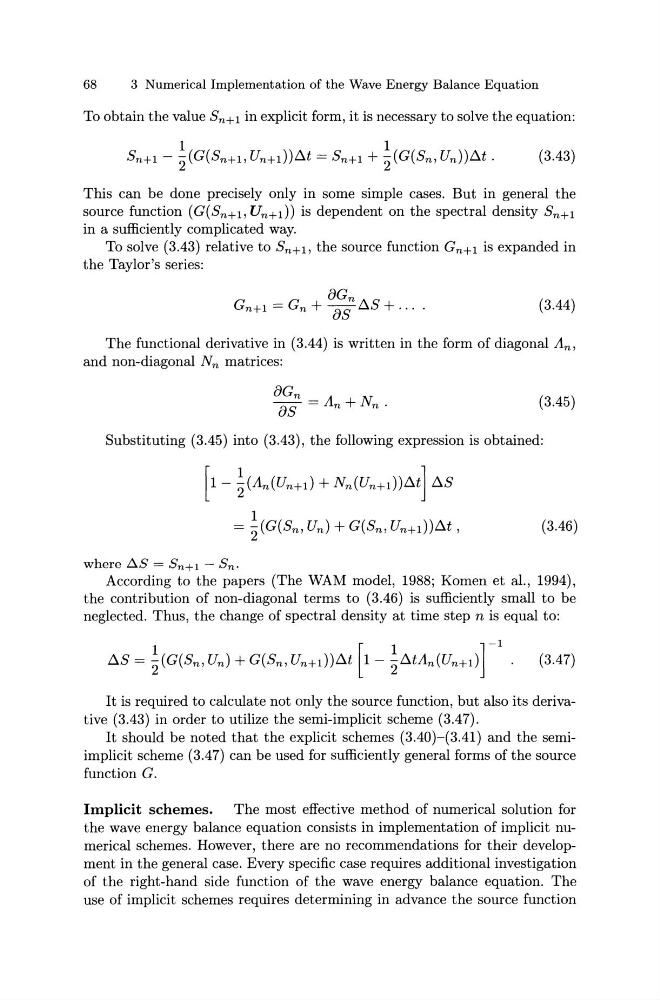
To obtain the value Sn+l in explicit form, it is necessary to solve the equation:
(3.43)
This can be done precisely only in some simple cases. But in general the
source function (G(Sn+l, Un+ 1 )) is dependent on the spectral density Sn+l
in a sufficiently complicated way.
To solve (3.43) relative to Sn+l, the source function Gn+l is expanded in
the Taylor's series:
(3.44)
The functional derivative in (3.44) is written in the form of diagonal An,
and non-diagonal Nn matrices:
8Gn
f)S =An +Nn.
(3.45)
Substituting (3.45) into (3.43), the following expression is obtained:
[1- ~(An(Un+I) + Nn(Un+I))~t] ~S
1
= 2(G(Sn, Un) + G(Sn, Un+I))~t,
where AS= Sn+l- Sn.
(3.46)
According to the papers (The WAM model, 1988; Komen et al., 1994),
the contribution of non-diagonal terms to (3.46) is sufficiently small to be
neglected. Thus, the change of spectral density at time step n is equal to:
(3.47)
It is required to calculate not only the source function, but also its derivative (3.43) in order to utilize the semi-implicit scheme (3.47).
It should be noted that the explicit schemes (3.40)-(3.41) and the semiimplicit scheme (3.47) can be used for sufficiently general forms of the source
function G.
Implicit schemes. The most effective method of numerical solution for
the wave energy balance equation consists in implementation of implicit numerical schemes. However, there are no recommendations for their development in the general case. Every specific case requires additional investigation
of the right-hand side function of the wave energy balance equation. The
use of implicit schemes requires determining in advance the source function
3 Numerical Implementation of the Wave Energy Balance Equation
To obtain the value Sn+l in explicit form, it is necessary to solve the equation:
(3.43)
This can be done precisely only in some simple cases. But in general the
source function (G(Sn+l, Un+ 1 )) is dependent on the spectral density Sn+l
in a sufficiently complicated way.
To solve (3.43) relative to Sn+l, the source function Gn+l is expanded in
the Taylor's series:
(3.44)
The functional derivative in (3.44) is written in the form of diagonal An,
and non-diagonal Nn matrices:
8Gn
f)S =An +Nn.
(3.45)
Substituting (3.45) into (3.43), the following expression is obtained:
[1- ~(An(Un+I) + Nn(Un+I))~t] ~S
1
= 2(G(Sn, Un) + G(Sn, Un+I))~t,
where AS= Sn+l- Sn.
(3.46)
According to the papers (The WAM model, 1988; Komen et al., 1994),
the contribution of non-diagonal terms to (3.46) is sufficiently small to be
neglected. Thus, the change of spectral density at time step n is equal to:
(3.47)
It is required to calculate not only the source function, but also its derivative (3.43) in order to utilize the semi-implicit scheme (3.47).
It should be noted that the explicit schemes (3.40)-(3.41) and the semiimplicit scheme (3.47) can be used for sufficiently general forms of the source
function G.
Implicit schemes. The most effective method of numerical solution for
the wave energy balance equation consists in implementation of implicit numerical schemes. However, there are no recommendations for their development in the general case. Every specific case requires additional investigation
of the right-hand side function of the wave energy balance equation. The
use of implicit schemes requires determining in advance the source function