

3.7 Numerical Integration of the Source Function
67
In this respect, the most optimal numerical scheme of the wave energy
balance equation consists in obtaining the most accurate numerical solution
in every synoptic term (i.e. at the time moment corresponding to the outcome of the wind wave result), using the least number of iterations. The
"ideal" numerical scheme should produce the most accurate calculated value
in every corresponding synoptical term in one numerical iteration. However,
this is hardly possible due to numerical instability or insufficient accuracy of
the calculations. Probably, it is necessary to find some compromise between
the time step of the initial information input, and the number of numerical
iterations and numerical errors.
Numerical schemes for integration of the source function of the
wave energy balance equation. Different numerical schemes used for
integrating the source function of the wave energy balance equation are considered, to investigate their accuracy and effectiveness. The following schemes
can be identified as explicit, semi-implicit and implicit.
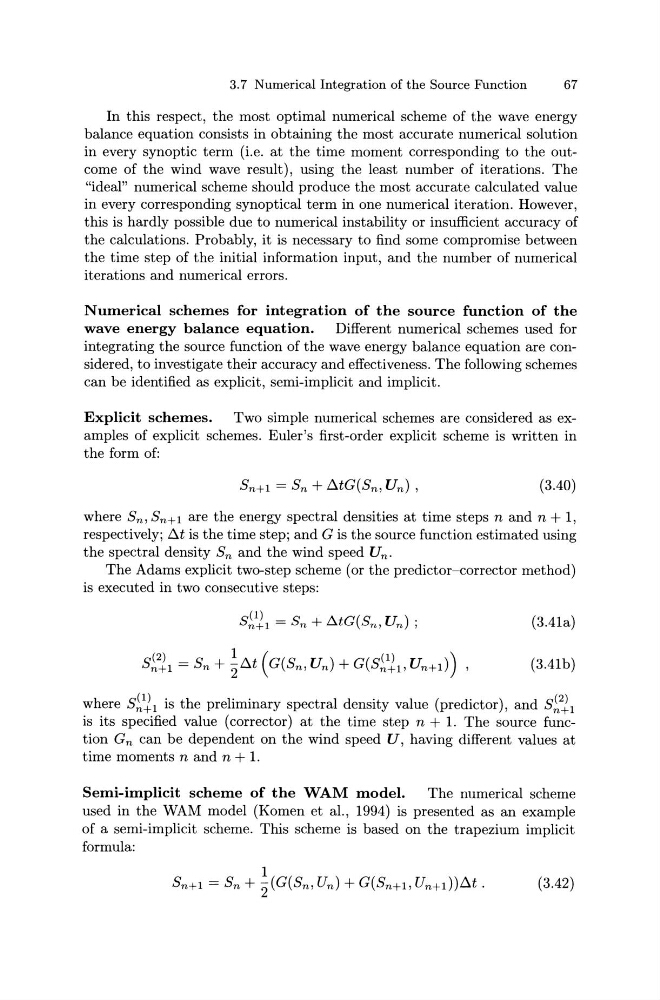
Explicit schemes. Two simple numerical schemes are considered as examples of explicit schemes. Euler's first-order explicit scheme is written in
the form of:
(3.40)
where Sn, Sn+l are the energy spectral densities at time steps nand n + 1,
respectively; tl.t is the time step; and G is the source function estimated using
the spectral density Sn and the wind speed Un.
The Adams explicit two-step scheme (or the predictor-corrector method)
is executed in two consecutive steps:
(3.41a)
(3.41b)
where s~~l is the preliminary spectral density value (predictor), and s~~l
is its specified value (corrector) at the time step n + 1. The source function Gn can be dependent on the wind speed U, having different values at
time moments n and n + 1.
Semi-implicit scheme of the WAM model.
The numerical scheme
used in the WAM model (Komen et al., 1994) is presented as an example
of a semi-implicit scheme. This scheme is based on the trapezium implicit
formula:
(3.42)
67
In this respect, the most optimal numerical scheme of the wave energy
balance equation consists in obtaining the most accurate numerical solution
in every synoptic term (i.e. at the time moment corresponding to the outcome of the wind wave result), using the least number of iterations. The
"ideal" numerical scheme should produce the most accurate calculated value
in every corresponding synoptical term in one numerical iteration. However,
this is hardly possible due to numerical instability or insufficient accuracy of
the calculations. Probably, it is necessary to find some compromise between
the time step of the initial information input, and the number of numerical
iterations and numerical errors.
Numerical schemes for integration of the source function of the
wave energy balance equation. Different numerical schemes used for
integrating the source function of the wave energy balance equation are considered, to investigate their accuracy and effectiveness. The following schemes
can be identified as explicit, semi-implicit and implicit.
Explicit schemes. Two simple numerical schemes are considered as examples of explicit schemes. Euler's first-order explicit scheme is written in
the form of:
(3.40)
where Sn, Sn+l are the energy spectral densities at time steps nand n + 1,
respectively; tl.t is the time step; and G is the source function estimated using
the spectral density Sn and the wind speed Un.
The Adams explicit two-step scheme (or the predictor-corrector method)
is executed in two consecutive steps:
(3.41a)
(3.41b)
where s~~l is the preliminary spectral density value (predictor), and s~~l
is its specified value (corrector) at the time step n + 1. The source function Gn can be dependent on the wind speed U, having different values at
time moments n and n + 1.
Semi-implicit scheme of the WAM model.
The numerical scheme
used in the WAM model (Komen et al., 1994) is presented as an example
of a semi-implicit scheme. This scheme is based on the trapezium implicit
formula:
(3.42)