

7.5 Surface Gravity Wave Interaction with Elastic Ice Floes
343
0.4
0.2
IRI
0
IRI
0.2
0.1
a)
UA.
2
4
6
~
+-J......-,h~.L..r-~..l.r-+-+-+-,.L-,.~, U A.
0
2
4
6
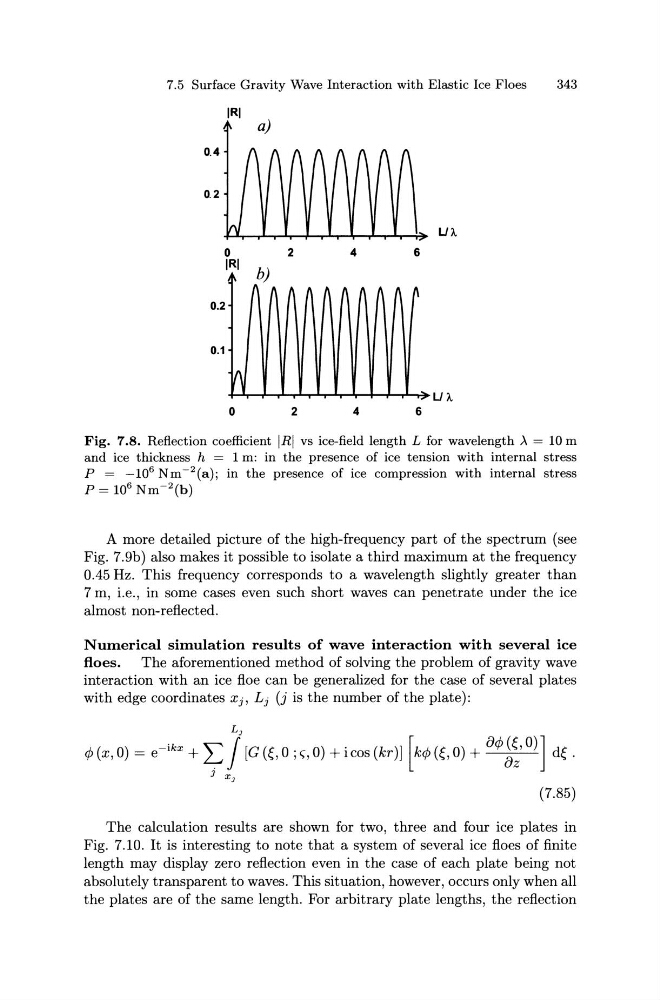
Fig. 7.8. Reflection coefficient IRI vs ice-field length L for wavelength A = 10m
and ice thickness h = 1 m: in the presence of ice tension with internal stress
P = -10 6 Nm- 2 (a); in the presence of ice compression with internal stress
P = 10 6 Nm- 2 (b)
A more detailed picture of the high-frequency part of the spectrum (see
Fig. 7.9b) also makes it possible to isolate a third maximum at the frequency
0.45 Hz. This frequency corresponds to a wavelength slightly greater than
7 m, i.e., in some cases even such short waves can penetrate under the ice
almost non-reflected.
Numerical simulation results of wave interaction with several ice
floes. The aforementioned method of solving the problem of gravity wave
interaction with an ice floe can be generalized for the case of several plates
with edge coordinates Xj, Lj (j is the number of the plate):
LJ
(x,O) = e-ikx + ~ J [G((,O ;<;,0) +icos(kr)] [k¢(~,0) + B~:,O)] d~.
J XJ
(7.85)
The calculation results are shown for two, three and four ice plates in
Fig. 7.10. It is interesting to note that a system of several ice floes of finite
length may display zero reflection even in the case of each plate being not
absolutely transparent to waves. This situation, however, occurs only when all
the plates are of the same length. For arbitrary plate lengths, the reflection
343
0.4
0.2
IRI
0
IRI
0.2
0.1
a)
UA.
2
4
6
~
+-J......-,h~.L..r-~..l.r-+-+-+-,.L-,.~, U A.
0
2
4
6
Fig. 7.8. Reflection coefficient IRI vs ice-field length L for wavelength A = 10m
and ice thickness h = 1 m: in the presence of ice tension with internal stress
P = -10 6 Nm- 2 (a); in the presence of ice compression with internal stress
P = 10 6 Nm- 2 (b)
A more detailed picture of the high-frequency part of the spectrum (see
Fig. 7.9b) also makes it possible to isolate a third maximum at the frequency
0.45 Hz. This frequency corresponds to a wavelength slightly greater than
7 m, i.e., in some cases even such short waves can penetrate under the ice
almost non-reflected.
Numerical simulation results of wave interaction with several ice
floes. The aforementioned method of solving the problem of gravity wave
interaction with an ice floe can be generalized for the case of several plates
with edge coordinates Xj, Lj (j is the number of the plate):
LJ
J XJ
(7.85)
The calculation results are shown for two, three and four ice plates in
Fig. 7.10. It is interesting to note that a system of several ice floes of finite
length may display zero reflection even in the case of each plate being not
absolutely transparent to waves. This situation, however, occurs only when all
the plates are of the same length. For arbitrary plate lengths, the reflection