

342
7 Wave Transformation in Ice-Covered Water
A 't A
4
2
1
2
... ····~ 3
........ ·~ .............. -
.... -:_:~ ............
.............
~:.:·"
0 +---.----.--.----.--~h lA
0.04
0.08
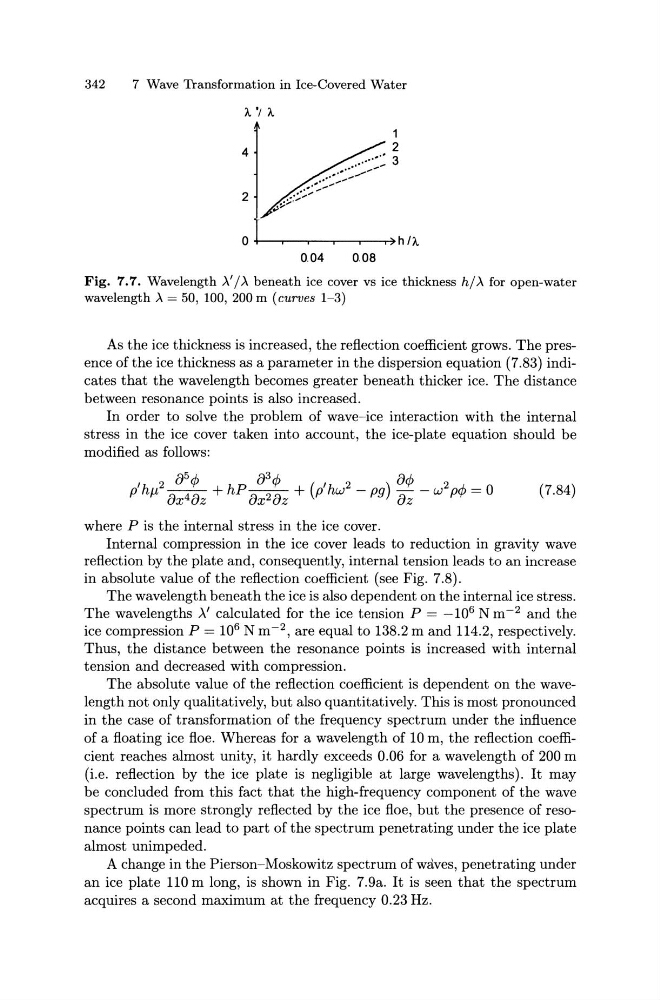
Fig. 1.1. Wavelength >..' / >.. beneath ice cover vs ice thickness h/ >.. for open-water
wavelength>..= 50, 100, 200m (curves 1-3)
As the ice thickness is increased, the reflection coefficient grows. The presence of the ice thickness as a parameter in the dispersion equation (7.83) indicates that the wavelength becomes greater beneath thicker ice. The distance
between resonance points is also increased.
In order to solve the problem of wave-ice interaction with the internal
stress in the ice cover taken into account, the ice-plate equation should be
modified as follows:
I
2 8 5 ¢
8 3 ¢
( I 2
) 8¢
2
p hp, 8x48z + hP 8x28z + p hw - pg 8z - w p¢ = 0
(7.84)
where Pis the internal stress in the ice cover.
Internal compression in the ice cover leads to reduction in gravity wave
reflection by the plate and, consequently, internal tension leads to an increase
in absolute value of the reflection coefficient (see Fig. 7.8).
The wavelength beneath the ice is also dependent on the internal ice stress.
The wavelengths >. 1 calculated for the ice tension P = -10 6 N m- 2 and the
ice compression P = 10 6 N m - 2 , are equal to 138.2 m and 114.2, respectively.
Thus, the distance between the resonance points is increased with internal
tension and decreased with compression.
The absolute value of the reflection coefficient is dependent on the wavelength not only qualitatively, but also quantitatively. This is most pronounced
in the case of transformation of the frequency spectrum under the influence
of a floating ice floe. Whereas for a wavelength of 10m, the reflection coefficient reaches almost unity, it hardly exceeds 0.06 for a wavelength of 200m
(i.e. reflection by the ice plate is negligible at large wavelengths). It may
be concluded from this fact that the high-frequency component of the wave
spectrum is more strongly reflected by the ice floe, but the presence of resonance points can lead to part of the spectrum penetrating under the ice plate
almost unimpeded.
A change in the Pierson-Moskowitz spectrum of waves, penetrating under
an ice plate 110m long, is shown in Fig. 7.9a. It is seen that the spectrum
acquires a second maximum at the frequency 0.23 Hz.
7 Wave Transformation in Ice-Covered Water
A 't A
4
2
1
2
... ····~ 3
........ ·~ .............. -
.... -:_:~ ............
.............
~:.:·"
0 +---.----.--.----.--~h lA
0.04
0.08
Fig. 1.1. Wavelength >..' / >.. beneath ice cover vs ice thickness h/ >.. for open-water
wavelength>..= 50, 100, 200m (curves 1-3)
As the ice thickness is increased, the reflection coefficient grows. The presence of the ice thickness as a parameter in the dispersion equation (7.83) indicates that the wavelength becomes greater beneath thicker ice. The distance
between resonance points is also increased.
In order to solve the problem of wave-ice interaction with the internal
stress in the ice cover taken into account, the ice-plate equation should be
modified as follows:
I
2 8 5 ¢
8 3 ¢
( I 2
) 8¢
2
p hp, 8x48z + hP 8x28z + p hw - pg 8z - w p¢ = 0
(7.84)
where Pis the internal stress in the ice cover.
Internal compression in the ice cover leads to reduction in gravity wave
reflection by the plate and, consequently, internal tension leads to an increase
in absolute value of the reflection coefficient (see Fig. 7.8).
The wavelength beneath the ice is also dependent on the internal ice stress.
The wavelengths >. 1 calculated for the ice tension P = -10 6 N m- 2 and the
ice compression P = 10 6 N m - 2 , are equal to 138.2 m and 114.2, respectively.
Thus, the distance between the resonance points is increased with internal
tension and decreased with compression.
The absolute value of the reflection coefficient is dependent on the wavelength not only qualitatively, but also quantitatively. This is most pronounced
in the case of transformation of the frequency spectrum under the influence
of a floating ice floe. Whereas for a wavelength of 10m, the reflection coefficient reaches almost unity, it hardly exceeds 0.06 for a wavelength of 200m
(i.e. reflection by the ice plate is negligible at large wavelengths). It may
be concluded from this fact that the high-frequency component of the wave
spectrum is more strongly reflected by the ice floe, but the presence of resonance points can lead to part of the spectrum penetrating under the ice plate
almost unimpeded.
A change in the Pierson-Moskowitz spectrum of waves, penetrating under
an ice plate 110m long, is shown in Fig. 7.9a. It is seen that the spectrum
acquires a second maximum at the frequency 0.23 Hz.