

344
7 Wave Transformation in Ice-Covered Water
S( ffi), sm 2 s
80
40
0.4
0.45
0.5 ffi, s- 1
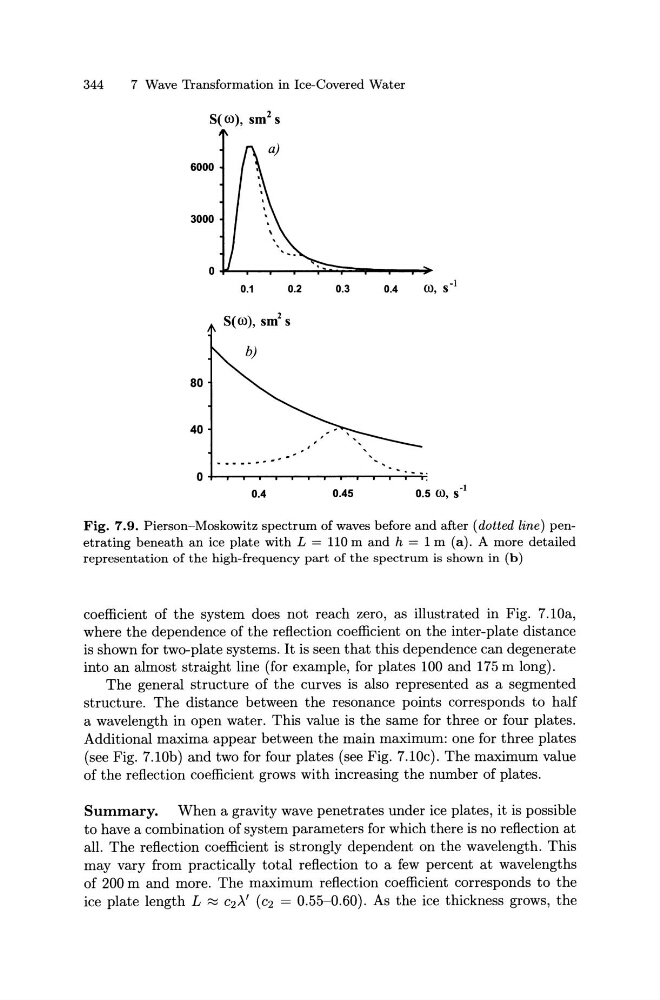
Fig. 7.9. Pierson-Moskowitz spectrum of waves before and after (dotted line) penetrating beneath an ice plate with L = 110m and h = 1m (a). A more detailed
representation of the high-frequency part of the spectrum is shown in (b)
coefficient of the system does not reach zero, as illustrated in Fig. 7.10a,
where the dependence of the reflection coefficient on the inter-plate distance
is shown for two-plate systems. It is seen that this dependence can degenerate
into an almost straight line (for example, for plates 100 and 175m long).
The general structure of the curves is also represented as a segmented
structure. The distance between the resonance points corresponds to half
a wavelength in open water. This value is the same for three or four plates.
Additional maxima appear between the main maximum: one for three plates
(see Fig. 7.10b) and two for four plates (see Fig. 7.10c). The maximum value
of the reflection coefficient grows with increasing the number of plates.
Summary. When a gravity wave penetrates under ice plates, it is possible
to have a combination of system parameters for which there is no reflection at
all. The reflection coefficient is strongly dependent on the wavelength. This
may vary from practically total reflection to a few percent at wavelengths
of 200m and more. The maximum reflection coefficient corresponds to the
ice plate length L ~ c2 >..' (c2 = 0.55-0.60). As the ice thickness grows, the
7 Wave Transformation in Ice-Covered Water
S( ffi), sm 2 s
80
40
0.4
0.45
0.5 ffi, s- 1
Fig. 7.9. Pierson-Moskowitz spectrum of waves before and after (dotted line) penetrating beneath an ice plate with L = 110m and h = 1m (a). A more detailed
representation of the high-frequency part of the spectrum is shown in (b)
coefficient of the system does not reach zero, as illustrated in Fig. 7.10a,
where the dependence of the reflection coefficient on the inter-plate distance
is shown for two-plate systems. It is seen that this dependence can degenerate
into an almost straight line (for example, for plates 100 and 175m long).
The general structure of the curves is also represented as a segmented
structure. The distance between the resonance points corresponds to half
a wavelength in open water. This value is the same for three or four plates.
Additional maxima appear between the main maximum: one for three plates
(see Fig. 7.10b) and two for four plates (see Fig. 7.10c). The maximum value
of the reflection coefficient grows with increasing the number of plates.
Summary. When a gravity wave penetrates under ice plates, it is possible
to have a combination of system parameters for which there is no reflection at
all. The reflection coefficient is strongly dependent on the wavelength. This
may vary from practically total reflection to a few percent at wavelengths
of 200m and more. The maximum reflection coefficient corresponds to the
ice plate length L ~ c2 >..' (c2 = 0.55-0.60). As the ice thickness grows, the