

340
7 Wave Transformation in Ice-Covered Water
Thus, in order to solve the boundary problem for the Laplace equation
(7.72)-(7.76), simultaneous solution of the system (7.80), (7.82) is required.
To test the numerical algorithm, the calculation results are compared with the
analytical solution. The deviation of the numerical results from the analytical
ones obtained by solving the system (7.78) does not exceed 10- 6 .
Numerical simulation results of the interaction between waves and
ice floe.
In calculations the following values of the physical parameters
are used: the Young modulus E = 6 x 10 9 Pa, the Poisson ratio for the ice
n = 0.3, sea-water and ice densities of 1025 and 922.5 kg m - 3 , respectively.
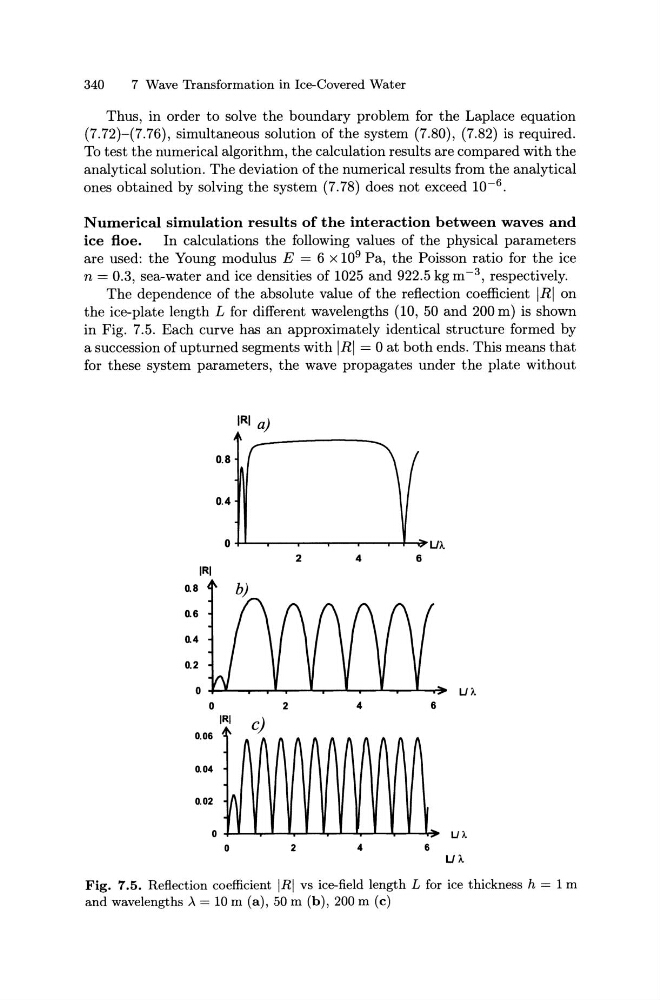
The dependence of the absolute value of the reflection coefficient IRI on
the ice-plate length L for different wavelengths (10, 50 and 200m) is shown
in Fig. 7.5. Each curve has an approximately identical structure formed by
a succession of upturned segments with I Rl = 0 at both ends. This means that
for these system parameters, the wave propagates under the plate without
IRI a)
0.8
0.4
2
4
6
IRI
0.8
0.6
0.4
0.2
0
UJ.
0
2
4
6
IRI
0.06
c)
A A n A n A A n A n A
0.04
UJ..
0
2
4
6
UA.
Fig. 7.5. Reflection coefficient IRI vs ice-field length L for ice thickness h = 1m
and wavelengths>.= 10m (a), 50 m (b), 200m (c)
7 Wave Transformation in Ice-Covered Water
Thus, in order to solve the boundary problem for the Laplace equation
(7.72)-(7.76), simultaneous solution of the system (7.80), (7.82) is required.
To test the numerical algorithm, the calculation results are compared with the
analytical solution. The deviation of the numerical results from the analytical
ones obtained by solving the system (7.78) does not exceed 10- 6 .
Numerical simulation results of the interaction between waves and
ice floe.
In calculations the following values of the physical parameters
are used: the Young modulus E = 6 x 10 9 Pa, the Poisson ratio for the ice
n = 0.3, sea-water and ice densities of 1025 and 922.5 kg m - 3 , respectively.
The dependence of the absolute value of the reflection coefficient IRI on
the ice-plate length L for different wavelengths (10, 50 and 200m) is shown
in Fig. 7.5. Each curve has an approximately identical structure formed by
a succession of upturned segments with I Rl = 0 at both ends. This means that
for these system parameters, the wave propagates under the plate without
IRI a)
0.8
0.4
2
4
6
IRI
0.8
0.6
0.4
0.2
0
UJ.
0
2
4
6
IRI
0.06
c)
A A n A n A A n A n A
0.04
UJ..
0
2
4
6
UA.
Fig. 7.5. Reflection coefficient IRI vs ice-field length L for ice thickness h = 1m
and wavelengths>.= 10m (a), 50 m (b), 200m (c)