

7.5 Surface Gravity Wave Interaction with Elastic Ice Floes
339
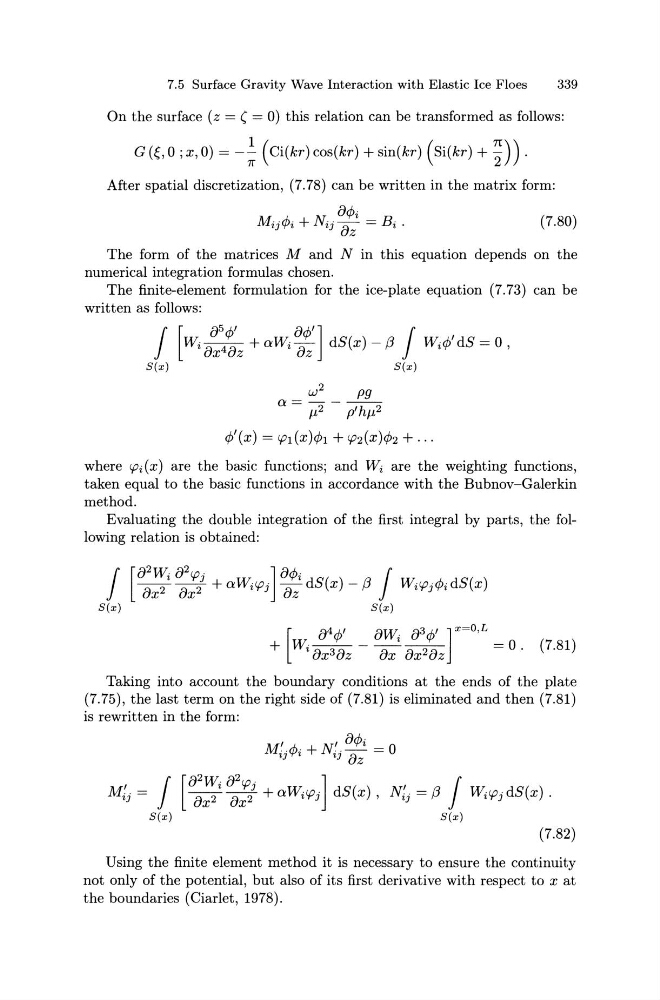
On the surface (z = ( = 0) this relation can be transformed as follows:
G (~, 0; x, 0) = -~ ( Ci(kr) cos(kr) + sin(kr) ( Si(kr) + ~)).
After spatial discretization, (7.78) can be written in the matrix form:
(7.80)
The form of the matrices M and N in this equation depends on the
numerical integration formulas chosen.
The finite-element formulation for the ice-plate equation (7.73) can be
written as follows:
I [ 8
5
¢/
8¢/]
I I
Wi 8 x 48 z + o:Wiaz dS(x)- {3 Wi¢ dS = o,
S(x)
S(x)
w2
pg
o : = - - - -
f-l2
p'hf-l2
¢'(x) = 'Pl(x)¢1 +
taken equal to the basic functions in accordance with the Bubnov-Galerkin
method.
Evaluating the double integration of the first integral by parts, the following relation is obtained:
(7.81)
Taking into account the boundary conditions at the ends of the plate
(7.75), the last term on the right side of (7.81) is eliminated and then (7.81)
is rewritten in the form:
M{j =I
N{i = {3 I Wi
S(x)
(7.82)
Using the finite element method it is necessary to ensure the continuity
not only of the potential, but also of its first derivative with respect to x at
the boundaries (Ciarlet, 1978).
339
On the surface (z = ( = 0) this relation can be transformed as follows:
G (~, 0; x, 0) = -~ ( Ci(kr) cos(kr) + sin(kr) ( Si(kr) + ~)).
After spatial discretization, (7.78) can be written in the matrix form:
(7.80)
The form of the matrices M and N in this equation depends on the
numerical integration formulas chosen.
The finite-element formulation for the ice-plate equation (7.73) can be
written as follows:
I [ 8
5
¢/
8¢/]
I I
Wi 8 x 48 z + o:Wiaz dS(x)- {3 Wi¢ dS = o,
S(x)
S(x)
w2
pg
o : = - - - -
f-l2
p'hf-l2
¢'(x) = 'Pl(x)¢1 +
taken equal to the basic functions in accordance with the Bubnov-Galerkin
method.
Evaluating the double integration of the first integral by parts, the following relation is obtained:
(7.81)
Taking into account the boundary conditions at the ends of the plate
(7.75), the last term on the right side of (7.81) is eliminated and then (7.81)
is rewritten in the form:
M{j =I
N{i = {3 I Wi
S(x)
(7.82)
Using the finite element method it is necessary to ensure the continuity
not only of the potential, but also of its first derivative with respect to x at
the boundaries (Ciarlet, 1978).