

338
7 Wave Transformation in Ice-Covered Water
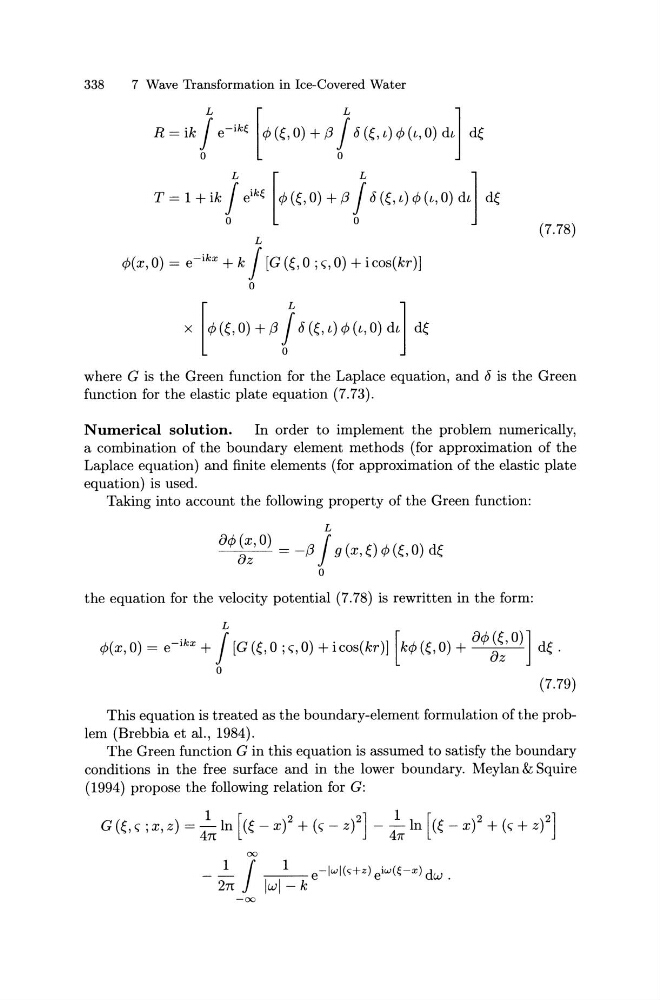
R ~ ik l e-"' [• ((, o) + !3! 5 (<. <) ¢ (,,o) d' l d(
T ~ 1+ ik l e"' [¢ ((, 0) + !3!8 ((, ') ¢(,, 0) d' l d(
L
¢(x, 0) = e-ikx + k J [G (~, 0 ; <;, 0) + i cos(kr)]
0
(7. 78)
where G is the Green function for the Laplace equation, and 8 is the Green
function for the elastic plate equation (7.73).
Numerical solution.
In order to implement the problem numerically,
a combination of the boundary element methods (for approximation of the
Laplace equation) and finite elements (for approximation of the elastic plate
equation) is used.
Taking into account the following property of the Green function:
L
8 ¢ ~:' O) = -{3 J g (x, ~) 4> (~, 0) d~
0
the equation for the velocity potential (7.78) is rewritten in the form:
L
¢(x,O) = e-ikx + J [G(~,O ;<;,0) +icos(kr)] [k¢(~,0) + 8 ¢~!,0)] d~.
0
(7.79)
This equation is treated as the boundary-element formulation of the problem (Brebbia et al., 1984).
The Green function G in this equation is assumed to satisfy the boundary
conditions in the free surface and in the lower boundary. Meylan & Squire
(1994) propose the following relation for G:
1
[
2
2] 1 [
2
2]
G(~,<;;x,z)= 4 ?tln (~-x) +(<;-z) - 4 7rln (~-x) +(<;+z)
()()
_ ~ J __ 1_e-lwl(<;+z)eiw(~-xldw.
2?t
lwl- k
-oo
7 Wave Transformation in Ice-Covered Water
R ~ ik l e-"' [• ((, o) + !3! 5 (<. <) ¢ (,,o) d' l d(
T ~ 1+ ik l e"' [¢ ((, 0) + !3!8 ((, ') ¢(,, 0) d' l d(
L
¢(x, 0) = e-ikx + k J [G (~, 0 ; <;, 0) + i cos(kr)]
0
(7. 78)
where G is the Green function for the Laplace equation, and 8 is the Green
function for the elastic plate equation (7.73).
Numerical solution.
In order to implement the problem numerically,
a combination of the boundary element methods (for approximation of the
Laplace equation) and finite elements (for approximation of the elastic plate
equation) is used.
Taking into account the following property of the Green function:
L
8 ¢ ~:' O) = -{3 J g (x, ~) 4> (~, 0) d~
0
the equation for the velocity potential (7.78) is rewritten in the form:
L
¢(x,O) = e-ikx + J [G(~,O ;<;,0) +icos(kr)] [k¢(~,0) + 8 ¢~!,0)] d~.
0
(7.79)
This equation is treated as the boundary-element formulation of the problem (Brebbia et al., 1984).
The Green function G in this equation is assumed to satisfy the boundary
conditions in the free surface and in the lower boundary. Meylan & Squire
(1994) propose the following relation for G:
1
[
2
2] 1 [
2
2]
G(~,<;;x,z)= 4 ?tln (~-x) +(<;-z) - 4 7rln (~-x) +(<;+z)
()()
_ ~ J __ 1_e-lwl(<;+z)eiw(~-xldw.
2?t
lwl- k
-oo