

7.5 Surface Gravity Wave Interaction with Elastic Ice Floes
337
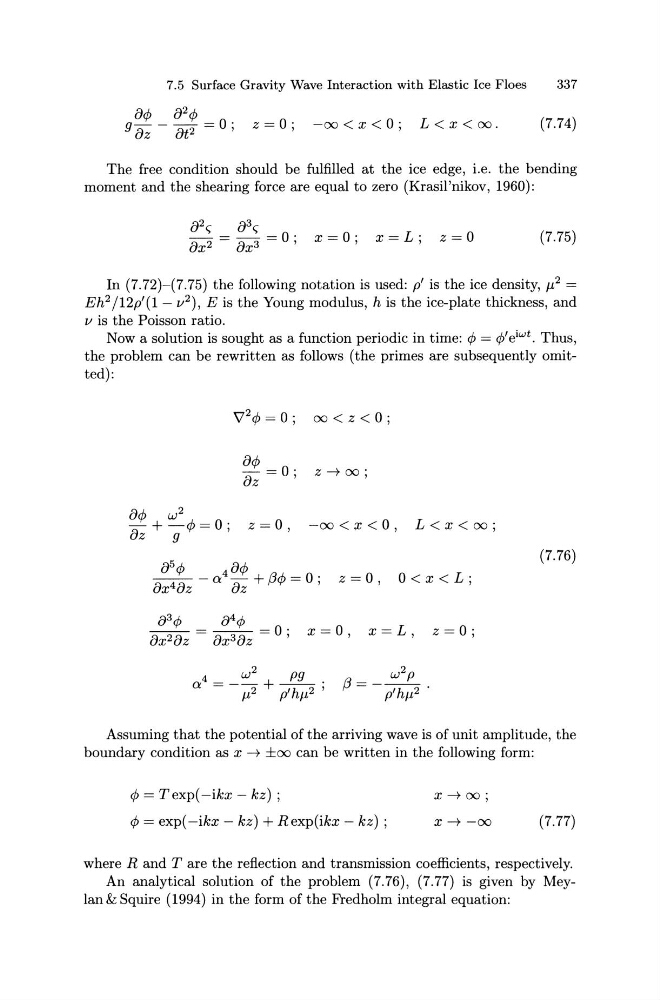
8 g 8z - 8t2 = 0 ; z = 0 ; -oo < X < 0 ; L < X < 00.
(7.74)
The free condition should be fulfilled at the ice edge, i.e. the bending
moment and the shearing force are equal to zero (Krasil'nikov, 1960):
(7.75)
In (7.72)-(7.75) the following notation is used: p' is the ice density, JL 2 =
Eh 2 /12p'(1- v 2 ), E is the Young modulus, his the ice-plate thickness, and
v is the Poisson ratio.
Now a solution is sought as a function periodic in time: the problem can be rewritten as follows (the primes are subsequently omitted):
oo
8z
'
z--+oo;
8 2 8z
g
85¢
48¢
8x48z - a 8z + /3 (7.76)
X= 0, x=L, z = 0;
Assuming that the potential of the arriving wave is of unit amplitude, the
boundary condition as x --+ ±oo can be written in the following form:
x--+oo;
x--+-oo
(7.77)
where R and T are the reflection and transmission coefficients, respectively.
An analytical solution of the problem (7. 76), (7. 77) is given by Meylan & Squire (1994) in the form of the Fredholm integral equation:
337
8 g 8z - 8t2 = 0 ; z = 0 ; -oo < X < 0 ; L < X < 00.
(7.74)
The free condition should be fulfilled at the ice edge, i.e. the bending
moment and the shearing force are equal to zero (Krasil'nikov, 1960):
(7.75)
In (7.72)-(7.75) the following notation is used: p' is the ice density, JL 2 =
Eh 2 /12p'(1- v 2 ), E is the Young modulus, his the ice-plate thickness, and
v is the Poisson ratio.
Now a solution is sought as a function periodic in time: the problem can be rewritten as follows (the primes are subsequently omitted):
oo
8z
'
z--+oo;
8 2 8z
g
85¢
48¢
8x48z - a 8z + /3 (7.76)
X= 0, x=L, z = 0;
Assuming that the potential of the arriving wave is of unit amplitude, the
boundary condition as x --+ ±oo can be written in the following form:
x--+oo;
x--+-oo
(7.77)
where R and T are the reflection and transmission coefficients, respectively.
An analytical solution of the problem (7. 76), (7. 77) is given by Meylan & Squire (1994) in the form of the Fredholm integral equation: