

326
7 Wave Transformation in Ice-Covered Water
where the symbol 6 means the functional derivative and the Hamiltonian 1-l
can be written as a function of the variables: TJ (x, t) and x (x, t).
This statement can be checked using the Fourier space with the help of
the expansion of the unknown function into a series by the power of the
non-linearity parameter c.
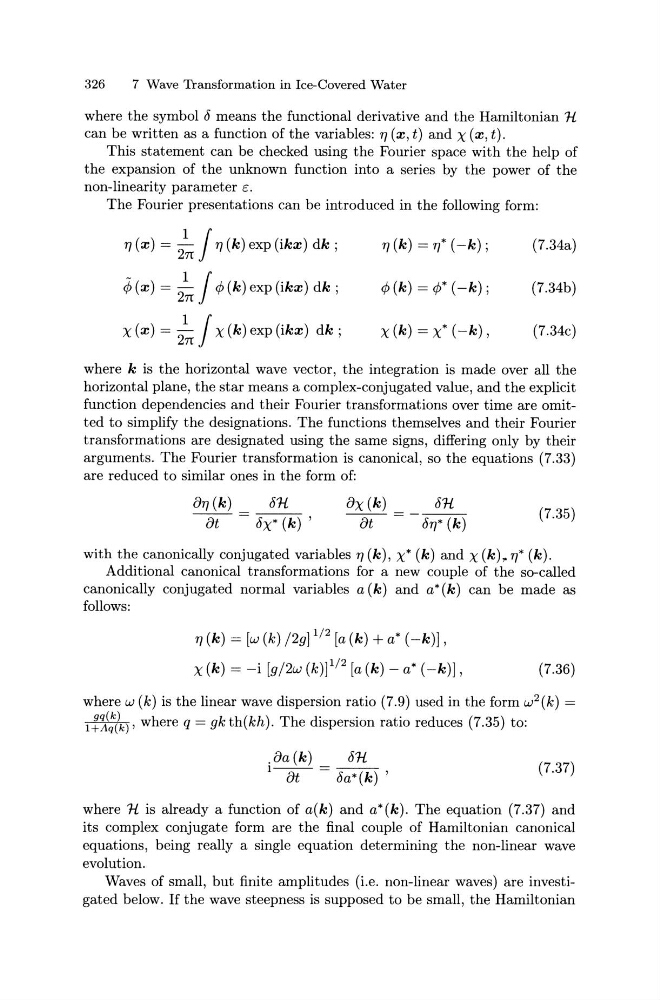
The Fourier presentations can be introduced in the following form:
TJ ( x) = -
TJ ( k) exp ( 1kx) dk ;
1 J .
27t
ry(k) = ry* (-k);
(7.34a)
-
1 J
cj;(x) = - cj;(k)exp(ikx) dk;
27t
cj;(k) = cj;* (-k);
(7.34b)
X(X) = - X(k)exp(Ikx) dk;
1 J .
27t
x(k)=x*(-k),
(7.34c)
where k is the horizontal wave vector, the integration is made over all the
horizontal plane, the star means a complex-conjugated value, and the explicit
function dependencies and their Fourier transformations over time are omitted to simplify the designations. The functions themselves and their Fourier
transformations are designated using the same signs, differing only by their
arguments. The Fourier transformation is canonical, so the equations (7.33)
are reduced to similar ones in the form of:
ary (k)
at
61-l
6x* (k) '
ax(k)
at
61-l
- - - -
6ry*(k)
(7.35)
with the canonically conjugated variables TJ (k), x* (k) and x (k)~ ry* (k).
Additional canonical transformations for a new couple of the so-called
canonically conjugated normal variables a (k) and a*(k) can be made as
follows:
TJ (k) = [w (k) /2g] 112 [a (k) +a* ( -k)J,
x (k) = -i [g/2w (k)] 1 / 2 [a (k)- a* ( -k)J,
(7.36)
where w (k) is the linear wave dispersion ratio (7.9) used in the form w 2 (k) =
1 !~~(k)' where q = gkth(kh). The dispersion ratio reduces (7.35) to:
. aa (k)
61-l
1 - - = - - -
at
6a*(k) '
(7.37)
where 1-l is already a function of a(k) and a*(k). The equation (7.37) and
its complex conjugate form are the final couple of Hamiltonian canonical
equations, being really a single equation determining the non-linear wave
evolution.
Waves of small, but finite amplitudes (i.e. non-linear waves) are investigated below. If the wave steepness is supposed to be small, the Hamiltonian
7 Wave Transformation in Ice-Covered Water
where the symbol 6 means the functional derivative and the Hamiltonian 1-l
can be written as a function of the variables: TJ (x, t) and x (x, t).
This statement can be checked using the Fourier space with the help of
the expansion of the unknown function into a series by the power of the
non-linearity parameter c.
The Fourier presentations can be introduced in the following form:
TJ ( x) = -
TJ ( k) exp ( 1kx) dk ;
1 J .
27t
ry(k) = ry* (-k);
(7.34a)
-
1 J
cj;(x) = - cj;(k)exp(ikx) dk;
27t
cj;(k) = cj;* (-k);
(7.34b)
X(X) = - X(k)exp(Ikx) dk;
1 J .
27t
x(k)=x*(-k),
(7.34c)
where k is the horizontal wave vector, the integration is made over all the
horizontal plane, the star means a complex-conjugated value, and the explicit
function dependencies and their Fourier transformations over time are omitted to simplify the designations. The functions themselves and their Fourier
transformations are designated using the same signs, differing only by their
arguments. The Fourier transformation is canonical, so the equations (7.33)
are reduced to similar ones in the form of:
ary (k)
at
61-l
6x* (k) '
ax(k)
at
61-l
- - - -
6ry*(k)
(7.35)
with the canonically conjugated variables TJ (k), x* (k) and x (k)~ ry* (k).
Additional canonical transformations for a new couple of the so-called
canonically conjugated normal variables a (k) and a*(k) can be made as
follows:
TJ (k) = [w (k) /2g] 112 [a (k) +a* ( -k)J,
x (k) = -i [g/2w (k)] 1 / 2 [a (k)- a* ( -k)J,
(7.36)
where w (k) is the linear wave dispersion ratio (7.9) used in the form w 2 (k) =
1 !~~(k)' where q = gkth(kh). The dispersion ratio reduces (7.35) to:
. aa (k)
61-l
1 - - = - - -
at
6a*(k) '
(7.37)
where 1-l is already a function of a(k) and a*(k). The equation (7.37) and
its complex conjugate form are the final couple of Hamiltonian canonical
equations, being really a single equation determining the non-linear wave
evolution.
Waves of small, but finite amplitudes (i.e. non-linear waves) are investigated below. If the wave steepness is supposed to be small, the Hamiltonian