

7.3 Kinetic Equation for Non-linear Waves in Sea with Ice Cakes
325
of non-linear waves in water with ice cakes. Methods of the Hamiltonian formalism, developed in the paper by Zakharov (1968) for waves in non-linear
media with dispersion will be applied. This technique allows passing from
the initial dynamic equations expressed by physical variables to the simpler
Hamiltonian equations expressed by special canonical variables. Such equations written in terms of Fourier variables give an exhaustive description of
non-linear waves both in the dynamic and statistical sense for small wave
non-linearity parameters: s "' ak, where a is the amplitude, and k is the
wave number. After deducing these equations, the transition to the kinetic
equation is made on the grounds of general theory results (Zakharov, 1968;
Krasitskii & Kalmykov, 1993).
General theses of the Hamiltonian formalism. In order to apply the
Hamiltonian formalism it is necessary for the system to preserve its energy.
The total system energy function in physical variables can be presented as:
'H=K+P,
(7.31)
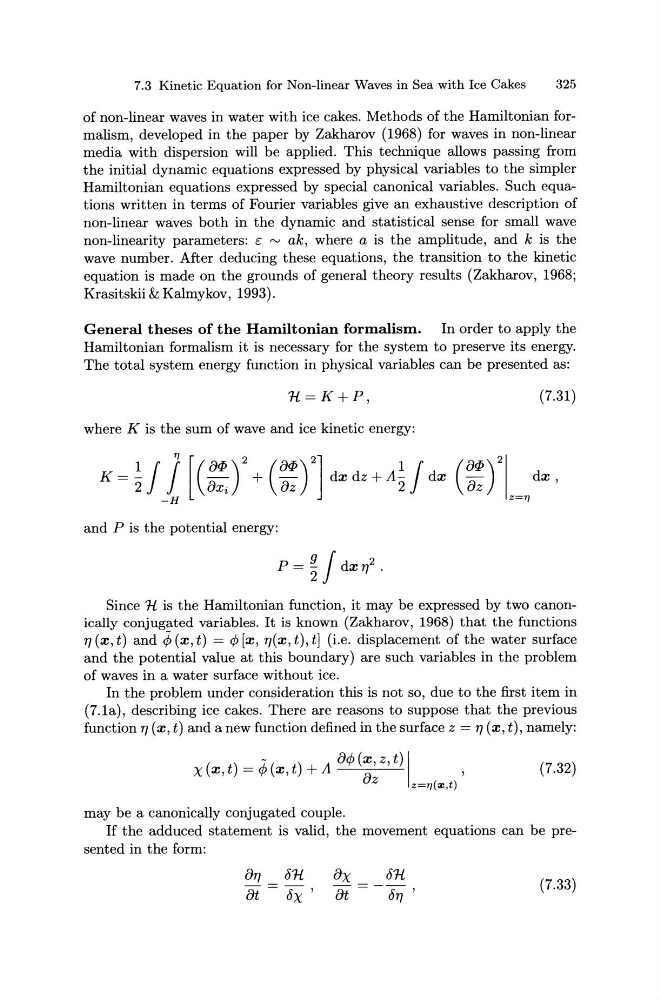
where K is the sum of wave and ice kinetic energy:
and P is the potential energy:
Since H is the Hamiltonian function, it may be expressed by two canonically conjugated variables. It is known (Zakharov, 1968) that the functions
' TJ (x, t) and ¢ (x, t) = ¢ [x, 'TJ(X, t), t] (i.e. displacement of the water surface
and the potential value at this boundary) are such variables in the problem
of waves in a water surface without ice.
In the problem under consideration this is not so, due to the first item in
(7.1a), describing ice cakes. There are reasons to suppose that the previous
function 'T] (x, t) and a new function defined in the surface z = ' TJ (x, t), namely:
( ) - ( ) A 8¢ (x, z, t) I
X x, t = ¢ x, t +
0
,
z
z=ry(oo,t)
(7.32)
may be a canonically conjugated couple.
If the adduced statement is valid, the movement equations can be presented in the form:
O'TJ
6H
ox
6H
at Jx ' at -8;]'
(7.33)
325
of non-linear waves in water with ice cakes. Methods of the Hamiltonian formalism, developed in the paper by Zakharov (1968) for waves in non-linear
media with dispersion will be applied. This technique allows passing from
the initial dynamic equations expressed by physical variables to the simpler
Hamiltonian equations expressed by special canonical variables. Such equations written in terms of Fourier variables give an exhaustive description of
non-linear waves both in the dynamic and statistical sense for small wave
non-linearity parameters: s "' ak, where a is the amplitude, and k is the
wave number. After deducing these equations, the transition to the kinetic
equation is made on the grounds of general theory results (Zakharov, 1968;
Krasitskii & Kalmykov, 1993).
General theses of the Hamiltonian formalism. In order to apply the
Hamiltonian formalism it is necessary for the system to preserve its energy.
The total system energy function in physical variables can be presented as:
'H=K+P,
(7.31)
where K is the sum of wave and ice kinetic energy:
and P is the potential energy:
Since H is the Hamiltonian function, it may be expressed by two canonically conjugated variables. It is known (Zakharov, 1968) that the functions
' TJ (x, t) and ¢ (x, t) = ¢ [x, 'TJ(X, t), t] (i.e. displacement of the water surface
and the potential value at this boundary) are such variables in the problem
of waves in a water surface without ice.
In the problem under consideration this is not so, due to the first item in
(7.1a), describing ice cakes. There are reasons to suppose that the previous
function 'T] (x, t) and a new function defined in the surface z = ' TJ (x, t), namely:
( ) - ( ) A 8¢ (x, z, t) I
X x, t = ¢ x, t +
0
,
z
z=ry(oo,t)
(7.32)
may be a canonically conjugated couple.
If the adduced statement is valid, the movement equations can be presented in the form:
O'TJ
6H
ox
6H
at Jx ' at -8;]'
(7.33)