

324
7 Wave Transformation in Ice-Covered Water
0.5
0
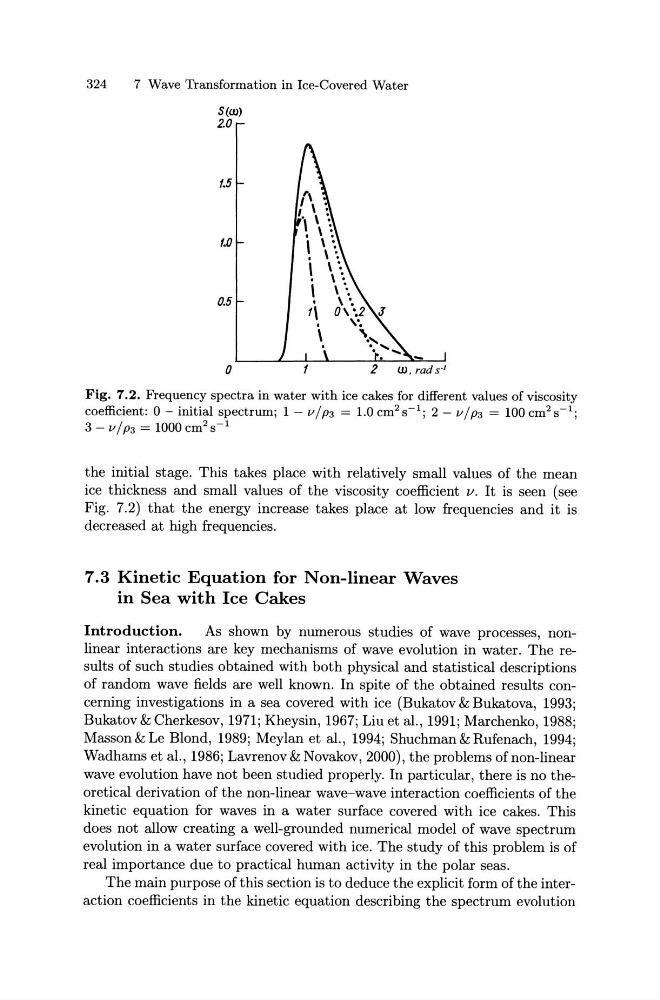
Fig. 7.2. Frequency spectra in water with ice cakes for different values of viscosity
coefficient: 0- initial spectrum; l-vjp3 = l.Ocm 2 s- 1 ; 2 -vjp3 = 100cm 2 s- 1 ;
3 -vjp3 = 1000 cm 2 s- 1
the initial stage. This takes place with relatively small values of the mean
ice thickness and small values of the viscosity coefficient v. It is seen (see
Fig. 7.2) that the energy increase takes place at low frequencies and it is
decreased at high frequencies.
7.3 Kinetic Equation for Non-linear Waves
in Sea with Ice Cakes
Introduction.
As shown by numerous studies of wave processes, nonlinear interactions are key mechanisms of wave evolution in water. The results of such studies obtained with both physical and statistical descriptions
of random wave fields are well known. In spite of the obtained results concerning investigations in a sea covered with ice (Bukatov & Bukatova, 1993;
Bukatov & Cherkesov, 1971; Kheysin, 1967; Liu et al., 1991; Marchenko, 1988;
Masson&Le Blond, 1989; Meylan et al., 1994; Shuchman&Rufenach, 1994;
Wadhams et al., 1986; Lavrenov & Novakov, 2000), the problems of non-linear
wave evolution have not been studied properly. In particular, there is no theoretical derivation of the non-linear wave-wave interaction coefficients of the
kinetic equation for waves in a water surface covered with ice cakes. This
does not allow creating a well-grounded numerical model of wave spectrum
evolution in a water surface covered with ice. The study of this problem is of
real importance due to practical human activity in the polar seas.
The main purpose of this section is to deduce the explicit form of the interaction coefficients in the kinetic equation describing the spectrum evolution
7 Wave Transformation in Ice-Covered Water
0.5
0
Fig. 7.2. Frequency spectra in water with ice cakes for different values of viscosity
coefficient: 0- initial spectrum; l-vjp3 = l.Ocm 2 s- 1 ; 2 -vjp3 = 100cm 2 s- 1 ;
3 -vjp3 = 1000 cm 2 s- 1
the initial stage. This takes place with relatively small values of the mean
ice thickness and small values of the viscosity coefficient v. It is seen (see
Fig. 7.2) that the energy increase takes place at low frequencies and it is
decreased at high frequencies.
7.3 Kinetic Equation for Non-linear Waves
in Sea with Ice Cakes
Introduction.
As shown by numerous studies of wave processes, nonlinear interactions are key mechanisms of wave evolution in water. The results of such studies obtained with both physical and statistical descriptions
of random wave fields are well known. In spite of the obtained results concerning investigations in a sea covered with ice (Bukatov & Bukatova, 1993;
Bukatov & Cherkesov, 1971; Kheysin, 1967; Liu et al., 1991; Marchenko, 1988;
Masson&Le Blond, 1989; Meylan et al., 1994; Shuchman&Rufenach, 1994;
Wadhams et al., 1986; Lavrenov & Novakov, 2000), the problems of non-linear
wave evolution have not been studied properly. In particular, there is no theoretical derivation of the non-linear wave-wave interaction coefficients of the
kinetic equation for waves in a water surface covered with ice cakes. This
does not allow creating a well-grounded numerical model of wave spectrum
evolution in a water surface covered with ice. The study of this problem is of
real importance due to practical human activity in the polar seas.
The main purpose of this section is to deduce the explicit form of the interaction coefficients in the kinetic equation describing the spectrum evolution