

7 Wave Transformation in Ice-Covered Water
7.1 Wave Problem Formulation in Water with Ice Cakes
Boundary conditions in a water surface.
In the Arctic sea when the
waves propagate from the open water surface into the region covered with
ice, they meet ice of different density, reducing their intensity considerable.
Now the cases of wave interaction with ice cases will be considered.
Let the ice cakes be accepted as floating masses without any interaction
between them (Kheysin, 1967). This idealization can be valid when omitting
the interaction forces between separate ice floes. At the same time their sizes
are supposed to be small enough compared with the wavelength, so the ice
floe is not bent. In order to use a comparatively simple mathematical approximation of the wave pattern, a supposition about the continuity of the
ice cake area will be applied. The mean ice thickness L, distributed evenly
over the local area, is usually introduced. Actually, the problem is reduced
to the study of two-layer medium motion with the upper layer describing
a continuous system of floats, simulating the ice dynamics.
The equations of motion make up the initial point of the problem formulation, taking into account the presence of ice in the water surface. The
following suppositions are used:
- water is covered evenly with ice cakes;
- ice dimensions are much less than the wavelength;
- wave frequencies are essentially less than the frequency of the ice floe eigenoscillation in water. This means the constancy of ice floe deepening.
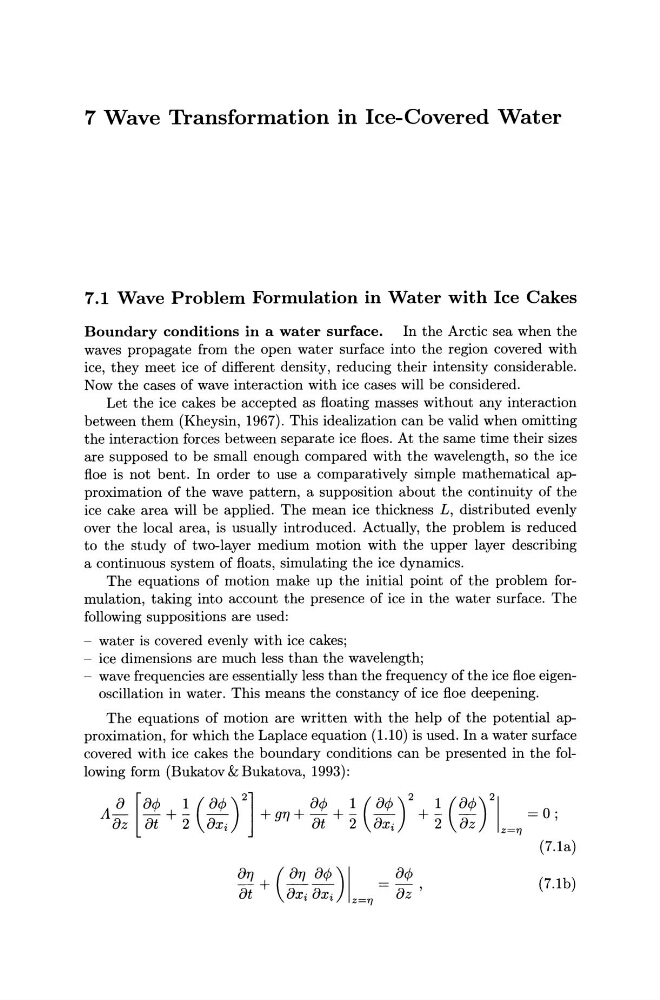
The equations of motion are written with the help of the potential approximation, for which the Laplace equation (1.10) is used. In a water surface
covered with ice cakes the boundary conditions can be presented in the following form (Bukatov&Bukatova, 1993):
a [a¢ 1 ( a¢ )
2 ]
a¢ 1 ( a¢ )
2
1 ( a¢)
2
1
A az at + 2 axi + g'f) + at + 2 axi + 2 az z=ry = 0 ;
(7.1a)
a¢
az '
(7.1b)
7.1 Wave Problem Formulation in Water with Ice Cakes
Boundary conditions in a water surface.
In the Arctic sea when the
waves propagate from the open water surface into the region covered with
ice, they meet ice of different density, reducing their intensity considerable.
Now the cases of wave interaction with ice cases will be considered.
Let the ice cakes be accepted as floating masses without any interaction
between them (Kheysin, 1967). This idealization can be valid when omitting
the interaction forces between separate ice floes. At the same time their sizes
are supposed to be small enough compared with the wavelength, so the ice
floe is not bent. In order to use a comparatively simple mathematical approximation of the wave pattern, a supposition about the continuity of the
ice cake area will be applied. The mean ice thickness L, distributed evenly
over the local area, is usually introduced. Actually, the problem is reduced
to the study of two-layer medium motion with the upper layer describing
a continuous system of floats, simulating the ice dynamics.
The equations of motion make up the initial point of the problem formulation, taking into account the presence of ice in the water surface. The
following suppositions are used:
- water is covered evenly with ice cakes;
- ice dimensions are much less than the wavelength;
- wave frequencies are essentially less than the frequency of the ice floe eigenoscillation in water. This means the constancy of ice floe deepening.
The equations of motion are written with the help of the potential approximation, for which the Laplace equation (1.10) is used. In a water surface
covered with ice cakes the boundary conditions can be presented in the following form (Bukatov&Bukatova, 1993):
a [a¢ 1 ( a¢ )
2 ]
a¢ 1 ( a¢ )
2
1 ( a¢)
2
1
A az at + 2 axi + g'f) + at + 2 axi + 2 az z=ry = 0 ;
(7.1a)
a¢
az '
(7.1b)