

316
7 Wave Transformation in Ice-Covered Water
where the following designations are accepted: A = Lp3 j p2 is the parameter
of ice floe deepening, L is the ice thickness, p3 is the ice density; p2 is the water
density;(x, z, t) is the liquid velocity potential and ry(x, t) is the elevation
of the water-ice boundary interface; and the index i indicates summation.
The traditional condition of non-leakage is assumed at the bottom:
81
=0
{)z
'
z=-H
(7.2)
where H is the water depth.
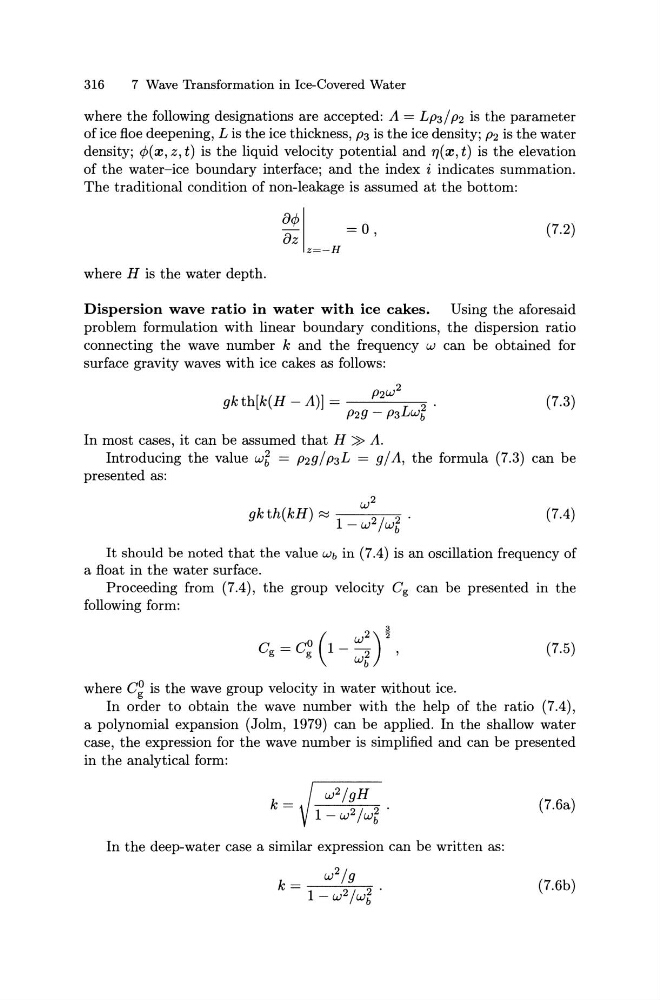
Dispersion wave ratio in water with ice cakes. Using the aforesaid
problem formulation with linear boundary conditions, the dispersion ratio
connecting the wave number k and the frequency w can be obtained for
surface gravity waves with ice cakes as follows:
P2W2
gkth[k(H- A)]=
L 2 •
P29- P3 wb
(7.3)
In most cases, it can be assumed that H :» A.
Introducing the value w~ = P29/ p3L = gf A, the formula (7.3) can be
presented as:
w2
gkth(kH)~
2 / 2
1-w wb
(7.4)
It should be noted that the value wb in (7.4) is an oscillation frequency of
a float in the water surface.
Proceeding from (7.4), the group velocity Cg can be presented in the
following form:
Cg = c~ ( 1 - ~;) ~ ,
(7.5)
where c~ is the wave group velocity in water without ice.
In order to obtain the wave number with the help of the ratio (7.4),
a polynomial expansion (Jolm, 1979) can be applied. In the shallow water
case, the expression for the wave number is simplified and can be presented
in the analytical form:
k=
(7.6a)
In the deep-water case a similar expression can be written as:
(7.6b)
7 Wave Transformation in Ice-Covered Water
where the following designations are accepted: A = Lp3 j p2 is the parameter
of ice floe deepening, L is the ice thickness, p3 is the ice density; p2 is the water
density;
of the water-ice boundary interface; and the index i indicates summation.
The traditional condition of non-leakage is assumed at the bottom:
81
=0
{)z
'
z=-H
(7.2)
where H is the water depth.
Dispersion wave ratio in water with ice cakes. Using the aforesaid
problem formulation with linear boundary conditions, the dispersion ratio
connecting the wave number k and the frequency w can be obtained for
surface gravity waves with ice cakes as follows:
P2W2
gkth[k(H- A)]=
L 2 •
P29- P3 wb
(7.3)
In most cases, it can be assumed that H :» A.
Introducing the value w~ = P29/ p3L = gf A, the formula (7.3) can be
presented as:
w2
gkth(kH)~
2 / 2
1-w wb
(7.4)
It should be noted that the value wb in (7.4) is an oscillation frequency of
a float in the water surface.
Proceeding from (7.4), the group velocity Cg can be presented in the
following form:
Cg = c~ ( 1 - ~;) ~ ,
(7.5)
where c~ is the wave group velocity in water without ice.
In order to obtain the wave number with the help of the ratio (7.4),
a polynomial expansion (Jolm, 1979) can be applied. In the shallow water
case, the expression for the wave number is simplified and can be presented
in the analytical form:
k=
(7.6a)
In the deep-water case a similar expression can be written as:
(7.6b)