

290
6 Wave Transformation in Shallow Water
conditions for normal stress continuity and liquid flow constancy are set at
the boundary of the two media ( z = -H).
The problem is considered for the thick-sand layer (Shemdin et al., 1978)
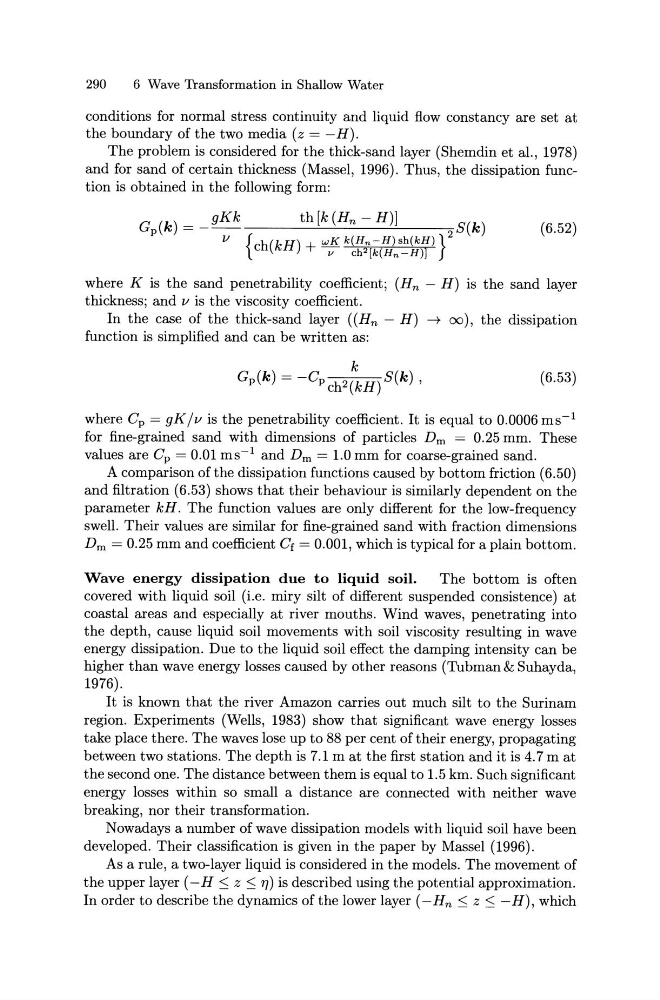
and for sand of certain thickness (Massel, 1996). Thus, the dissipation function is obtained in the following form:
Gp(k)=-gKk
th[k(Hn-H)]
2 S(k)
1/
{ch(kH) + wK k(Hn-H)sh(kH)}
v
ch2[k(Hn-H)J
(6.52)
where K is the sand penetrability coefficient; (Hn - H) is the sand layer
thickness; and v is the viscosity coefficient.
In the case of the thick-sand layer ((Hn -H) ---+ oo), the dissipation
function is simplified and can be written as:
k
Gp(k) = -CP ch2(kH) S(k) '
(6.53)
where CP = gK jv is the penetrability coefficient. It is equal to 0.0006 ms- 1
for fine-grained sand with dimensions of particles Dm = 0.25 mm. These
values are Cp = 0.01 ms- 1 and Dm = 1.0 mm for coarse-grained sand.
A comparison of the dissipation functions caused by bottom friction (6.50)
and filtration (6.53) shows that their behaviour is similarly dependent on the
parameter kH. The function values are only different for the low-frequency
swell. Their values are similar for fine-grained sand with fraction dimensions
Dm = 0.25 mm and coefficient Cr = 0.001, which is typical for a plain bottom.
Wave energy dissipation due to liquid soil.
The bottom is often
covered with liquid soil (i.e. miry silt of different suspended consistence) at
coastal areas and especially at river mouths. Wind waves, penetrating into
the depth, cause liquid soil movements with soil viscosity resulting in wave
energy dissipation. Due to the liquid soil effect the damping intensity can be
higher than wave energy losses caused by other reasons (Tubman & Suhayda,
1976).
It is known that the river Amazon carries out much silt to the Surinam
region. Experiments (Wells, 1983) show that significant wave energy losses
take place there. The waves lose up to 88 per cent of their energy, propagating
between two stations. The depth is 7.1 mat the first station and it is 4.7 mat
the second one. The distance between them is equal to 1.5 km. Such significant
energy losses within so small a distance are connected with neither wave
breaking, nor their transformation.
Nowadays a number of wave dissipation models with liquid soil have been
developed. Their classification is given in the paper by Massel (1996).
As a rule, a two-layer liquid is considered in the models. The movement of
the upper layer ( -H s z s 77) is described using the potential approximation.
In order to describe the dynamics of the lower layer (- Hn S z S -H), which
6 Wave Transformation in Shallow Water
conditions for normal stress continuity and liquid flow constancy are set at
the boundary of the two media ( z = -H).
The problem is considered for the thick-sand layer (Shemdin et al., 1978)
and for sand of certain thickness (Massel, 1996). Thus, the dissipation function is obtained in the following form:
Gp(k)=-gKk
th[k(Hn-H)]
2 S(k)
1/
{ch(kH) + wK k(Hn-H)sh(kH)}
v
ch2[k(Hn-H)J
(6.52)
where K is the sand penetrability coefficient; (Hn - H) is the sand layer
thickness; and v is the viscosity coefficient.
In the case of the thick-sand layer ((Hn -H) ---+ oo), the dissipation
function is simplified and can be written as:
k
Gp(k) = -CP ch2(kH) S(k) '
(6.53)
where CP = gK jv is the penetrability coefficient. It is equal to 0.0006 ms- 1
for fine-grained sand with dimensions of particles Dm = 0.25 mm. These
values are Cp = 0.01 ms- 1 and Dm = 1.0 mm for coarse-grained sand.
A comparison of the dissipation functions caused by bottom friction (6.50)
and filtration (6.53) shows that their behaviour is similarly dependent on the
parameter kH. The function values are only different for the low-frequency
swell. Their values are similar for fine-grained sand with fraction dimensions
Dm = 0.25 mm and coefficient Cr = 0.001, which is typical for a plain bottom.
Wave energy dissipation due to liquid soil.
The bottom is often
covered with liquid soil (i.e. miry silt of different suspended consistence) at
coastal areas and especially at river mouths. Wind waves, penetrating into
the depth, cause liquid soil movements with soil viscosity resulting in wave
energy dissipation. Due to the liquid soil effect the damping intensity can be
higher than wave energy losses caused by other reasons (Tubman & Suhayda,
1976).
It is known that the river Amazon carries out much silt to the Surinam
region. Experiments (Wells, 1983) show that significant wave energy losses
take place there. The waves lose up to 88 per cent of their energy, propagating
between two stations. The depth is 7.1 mat the first station and it is 4.7 mat
the second one. The distance between them is equal to 1.5 km. Such significant
energy losses within so small a distance are connected with neither wave
breaking, nor their transformation.
Nowadays a number of wave dissipation models with liquid soil have been
developed. Their classification is given in the paper by Massel (1996).
As a rule, a two-layer liquid is considered in the models. The movement of
the upper layer ( -H s z s 77) is described using the potential approximation.
In order to describe the dynamics of the lower layer (- Hn S z S -H), which