

6.4 Wave Energy Dissipation in Shallow Water
291
is viscous, the flow function is used. A solution to the problem was obtained
by Hsiao & Shemdin ( 1980). The connection between the wave number and
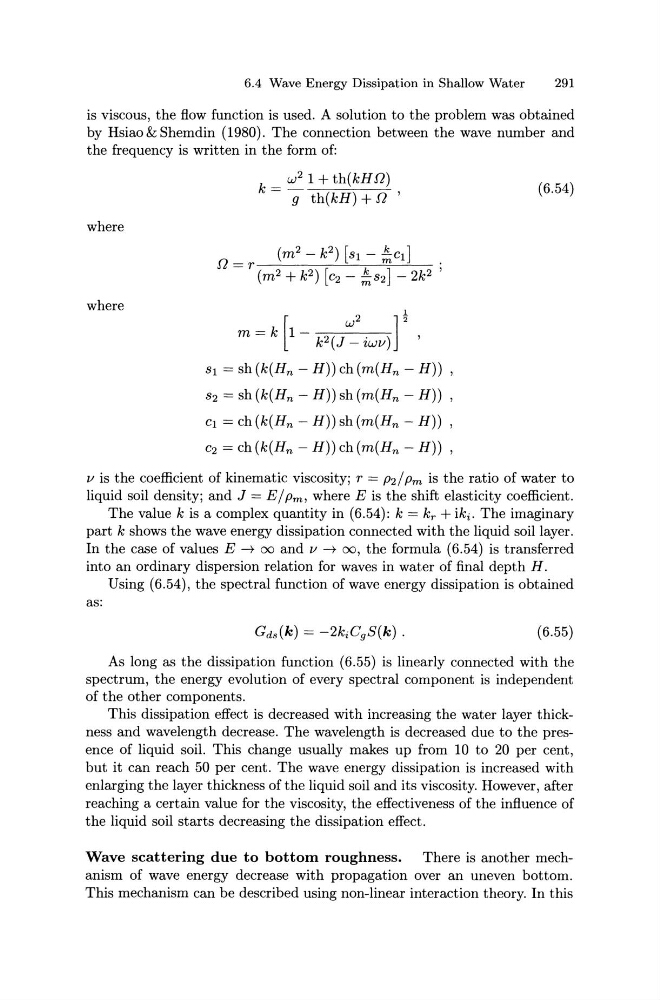
the frequency is written in the form of:
where
where
k = w 2 1 + th(kHil)
9 th(kH) + n '
m = k [1- k2(J~ iwv)r ,
81 =sh(k(Hn-H))ch(m(Hn-H)),
82 = sh (k(Hn- H)) sh (m(Hn- H)) ,
c1 = ch (k(Hn- H)) sh (m(Hn- H)) ,
c2 = ch (k(Hn- H)) ch (m(Hn- H)) ,
(6.54)
v is the coefficient of kinematic viscosity; r = p2 / Pm is the ratio of water to
liquid soil density; and J = E / Pm, where E is the shift elasticity coefficient.
The value k is a complex quantity in (6.54): k = kr + iki. The imaginary
part k shows the wave energy dissipation connected with the liquid soil layer.
In the case of values E -t oo and v -t oo, the formula (6.54) is transferred
into an ordinary dispersion relation for waves in water of final depth H.
Using (6.54), the spectral function of wave energy dissipation is obtained
as:
(6.55)
As long as the dissipation function (6.55) is linearly connected with the
spectrum, the energy evolution of every spectral component is independent
of the other components.
This dissipation effect is decreased with increasing the water layer thickness and wavelength decrease. The wavelength is decreased due to the presence of liquid soil. This change usually makes up from 10 to 20 per cent,
but it can reach 50 per cent. The wave energy dissipation is increased with
enlarging the layer thickness of the liquid soil and its viscosity. However, after
reaching a certain value for the viscosity, the effectiveness of the influence of
the liquid soil starts decreasing the dissipation effect.
Wave scattering due to bottom roughness. There is another mechanism of wave energy decrease with propagation over an uneven bottom.
This mechanism can be described using non-linear interaction theory. In this
291
is viscous, the flow function is used. A solution to the problem was obtained
by Hsiao & Shemdin ( 1980). The connection between the wave number and
the frequency is written in the form of:
where
where
k = w 2 1 + th(kHil)
9 th(kH) + n '
m = k [1- k2(J~ iwv)r ,
81 =sh(k(Hn-H))ch(m(Hn-H)),
82 = sh (k(Hn- H)) sh (m(Hn- H)) ,
c1 = ch (k(Hn- H)) sh (m(Hn- H)) ,
c2 = ch (k(Hn- H)) ch (m(Hn- H)) ,
(6.54)
v is the coefficient of kinematic viscosity; r = p2 / Pm is the ratio of water to
liquid soil density; and J = E / Pm, where E is the shift elasticity coefficient.
The value k is a complex quantity in (6.54): k = kr + iki. The imaginary
part k shows the wave energy dissipation connected with the liquid soil layer.
In the case of values E -t oo and v -t oo, the formula (6.54) is transferred
into an ordinary dispersion relation for waves in water of final depth H.
Using (6.54), the spectral function of wave energy dissipation is obtained
as:
(6.55)
As long as the dissipation function (6.55) is linearly connected with the
spectrum, the energy evolution of every spectral component is independent
of the other components.
This dissipation effect is decreased with increasing the water layer thickness and wavelength decrease. The wavelength is decreased due to the presence of liquid soil. This change usually makes up from 10 to 20 per cent,
but it can reach 50 per cent. The wave energy dissipation is increased with
enlarging the layer thickness of the liquid soil and its viscosity. However, after
reaching a certain value for the viscosity, the effectiveness of the influence of
the liquid soil starts decreasing the dissipation effect.
Wave scattering due to bottom roughness. There is another mechanism of wave energy decrease with propagation over an uneven bottom.
This mechanism can be described using non-linear interaction theory. In this