

6.4 Wave Energy Dissipation in Shallow Water
289
It should be noted that the wave phase is included non-linearly in (6.48),
while this does not happen in (6.47). In this case the resistance coefficient can
be determined using experimental estimations for wave energy dissipation.
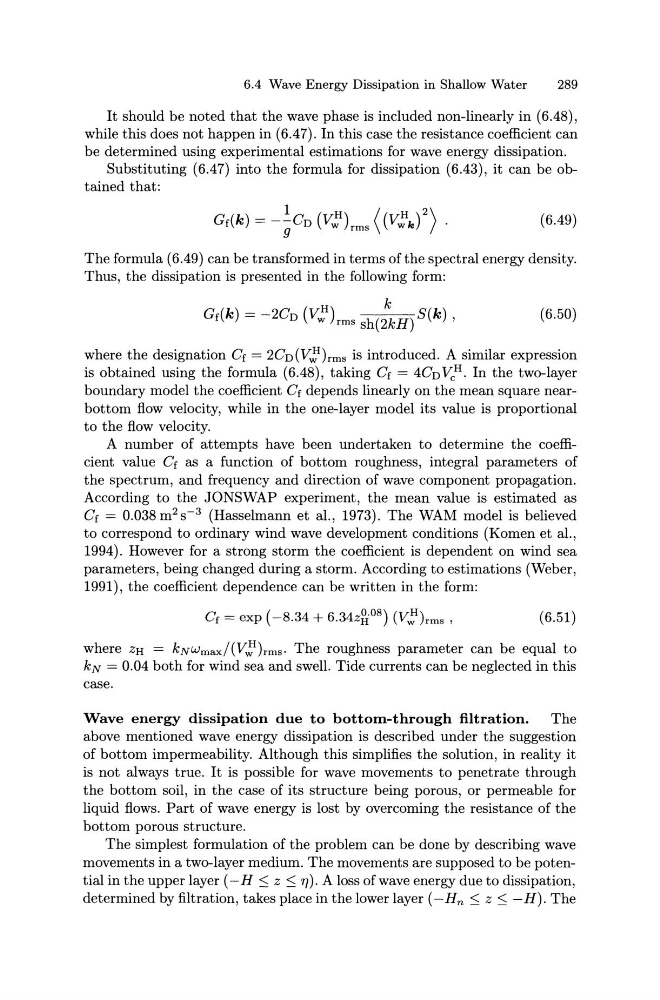
Substituting (6.47) into the formula for dissipation (6.43), it can be obtained that:
(6.49)
The formula ( 6.49) can be transformed in terms of the spectral energy density.
Thus, the dissipation is presented in the following form:
(6.50)
where the designation Cr = 2Cn(V:)rms is introduced. A similar expression
is obtained using the formula (6.48), taking Cr = 4CnV.,H. In the two-layer
boundary model the coefficient Cr depends linearly on the mean square nearbottom flow velocity, while in the one-layer model its value is proportional
to the flow velocity.
A number of attempts have been undertaken to determine the coefficient value Cr as a function of bottom roughness, integral parameters of
the spectrum, and frequency and direction of wave component propagation.
According to the JONSWAP experiment, the mean value is estimated as
Cr = 0.038 m 2 s- 3 (Hasselmann et al., 1973). The WAM model is believed
to correspond to ordinary wind wave development conditions (Komen et al.,
1994). However for a strong storm the coefficient is dependent on wind sea
parameters, being changed during a storm. According to estimations (Weber,
1991), the coefficient dependence can be written in the form:
Cr = exp ( -8.34 + 6.34z~ 08 ) (V:)rrns ,
(6.51)
where ZH = kNWmax/(V:)rms· The roughness parameter can be equal to
kN = 0.04 both for wind sea and swell. Tide currents can be neglected in this
case.
Wave energy dissipation due to bottom-through filtration.
The
above mentioned wave energy dissipation is described under the suggestion
of bottom impermeability. Although this simplifies the solution, in reality it
is not always true. It is possible for wave movements to penetrate through
the bottom soil, in the case of its structure being porous, or permeable for
liquid flows. Part of wave energy is lost by overcoming the resistance of the
bottom porous structure.
The simplest formulation of the problem can be done by describing wave
movements in a two-layer medium. The movements are supposed to be potential in the upper layer (-H :=:; z :=:; "1). A loss of wave energy due to dissipation,
determined by filtration, takes place in the lower layer ( -Hn :=:; z :=:;-H). The
289
It should be noted that the wave phase is included non-linearly in (6.48),
while this does not happen in (6.47). In this case the resistance coefficient can
be determined using experimental estimations for wave energy dissipation.
Substituting (6.47) into the formula for dissipation (6.43), it can be obtained that:
(6.49)
The formula ( 6.49) can be transformed in terms of the spectral energy density.
Thus, the dissipation is presented in the following form:
(6.50)
where the designation Cr = 2Cn(V:)rms is introduced. A similar expression
is obtained using the formula (6.48), taking Cr = 4CnV.,H. In the two-layer
boundary model the coefficient Cr depends linearly on the mean square nearbottom flow velocity, while in the one-layer model its value is proportional
to the flow velocity.
A number of attempts have been undertaken to determine the coefficient value Cr as a function of bottom roughness, integral parameters of
the spectrum, and frequency and direction of wave component propagation.
According to the JONSWAP experiment, the mean value is estimated as
Cr = 0.038 m 2 s- 3 (Hasselmann et al., 1973). The WAM model is believed
to correspond to ordinary wind wave development conditions (Komen et al.,
1994). However for a strong storm the coefficient is dependent on wind sea
parameters, being changed during a storm. According to estimations (Weber,
1991), the coefficient dependence can be written in the form:
Cr = exp ( -8.34 + 6.34z~ 08 ) (V:)rrns ,
(6.51)
where ZH = kNWmax/(V:)rms· The roughness parameter can be equal to
kN = 0.04 both for wind sea and swell. Tide currents can be neglected in this
case.
Wave energy dissipation due to bottom-through filtration.
The
above mentioned wave energy dissipation is described under the suggestion
of bottom impermeability. Although this simplifies the solution, in reality it
is not always true. It is possible for wave movements to penetrate through
the bottom soil, in the case of its structure being porous, or permeable for
liquid flows. Part of wave energy is lost by overcoming the resistance of the
bottom porous structure.
The simplest formulation of the problem can be done by describing wave
movements in a two-layer medium. The movements are supposed to be potential in the upper layer (-H :=:; z :=:; "1). A loss of wave energy due to dissipation,
determined by filtration, takes place in the lower layer ( -Hn :=:; z :=:;-H). The