

288
6 Wave Transformation in Shallow Water
(6.44)
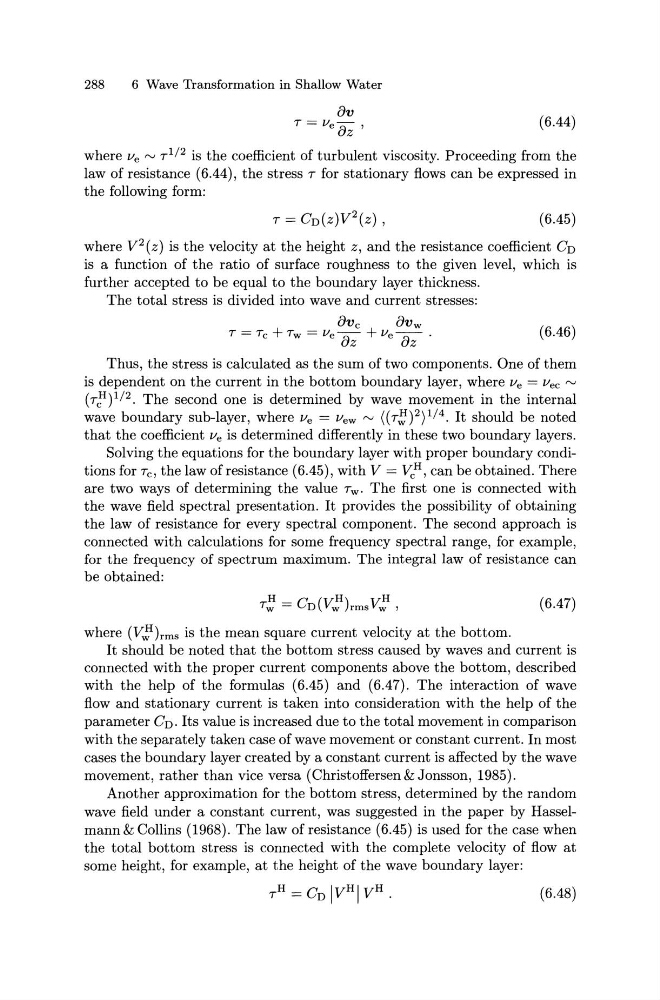
where Ve ,..., r 1 1 2 is the coefficient of turbulent viscosity. Proceeding from the
law of resistance (6.44), the stress T for stationary flows can be expressed in
the following form:
(6.45)
where V 2 (z) is the velocity at the height z, and the resistance coefficient Cn
is a function of the ratio of surface roughness to the given level, which is
further accepted to be equal to the boundary layer thickness.
The total stress is divided into wave and current stresses:
(6.46)
Thus, the stress is calculated as the sum of two components. One of them
is dependent on the current in the bottom boundary layer, where Ve = Vee ,...,
(rJf) 1 1 2 . The second one is determined by wave movement in the internal
wave boundary sub-layer, where Ve = Vew ,..., ((r~) 2 ) 1 1 4 . It should be noted
that the coefficient Ve is determined differently in these two boundary layers.
Solving the equations for the boundary layer with proper boundary conditions for Tc, the law of resistance (6.45), with V = V.,H, can be obtained. There
are two ways of determining the value Tw. The first one is connected with
the wave field spectral presentation. It provides the possibility of obtaining
the law of resistance for every spectral component. The second approach is
connected with calculations for some frequency spectral range, for example,
for the frequency of spectrum maximum. The integral law of resistance can
be obtained:
(6.47)
where cv:)rms is the mean square current velocity at the bottom.
It should be noted that the bottom stress caused by waves and current is
connected with the proper current components above the bottom, described
with the help of the formulas (6.45) and (6.47). The interaction of wave
flow and stationary current is taken into consideration with the help of the
parameter Cn. Its value is increased due to the total movement in comparison
with the separately taken case of wave movement or constant current. In most
cases the boundary layer created by a constant current is affected by the wave
movement, rather than vice versa (Christoffersen & Jonsson, 1985).
Another approximation for the bottom stress, determined by the random
wave field under a constant current, was suggested in the paper by Hasselmann & Collins (1968). The law of resistance (6.45) is used for the case when
the total bottom stress is connected with the complete velocity of flow at
some height, for example, at the height of the wave boundary layer:
(6.48)
6 Wave Transformation in Shallow Water
(6.44)
where Ve ,..., r 1 1 2 is the coefficient of turbulent viscosity. Proceeding from the
law of resistance (6.44), the stress T for stationary flows can be expressed in
the following form:
(6.45)
where V 2 (z) is the velocity at the height z, and the resistance coefficient Cn
is a function of the ratio of surface roughness to the given level, which is
further accepted to be equal to the boundary layer thickness.
The total stress is divided into wave and current stresses:
(6.46)
Thus, the stress is calculated as the sum of two components. One of them
is dependent on the current in the bottom boundary layer, where Ve = Vee ,...,
(rJf) 1 1 2 . The second one is determined by wave movement in the internal
wave boundary sub-layer, where Ve = Vew ,..., ((r~) 2 ) 1 1 4 . It should be noted
that the coefficient Ve is determined differently in these two boundary layers.
Solving the equations for the boundary layer with proper boundary conditions for Tc, the law of resistance (6.45), with V = V.,H, can be obtained. There
are two ways of determining the value Tw. The first one is connected with
the wave field spectral presentation. It provides the possibility of obtaining
the law of resistance for every spectral component. The second approach is
connected with calculations for some frequency spectral range, for example,
for the frequency of spectrum maximum. The integral law of resistance can
be obtained:
(6.47)
where cv:)rms is the mean square current velocity at the bottom.
It should be noted that the bottom stress caused by waves and current is
connected with the proper current components above the bottom, described
with the help of the formulas (6.45) and (6.47). The interaction of wave
flow and stationary current is taken into consideration with the help of the
parameter Cn. Its value is increased due to the total movement in comparison
with the separately taken case of wave movement or constant current. In most
cases the boundary layer created by a constant current is affected by the wave
movement, rather than vice versa (Christoffersen & Jonsson, 1985).
Another approximation for the bottom stress, determined by the random
wave field under a constant current, was suggested in the paper by Hasselmann & Collins (1968). The law of resistance (6.45) is used for the case when
the total bottom stress is connected with the complete velocity of flow at
some height, for example, at the height of the wave boundary layer:
(6.48)