

286
6 Wave Transformation in Shallow Water
boundary layer (Shemdin et al., 1978). The first mechanism results in a local
wave energy redistribution due to wave component scattering, for example,
by small-scale coral reefs or sand riffles. The last three mechanisms are dissipative. Their effectiveness is determined by concrete conditions of forming the
boundary layer at the bottom. The filtration depends on the porous structure
(penetrability) of the bottom material, and the bottom friction is connected
with the dimensions of the bottom roughness.
Dissipation dependence on wave bottom stress.
The wave energy
dissipation determined by bottom friction due to a random wave field with
an average current will be considered. This approach for a regular wave was
suggested by K. Kajiura (1968) and generalized for monochromatic waves
and current in the paper by Christoffersen & Jonsson (1985).
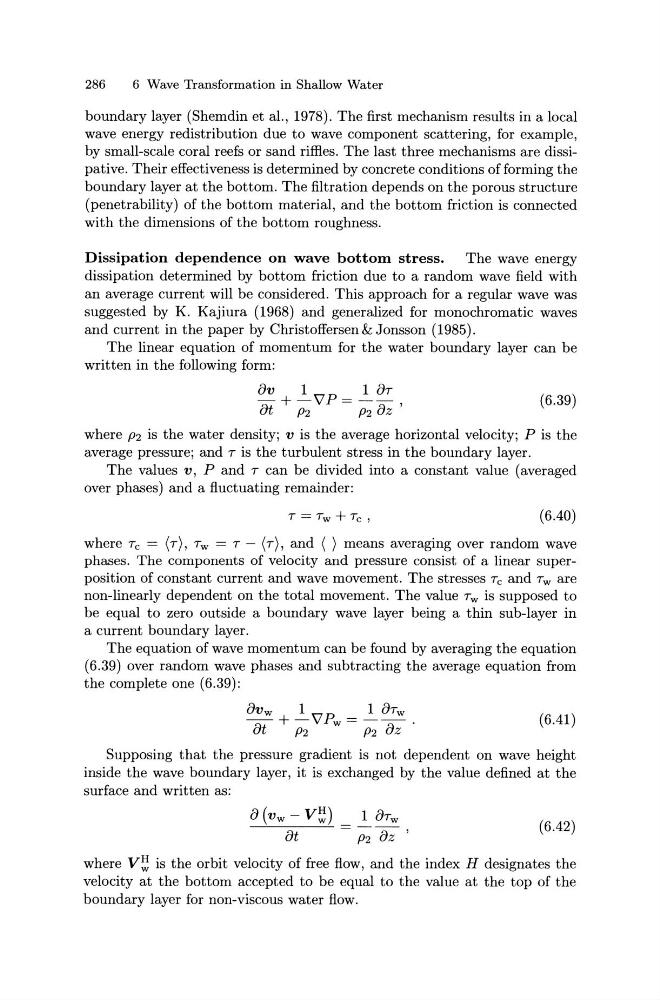
The linear equation of momentum for the water boundary layer can be
written in the following form:
av + _!._ V' p _ _!._ a7
at P2 - P2 az '
(6.39)
where p2 is the water density; v is the average horizontal velocity; P is the
average pressure; and 7 is the turbulent stress in the boundary layer.
The values v, P and 7 can be divided into a constant value (averaged
over phases) and a fluctuating remainder:
7 = 7w + 7c,
(6.40)
where 7c = (7), 7w = 7 - (7), and ( ) means averaging over random wave
phases. The components of velocity and pressure consist of a linear superposition of constant current and wave movement. The stresses 7c and 7w are
non-linearly dependent on the total movement. The value 7w is supposed to
be equal to zero outside a boundary wave layer being a thin sub-layer in
a current boundary layer.
The equation of wave momentum can be found by averaging the equation
(6.39) over random wave phases and subtracting the average equation from
the complete one (6.39):
avw + _!_V'Pw = _!._ a7w .
at P2
P2 az
(6.41)
Supposing that the pressure gradient is not dependent on wave height
inside the wave boundary layer, it is exchanged by the value defined at the
surface and written as:
a(vw-V~)
at
(6.42)
where V~ is the orbit velocity of free flow, and the index H designates the
velocity at the bottom accepted to be equal to the value at the top of the
boundary layer for non-viscous water flow.
6 Wave Transformation in Shallow Water
boundary layer (Shemdin et al., 1978). The first mechanism results in a local
wave energy redistribution due to wave component scattering, for example,
by small-scale coral reefs or sand riffles. The last three mechanisms are dissipative. Their effectiveness is determined by concrete conditions of forming the
boundary layer at the bottom. The filtration depends on the porous structure
(penetrability) of the bottom material, and the bottom friction is connected
with the dimensions of the bottom roughness.
Dissipation dependence on wave bottom stress.
The wave energy
dissipation determined by bottom friction due to a random wave field with
an average current will be considered. This approach for a regular wave was
suggested by K. Kajiura (1968) and generalized for monochromatic waves
and current in the paper by Christoffersen & Jonsson (1985).
The linear equation of momentum for the water boundary layer can be
written in the following form:
av + _!._ V' p _ _!._ a7
at P2 - P2 az '
(6.39)
where p2 is the water density; v is the average horizontal velocity; P is the
average pressure; and 7 is the turbulent stress in the boundary layer.
The values v, P and 7 can be divided into a constant value (averaged
over phases) and a fluctuating remainder:
7 = 7w + 7c,
(6.40)
where 7c = (7), 7w = 7 - (7), and ( ) means averaging over random wave
phases. The components of velocity and pressure consist of a linear superposition of constant current and wave movement. The stresses 7c and 7w are
non-linearly dependent on the total movement. The value 7w is supposed to
be equal to zero outside a boundary wave layer being a thin sub-layer in
a current boundary layer.
The equation of wave momentum can be found by averaging the equation
(6.39) over random wave phases and subtracting the average equation from
the complete one (6.39):
avw + _!_V'Pw = _!._ a7w .
at P2
P2 az
(6.41)
Supposing that the pressure gradient is not dependent on wave height
inside the wave boundary layer, it is exchanged by the value defined at the
surface and written as:
a(vw-V~)
at
(6.42)
where V~ is the orbit velocity of free flow, and the index H designates the
velocity at the bottom accepted to be equal to the value at the top of the
boundary layer for non-viscous water flow.