

6.4 Wave Energy Dissipation in Shallow Water
285
li,'t,"f..
1.6
!.ft.
1.2
t.O
0.8
0.6
O.t,.
0.2
0
2
J
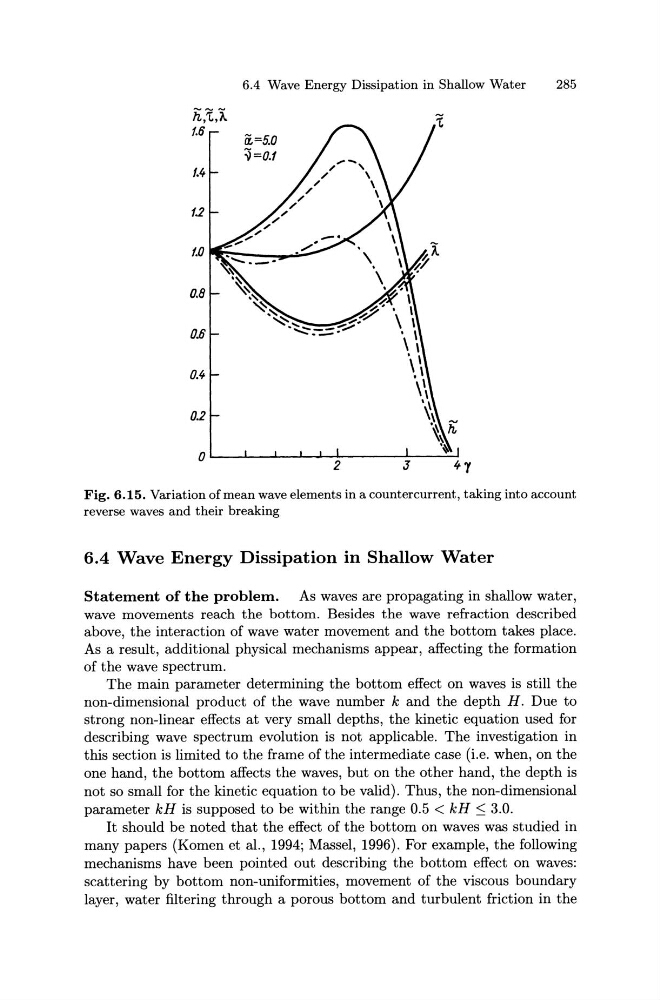
Fig. 6.15. Variation of mean wave elements in a countercurrent, taking into account
reverse waves and their breaking
6.4 Wave Energy Dissipation in Shallow Water
Statement of the problem. As waves are propagating in shallow water,
wave movements reach the bottom. Besides the wave refraction described
above, the interaction of wave water movement and the bottom takes place.
As a result, additional physical mechanisms appear, affecting the formation
of the wave spectrum.
The main parameter determining the bottom effect on waves is still the
non-dimensional product of the wave number k and the depth H. Due to
strong non-linear effects at very small depths, the kinetic equation used for
describing wave spectrum evolution is not applicable. The investigation in
this section is limited to the frame of the intermediate case (i.e. when, on the
one hand, the bottom affects the waves, but on the other hand, the depth is
not so small for the kinetic equation to be valid). Thus, the non-dimensional
parameter kH is supposed to be within the range 0.5 < kH:::; 3.0.
It should be noted that the effect of the bottom on waves was studied in
many papers (Komen et al., 1994; Massel, 1996). For example, the following
mechanisms have been pointed out describing the bottom effect on waves:
scattering by bottom non-uniformities, movement of the viscous boundary
layer, water filtering through a porous bottom and turbulent friction in the
285
li,'t,"f..
1.6
!.ft.
1.2
t.O
0.8
0.6
O.t,.
0.2
0
2
J
Fig. 6.15. Variation of mean wave elements in a countercurrent, taking into account
reverse waves and their breaking
6.4 Wave Energy Dissipation in Shallow Water
Statement of the problem. As waves are propagating in shallow water,
wave movements reach the bottom. Besides the wave refraction described
above, the interaction of wave water movement and the bottom takes place.
As a result, additional physical mechanisms appear, affecting the formation
of the wave spectrum.
The main parameter determining the bottom effect on waves is still the
non-dimensional product of the wave number k and the depth H. Due to
strong non-linear effects at very small depths, the kinetic equation used for
describing wave spectrum evolution is not applicable. The investigation in
this section is limited to the frame of the intermediate case (i.e. when, on the
one hand, the bottom affects the waves, but on the other hand, the depth is
not so small for the kinetic equation to be valid). Thus, the non-dimensional
parameter kH is supposed to be within the range 0.5 < kH:::; 3.0.
It should be noted that the effect of the bottom on waves was studied in
many papers (Komen et al., 1994; Massel, 1996). For example, the following
mechanisms have been pointed out describing the bottom effect on waves:
scattering by bottom non-uniformities, movement of the viscous boundary
layer, water filtering through a porous bottom and turbulent friction in the