

274
6 Wave Transformation in Shallow Water
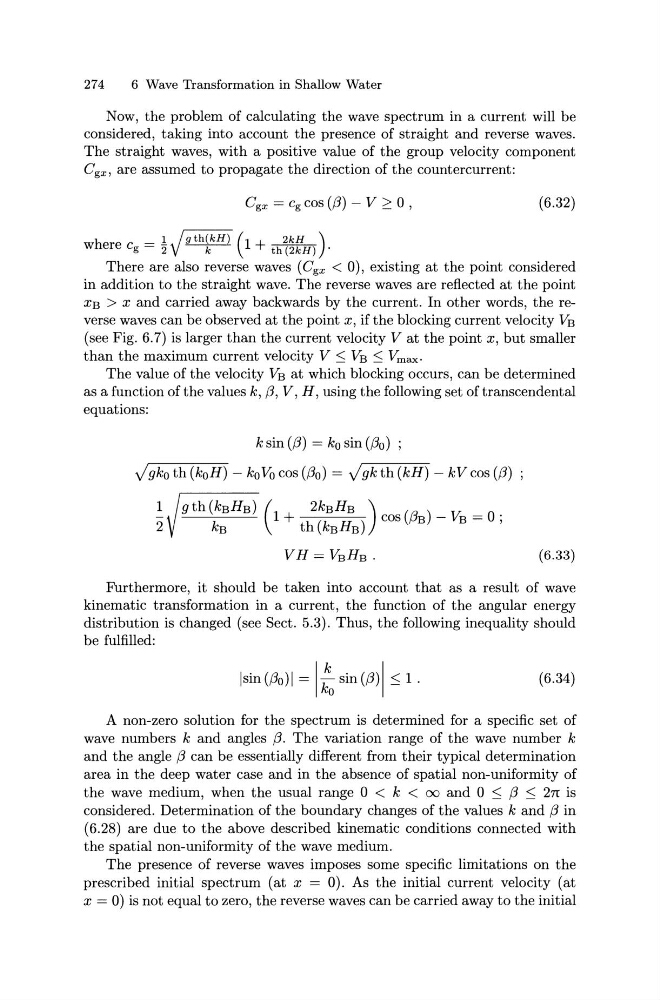
Now, the problem of calculating the wave spectrum in a current will be
considered, taking into account the presence of straight and reverse waves.
The straight waves, with a positive value of the group velocity component
Cgx, are assumed to propagate the direction of the countercurrent:
Cgx = Cg COS ({3) - V ::::: 0 ,
(6.32)
h
_ 1 J gth(kH) ( 1 2kH )
w ere cg - 2 - - k -
+ th (2kH) .
There are also reverse waves (Cgx < 0), existing at the point considered
in addition to the straight wave. The reverse waves are reflected at the point
xs > x and carried away backwards by the current. In other words, thereverse waves can be observed at the point x, if the blocking current velocity V8
(see Fig. 6.7) is larger than the current velocity Vat the point x, but smaller
than the maximum current velocity V ~ Vs ~ Vmax·
The value of the velocity V8 at which blocking occurs, can be determined
as a function of the values k, {3, V, H, using the following set of transcendental
equations:
k sin ({3) = kosin (f3o) ;
J gko th (koH) - ko Vo cos (f3o) = J gk th (kH) - kV cos ({3)
1
2
gth(k8 Hs) ( 1
2ksHs )
({3 )-Vi_ .
ks
+ th(ksHs) cos 8
8 - 0 '
VH=VBHB.
(6.33)
Furthermore, it should be taken into account that as a result of wave
kinematic transformation in a current, the function of the angular energy
distribution is changed (see Sect. 5.3). Thus, the following inequality should
be fulfilled:
jsin (f3o)l = I~ sin ({3)1 ~ 1.
(6.34)
A non-zero solution for the spectrum is determined for a specific set of
wave numbers k and angles {3. The variation range of the wave number k
and the angle {3 can be essentially different from their typical determination
area in the deep water case and in the absence of spatial non-uniformity of
the wave medium, when the usual range 0 < k < oo and 0 ~ {3 ~ 2n is
considered. Determination of the boundary changes of the values k and {3 in
(6.28) are due to the above described kinematic conditions connected with
the spatial non-uniformity of the wave medium.
The presence of reverse waves imposes some specific limitations on the
prescribed initial spectrum (at x = 0). As the initial current velocity (at
x = 0) is not equal to zero, the reverse waves can be carried away to the initial
6 Wave Transformation in Shallow Water
Now, the problem of calculating the wave spectrum in a current will be
considered, taking into account the presence of straight and reverse waves.
The straight waves, with a positive value of the group velocity component
Cgx, are assumed to propagate the direction of the countercurrent:
Cgx = Cg COS ({3) - V ::::: 0 ,
(6.32)
h
_ 1 J gth(kH) ( 1 2kH )
w ere cg - 2 - - k -
+ th (2kH) .
There are also reverse waves (Cgx < 0), existing at the point considered
in addition to the straight wave. The reverse waves are reflected at the point
xs > x and carried away backwards by the current. In other words, thereverse waves can be observed at the point x, if the blocking current velocity V8
(see Fig. 6.7) is larger than the current velocity Vat the point x, but smaller
than the maximum current velocity V ~ Vs ~ Vmax·
The value of the velocity V8 at which blocking occurs, can be determined
as a function of the values k, {3, V, H, using the following set of transcendental
equations:
k sin ({3) = kosin (f3o) ;
J gko th (koH) - ko Vo cos (f3o) = J gk th (kH) - kV cos ({3)
1
2
gth(k8 Hs) ( 1
2ksHs )
({3 )-Vi_ .
ks
+ th(ksHs) cos 8
8 - 0 '
VH=VBHB.
(6.33)
Furthermore, it should be taken into account that as a result of wave
kinematic transformation in a current, the function of the angular energy
distribution is changed (see Sect. 5.3). Thus, the following inequality should
be fulfilled:
jsin (f3o)l = I~ sin ({3)1 ~ 1.
(6.34)
A non-zero solution for the spectrum is determined for a specific set of
wave numbers k and angles {3. The variation range of the wave number k
and the angle {3 can be essentially different from their typical determination
area in the deep water case and in the absence of spatial non-uniformity of
the wave medium, when the usual range 0 < k < oo and 0 ~ {3 ~ 2n is
considered. Determination of the boundary changes of the values k and {3 in
(6.28) are due to the above described kinematic conditions connected with
the spatial non-uniformity of the wave medium.
The presence of reverse waves imposes some specific limitations on the
prescribed initial spectrum (at x = 0). As the initial current velocity (at
x = 0) is not equal to zero, the reverse waves can be carried away to the initial