

6.3 Bottom and a Non-Uniform Current Influence on Waves
273
18
14
12
10
8
8
2
0
' , (1;=1,0
', v=to- 3
\
\ \
\
\
\
I
I
I
I
J
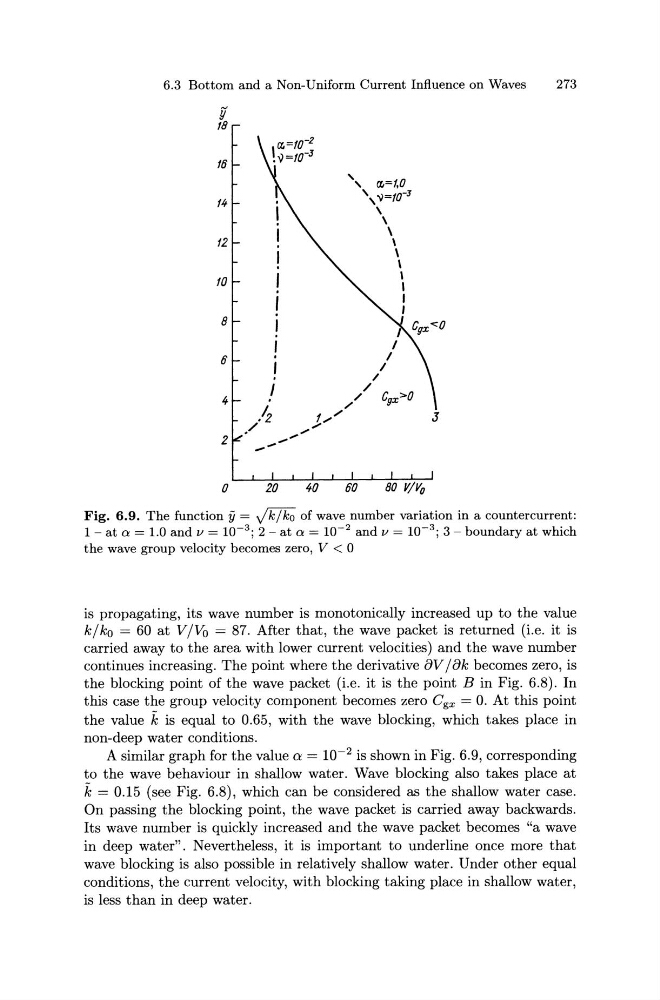
Fig. 6.9. The function fj =~of wave number variation in a countercurrent:
1- at Q = 1.0 and 1/ = w- 3 ; 2- at Q = 10- 2 and 1/ = w- 3 ; 3- boundary at which
the wave group velocity becomes zero, V < 0
is propagating, its wave number is monotonically increased up to the value
k/ko = 60 at V /V0 = 87. After that, the wave packet is returned (i.e. it is
carried away to the area with lower current velocities) and the wave number
continues increasing. The point where the derivative 8V I ok becomes zero, is
the blocking point of the wave packet (i.e. it is the point B in Fig. 6.8). In
this case t~e group velocity component becomes zero Cgx = 0. At this point
the value k is equal to 0.65, with the wave blocking, which takes place in
non-deep water conditions.
A similar graph for the value a= 10- 2 is shown in Fig. 6.9, corresponding
to the wave behaviour in shallow water. Wave blocking also takes place at
k = 0.15 (see Fig. 6.8), which can be considered as the shallow water case.
On passing the blocking point, the wave packet is carried away backwards.
Its wave number is quickly increased and the wave packet becomes "a wave
in deep water". Nevertheless, it is important to underline once more that
wave blocking is also possible in relatively shallow water. Under other equal
conditions, the current velocity, with blocking taking place in shallow water,
is less than in deep water.
273
18
14
12
10
8
8
2
0
' , (1;=1,0
', v=to- 3
\
\ \
\
\
\
I
I
I
I
J
Fig. 6.9. The function fj =~of wave number variation in a countercurrent:
1- at Q = 1.0 and 1/ = w- 3 ; 2- at Q = 10- 2 and 1/ = w- 3 ; 3- boundary at which
the wave group velocity becomes zero, V < 0
is propagating, its wave number is monotonically increased up to the value
k/ko = 60 at V /V0 = 87. After that, the wave packet is returned (i.e. it is
carried away to the area with lower current velocities) and the wave number
continues increasing. The point where the derivative 8V I ok becomes zero, is
the blocking point of the wave packet (i.e. it is the point B in Fig. 6.8). In
this case t~e group velocity component becomes zero Cgx = 0. At this point
the value k is equal to 0.65, with the wave blocking, which takes place in
non-deep water conditions.
A similar graph for the value a= 10- 2 is shown in Fig. 6.9, corresponding
to the wave behaviour in shallow water. Wave blocking also takes place at
k = 0.15 (see Fig. 6.8), which can be considered as the shallow water case.
On passing the blocking point, the wave packet is carried away backwards.
Its wave number is quickly increased and the wave packet becomes "a wave
in deep water". Nevertheless, it is important to underline once more that
wave blocking is also possible in relatively shallow water. Under other equal
conditions, the current velocity, with blocking taking place in shallow water,
is less than in deep water.