

272
6 Wave Transformation in Shallow Water
w
1.0
V=O
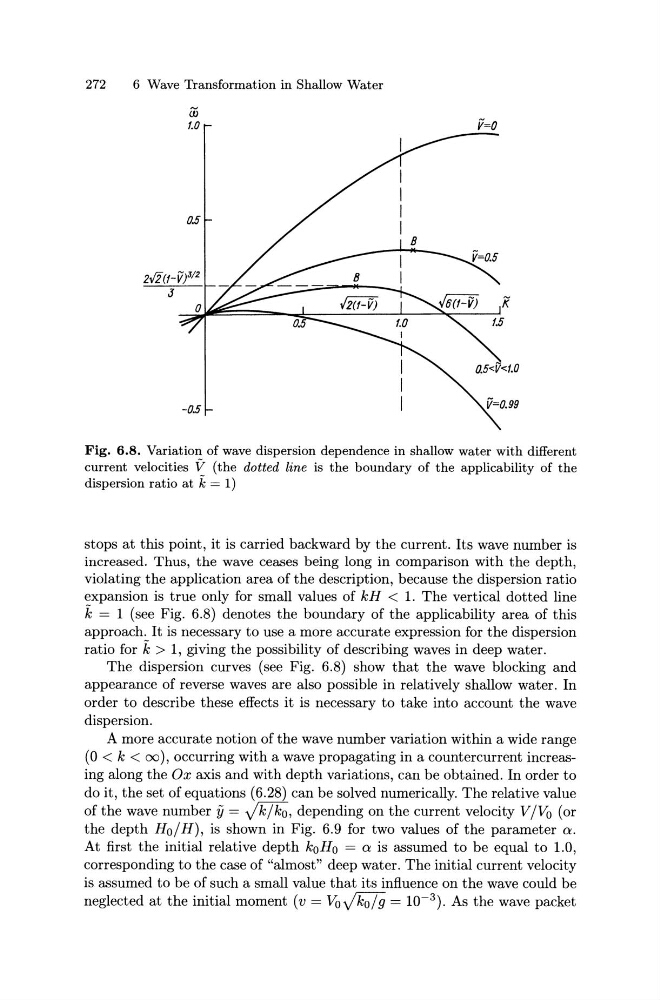
Fig. 6.8. Variation of wave dispersion dependence in shallow water with different
current velocities V (the dotted line is the boundary of the applicability of the
dispersion ratio at k = 1)
stops at this point, it is carried backward by the current. Its wave number is
increased. Thus, the wave ceases being long in comparison with the depth,
violating the application area of the description, because the dispersion ratio
expansion is true only for small values of kH < 1. The vertical dotted line
k = 1 (see Fig. 6.8) denotes the boundary of the applicability area of this
approach. It is necessary to use a more accurate expression for the dispersion
ratio for k > 1, giving the possibility of describing waves in deep water.
The dispersion curves (see Fig. 6.8) show that the wave blocking and
appearance of reverse waves are also possible in relatively shallow water. In
order to describe these effects it is necessary to take into account the wave
dispersion.
A more accurate notion of the wave number variation within a wide range
(0 < k < oo), occurring with a wave propagating in a countercurrent increasing along the Ox axis and with depth variations, can be obtained. In order to
do it, the set of equations (6.28) can be solved numerically. The relative value
of the wave number y =~'depending on the current velocity V/Vo (or
the depth Ho/ H), is shown in Fig. 6.9 for two values of the parameter a.
At first the initial relative depth k0 H0 = a is assumed to be equal to 1.0,
corresponding to the case of "almost" deep water. The initial current velocity
is assumed to be of such a small value that its influence on the wave could be
neglected at the initial moment (v = V0 -.jkrJ9 = 10- 3 ). As the wave packet
6 Wave Transformation in Shallow Water
w
1.0
V=O
Fig. 6.8. Variation of wave dispersion dependence in shallow water with different
current velocities V (the dotted line is the boundary of the applicability of the
dispersion ratio at k = 1)
stops at this point, it is carried backward by the current. Its wave number is
increased. Thus, the wave ceases being long in comparison with the depth,
violating the application area of the description, because the dispersion ratio
expansion is true only for small values of kH < 1. The vertical dotted line
k = 1 (see Fig. 6.8) denotes the boundary of the applicability area of this
approach. It is necessary to use a more accurate expression for the dispersion
ratio for k > 1, giving the possibility of describing waves in deep water.
The dispersion curves (see Fig. 6.8) show that the wave blocking and
appearance of reverse waves are also possible in relatively shallow water. In
order to describe these effects it is necessary to take into account the wave
dispersion.
A more accurate notion of the wave number variation within a wide range
(0 < k < oo), occurring with a wave propagating in a countercurrent increasing along the Ox axis and with depth variations, can be obtained. In order to
do it, the set of equations (6.28) can be solved numerically. The relative value
of the wave number y =~'depending on the current velocity V/Vo (or
the depth Ho/ H), is shown in Fig. 6.9 for two values of the parameter a.
At first the initial relative depth k0 H0 = a is assumed to be equal to 1.0,
corresponding to the case of "almost" deep water. The initial current velocity
is assumed to be of such a small value that its influence on the wave could be
neglected at the initial moment (v = V0 -.jkrJ9 = 10- 3 ). As the wave packet