

6.3 Bottom and a Non-Uniform Current Influence on Waves
275
boundary and can exist within this area. Their spectral density cannot be
prescribed in a random way at x = 0. This is connected with the expression
(6.27) of the corresponding straight wave spectral density.
Reducing the problem solution to a non-dimensional form.
The
obtained spectrum solution (6.27) will be presented in a more universal form.
In order to do so, it is expressed as a function of non-dimensional arguments
and parameters. The following non-dimensional parameters are introduced:
the initial depth a = kmHo; the initial current velocity v = V0 yk;;:79; the
parameter characterizing the maximum current velocity relative to its initial
value fJ = Vo/Vmax (0 < fJ < 1) and the parameter of the relative present
current velocity 'Y = V/Vo (or 'Y = HjH0 ; 1 s; 'Y s; 1/JL); and the wave
number of the spectrum maximum km.
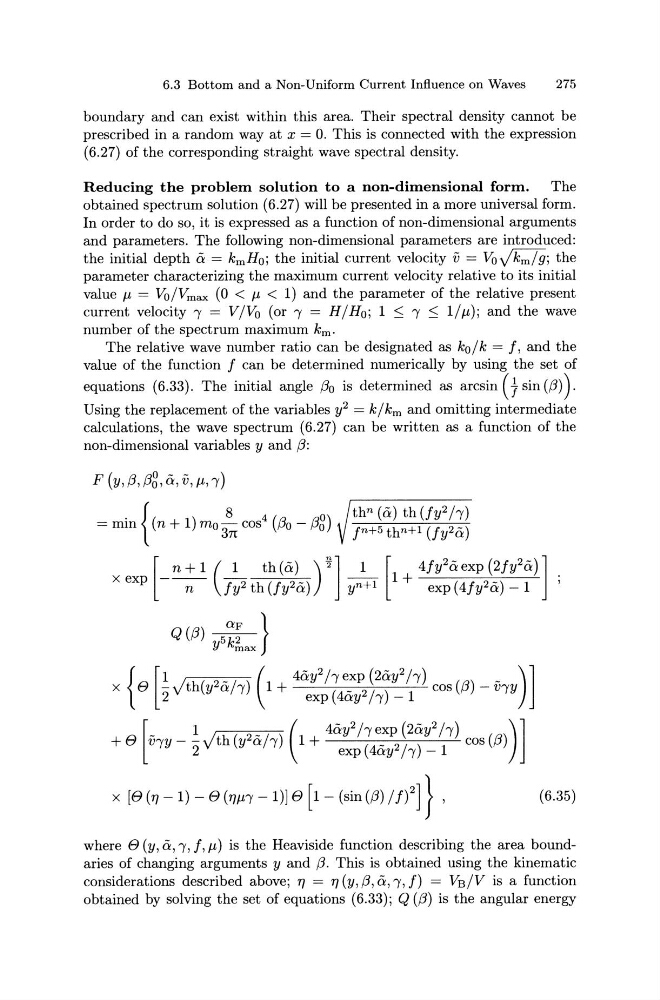
The relative wave number ratio can be designated as ko/k = f, and the
value of the function f can be determined numerically by using the set of
equations (6.33). The initial angle (30 is determined as arcsin ( y sin ((3)).
Using the replacement of the variables y 2 = k/km and omitting intermediate
calculations, the wave spectrum (6.27) can be written as a function of the
non-dimensional variables y and (3:
F (y,f3,f38,a,v,JL,"f)
[
1
(
4ay 2 h exp ( 2ay 2 h)
) l
+ 8 V"fY- 2 y/th (y2ah) 1 + exp (4ay2 h)- 1 cos ((3)
X [8 (TJ- 1)- e (TJJL'Y- 1)] e [ 1- (sin ((3) I !) 2 ] } '
(6.35)
where 8 (y, a,"(, j, JL) is the Heaviside function describing the area boundaries of changing arguments y and (3. This is obtained using the kinematic
considerations described above; 1J = 1J (y, (3, a,"(, f) = VB/V is a function
obtained by solving the set of equations (6.33); Q ((3) is the angular energy
275
boundary and can exist within this area. Their spectral density cannot be
prescribed in a random way at x = 0. This is connected with the expression
(6.27) of the corresponding straight wave spectral density.
Reducing the problem solution to a non-dimensional form.
The
obtained spectrum solution (6.27) will be presented in a more universal form.
In order to do so, it is expressed as a function of non-dimensional arguments
and parameters. The following non-dimensional parameters are introduced:
the initial depth a = kmHo; the initial current velocity v = V0 yk;;:79; the
parameter characterizing the maximum current velocity relative to its initial
value fJ = Vo/Vmax (0 < fJ < 1) and the parameter of the relative present
current velocity 'Y = V/Vo (or 'Y = HjH0 ; 1 s; 'Y s; 1/JL); and the wave
number of the spectrum maximum km.
The relative wave number ratio can be designated as ko/k = f, and the
value of the function f can be determined numerically by using the set of
equations (6.33). The initial angle (30 is determined as arcsin ( y sin ((3)).
Using the replacement of the variables y 2 = k/km and omitting intermediate
calculations, the wave spectrum (6.27) can be written as a function of the
non-dimensional variables y and (3:
F (y,f3,f38,a,v,JL,"f)
[
1
(
4ay 2 h exp ( 2ay 2 h)
) l
+ 8 V"fY- 2 y/th (y2ah) 1 + exp (4ay2 h)- 1 cos ((3)
X [8 (TJ- 1)- e (TJJL'Y- 1)] e [ 1- (sin ((3) I !) 2 ] } '
(6.35)
where 8 (y, a,"(, j, JL) is the Heaviside function describing the area boundaries of changing arguments y and (3. This is obtained using the kinematic
considerations described above; 1J = 1J (y, (3, a,"(, f) = VB/V is a function
obtained by solving the set of equations (6.33); Q ((3) is the angular energy